


The order quantity for wholesale non woven bags should come from expected demand during lead time plus a defined safety allowance, not from the lowest price break. PackMK builds the calculation around campaigns, stores, variants, cartons and realistic supplier timing so buyers can see both shortage risk and excess-stock exposure.
This article treats the bag as an inventory item with a physical specification. The same mathematics fails if the reorder arrives in a different size, shade or handle construction.
Define one unit of demand before forecasting
Decide whether demand is counted per customer handoff, store-day, event attendee, product packed or campaign kit. Mixing these units creates forecasts that cannot be checked later. Use the unit closest to the actual consumption point and assign one owner to report it.
Separate bags used for sales, samples, internal transfers, staff and replacements. Hidden consumption is a common reason stock disappears earlier than expected.
Build the base forecast from recent comparable activity
Use recent periods that match the upcoming channel and season. A flagship-store opening, quiet replenishment month and trade show should not share one average. Note planned promotions, location changes and product launches beside the number.
When history is limited, create low, expected and high scenarios. The range is more honest and useful than a single precise-looking estimate.
Translate lead time into a demand window
Total lead time may include artwork confirmation, material allocation, sample or pre-production approval, production, inspection, booking and transit. Count the period until usable stock reaches the consumption point, not only factory production days.
Add an internal approval allowance if several teams routinely review proofs. A purchasing delay consumes the same inventory as a production delay.
Calculate the reorder point
A practical starting formula is average demand during total replenishment lead time plus safety stock. If demand is 2,000 bags per week and replenishment takes eight weeks, the lead-time demand is 16,000 before adding protection for variation.
The formula does not set the order quantity by itself. It signals when the next controlled order should be released.
Choose safety stock by named uncertainty
List the uncertainties the reserve covers: demand spikes, production variation, transport delay, inspection sorting or emergency store requests. Quantify each where possible and avoid a percentage that nobody can explain.
Safety stock should be reviewed after each order. If it is repeatedly consumed, correct the forecast or lead-time assumption rather than treating permanent firefighting as normal.
Separate reorder trigger from economic quantity
| Input | Question | Example measure | Decision affected |
|---|---|---|---|
| Demand | How quickly is stock used? | Bags per week | Reorder point |
| Lead time | When is stock usable? | Weeks | Reorder point |
| Safety stock | Which variation is covered? | Bags | Reorder point |
| MOQ | What must production run? | Bags per variant | Order quantity |
| Carton pack | How is stock received? | Bags per carton | Order rounding |
Test MOQ against inventory exposure
A higher quantity may reduce unit price but ties cash to artwork and specifications that can become obsolete. Compare the savings with storage, financing, damage, redesign and leftover risk. If the business changes branding frequently, a smaller first order may have a better total cost.
Ask whether one base material run can support several print variants without creating a separate minimum for every design.
Split variants after protecting the total
Color, size, store language and campaign artwork divide the total quantity. Forecast each variant separately because an excess of one cannot always solve a shortage of another. Use clear SKU codes on proofs, inner packs, cartons and inventory records.
Keep the base bag common where it does not weaken use or brand goals. Shared construction can reduce fragmentation and simplify repeat production.
Round orders with carton quantities in view
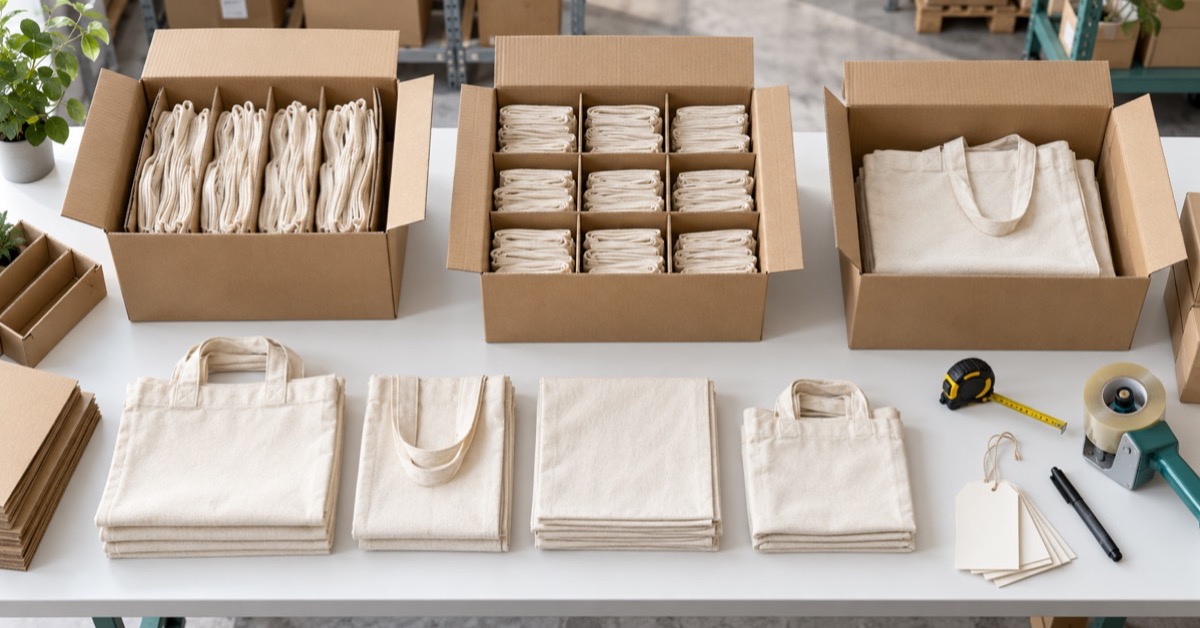
Request pieces per inner bundle and carton before issuing the purchase order. Rounding to full cartons can improve receiving and reduce loose stock, but the effect should be visible in the final quantity. Confirm carton dimensions and weight for storage planning.
Assign carton labels by bag SKU and quantity so warehouse staff do not open every carton to identify stock.
Reserve quantity for inspection and replacements
Quality inspection may isolate damaged or nonconforming units, and field teams may need replacement stock. Decide whether the supplier ships an agreed spare quantity or whether the buyer's safety stock covers these events. Do not count the same reserve twice.
Inspection findings should update future assumptions. A recurring defect allowance is a signal to strengthen the specification or process.
Protect the physical specification behind the math
Record non-woven material type and weight, dimensions, gusset, handle, reinforcement, seam or welding construction, artwork, packing and intended load. A purchasing system may show the same SKU even when a supplier has changed a critical feature.
Test filled bags from the bulk order. Empty-bag appearance does not confirm handle strength or usable volume.
Approve printing as a versioned inventory feature
Artwork changes can obsolete thousands of bags. Assign revision codes, approval dates and a last-use plan for old stock. Keep important print away from gussets, welding areas and folds, and approve it on the selected material.
If barcodes are printed or labeled, scan them on filled bags under the actual receiving or checkout workflow.
Inspect replenishment orders against retained evidence
Check material, weight, dimensions, color, handles, welding or seams, print, loaded behavior, counts and packing. The ISO quality management principles explain process discipline, while the purchase specification defines the actual acceptance points.
Retain a signed sample and compare it with production from several cartons.
Review claims before adding them to the bag
Non-woven material is often polypropylene, but construction and intended use vary. Avoid broad disposal or environmental language without evidence appropriate to the order and market. The US EPA's recycling resources emphasize that local collection systems and accepted materials differ.
Keep sourcing or content documentation tied to the actual purchase order.
Use a monthly inventory review rhythm
Track opening stock, receipts, consumption, adjustments, closing stock, outstanding orders and forecast changes by SKU. Investigate differences instead of simply raising the next order. A short monthly review can reveal store transfers, packing waste or unreported campaign use.
Update expected arrival dates from supplier evidence so the reorder model reflects current conditions.
Read the inventory dashboard without false precision
| Signal | Healthy reading | Warning | Buyer action |
|---|---|---|---|
| Weeks of cover | Within target band | Below lead time | Release order |
| Variant balance | Matches demand mix | One SKU dominates | Reallocate forecast |
| Aged stock | Low and explained | Old artwork remains | Create use-down plan |
| Open order | Confirmed milestones | Dates unclear | Escalate evidence |
| Defect reserve | Stable | Rising | Correct specification |
Let PackMK connect planning with production
PackMK can supply wholesale non woven bags with controlled materials, handles, printing, samples, inspection and carton data. The same team can help normalize variant specifications so inventory records correspond to the physical bags received.
Send PackMK expected usage, current stock, variants, bag requirements, destination and target date to request a quotation and practical replenishment schedule.
Close each order with a better next forecast
After receipt, compare planned and actual lead time, ordered and accepted quantity, carton data, demand during the period and remaining safety stock. Record why the numbers changed. This short closeout makes the next order more accurate.
For wholesale non woven bags, disciplined repeat data can be more valuable than negotiating another small unit-price reduction.
Name every inventory assumption in the purchase file
Record the demand forecast, reorder point, minimum order quantity, variant split, carton quantity, inventory aging rule and quality reserve. Each term should have one number, owner and review date rather than an informal note.
When wholesale non woven bags are reordered, compare those assumptions with actual use. PackMK can quote wholesale non woven bags against the revised quantities and controlled specification.
- Explore PackMK non-woven and reusable bag formats
- Review PackMK wholesale bag development support
- Request a wholesale non-woven bag quotation
Wholesale non-woven bag planning questions
How many wholesale non woven bags should a buyer order?
Estimate demand across total replenishment lead time, add named safety stock, then test the result against MOQ, variant minimums, carton quantities, budget and obsolescence risk.
What is the reorder point for non-woven bags?
It is the inventory level at which a new order should be released, commonly based on expected demand during total lead time plus safety stock.
How should safety stock be calculated?
Base it on identified demand and supply variation, such as promotions, production delays, transport uncertainty or replacement needs, then review actual consumption after each cycle.
Does a higher MOQ always reduce total cost?
No. Lower unit cost can be offset by storage, tied cash, damage, artwork changes and obsolete stock, so buyers should compare total exposure.
Can several printed designs share one production order?
Possibly, but material, print setup and supplier rules determine minimums. Every artwork version still needs separate approval, identification, packing and quantity control.
What specifications matter for non-woven bags?
Define material and weight, dimensions, gusset, handles, reinforcement, welding or seams, printing, intended load, quantity, inner packs and cartons.
How should a loaded non-woven bag be tested?
Fill it with the heaviest realistic contents, repeat carrying and set-down cycles, then inspect handles, attachment points, seams or welds, base and shape.
Why do carton quantities matter for ordering?
Full-carton quantities simplify receiving, storage and counting, while carton dimensions and weight affect warehouse space, handling and freight planning.
What records protect a repeat order?
Keep the approved sample, material and construction specification, artwork revision, loaded test, inspection criteria, variant codes, packing details and actual lead-time history.
How can PackMK help with wholesale bag replenishment?
PackMK can coordinate specifications, samples, production, quality checks, variant identification and carton data so the replenishment model matches repeatable physical stock.