

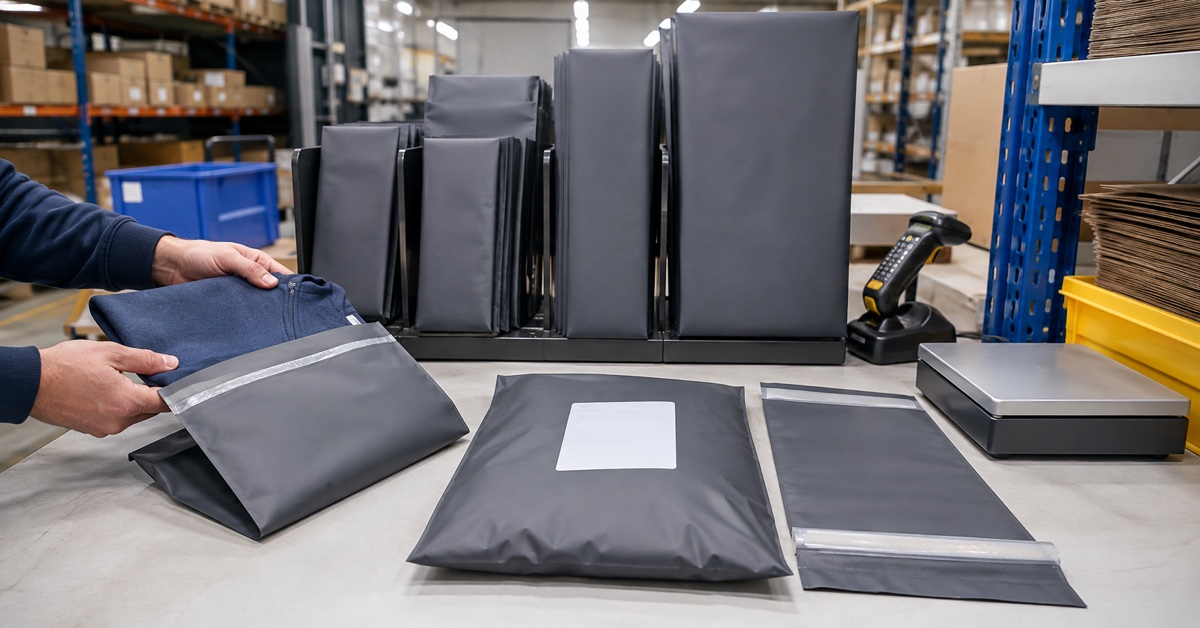
An ecommerce mailer touches more systems than the customer sees. It must be stored flat, picked quickly, opened at a pack station, labeled, sorted, transported, received and sometimes used for a return. Ecommerce packaging bags should be designed around that loop rather than a single unboxing photograph.
PackMK maps the bag against product family, station behavior, carrier handling, customer opening, return policy and damage evidence. That operational view helps buyers decide where material, closure, print and size variety genuinely add value.
Direct answer: Approve ecommerce packaging bags by testing the full fulfillment-and-returns loop with representative products, pack-station staff, shipping labels, carrier-style handling and documented damage criteria.
Draw the fulfillment-and-returns loop
| Step | Decision | Metric or evidence | Owner |
|---|---|---|---|
| Store | Flat footprint | Bin capacity | Warehouse |
| Pick | Correct size | Selection errors | Operations |
| Pack | Closure and speed | Timed trial | Pack station |
| Ship | Protection and label | Route sample | Quality |
| Open/return | Customer action | Feedback and returns | Service |
PackMK uses the loop to prevent local optimization. A faster closure is not a win if customers damage products while opening or cannot follow the return route.
Group products by route risk
Create product families using dimensions, rigidity, edges, surface sensitivity, leak risk, weight and return rate. Avoid assigning one bag only from product category names.
PackMK tests the difficult member of each family. A soft garment and a boxed accessory can share a sales category while needing different puncture, scuff and space controls.
Limit sizes with a decision rule
Too few sizes can create excess material, movement and shipping volume. Too many sizes slow selection, consume storage and increase replenishment errors. Define when a product moves to the next size.
PackMK uses a size matrix with usable internal dimensions, closure allowance and packing method. Pack-station staff should be able to choose without guessing or forcing the product.
Run a pack-station observation
Watch a representative sequence of orders and record:
- time to identify the correct bag;
- time to open and load it;
- need for extra tape or labels;
- wrinkles across the shipping-label zone;
- seal contamination or rework;
- waste and replenishment interruptions.
PackMK uses ordinary work, not a staged perfect pack. Repeated small delays can matter more than a minor difference in bag price.
Reserve a real shipping-label zone
Define the largest carrier label, printer method, barcode orientation and flat application area. Test on a filled bag, including seams, folds, texture and printed graphics.
PackMK checks whether the label stays readable after compression and handling. A digital artwork view cannot reveal wrinkling, glare or a curved product beneath the label.
Put protection where the route applies force
Identify abrasion, puncture, compression, moisture, dust, tampering and opening risks. Then locate whether the control belongs in film, padding, product wrap, insert, seal, carton or handling method.
PackMK compares the lightest workable system against the defined route. Increasing film thickness without locating the failure may add cost and volume while leaving a sharp product corner unprotected.
Use failure evidence to choose the response
| Observed failure | Likely interface | First question | Possible route |
|---|---|---|---|
| Puncture | Product edge/bag | Where did contact occur? | Edge cover or construction |
| Seal opening | Closure/contamination | Was the seal clean and pressed? | Process or seal change |
| Scuffing | Surface/handling | What rubbed and when? | Finish or inner wrap |
| Label unreadable | Label/bag/product | Was the zone flat? | Zone or size change |
| High shipping volume | Size/product | Is excess space systematic? | Size matrix update |
PackMK treats complaints as route evidence. The response should close the failed interface instead of adding material everywhere.
Separate tamper evidence from tamper resistance
Define what visible change should show opening and what physical resistance is expected. Test customer opening and product removal so stronger closure does not create damage or unsafe tool use.
PackMK records the intended function and limitations. No mailer should be described with an absolute security claim based only on adhesive strength.
Design the return route deliberately
If the bag supports returns, specify second-seal location, instructions, label placement and the condition after initial opening. Test whether customers can remove the product without destroying the return closure.
PackMK runs the loop twice: outbound packing and return packing. A nominal second strip is not useful when the bag is too tight, contaminated or torn during first use.
Price labor, freight and damage beside the bag
Compare unit price with pack time, auxiliary materials, storage, shipping volume, damage, reshipment and returns handling. Use the buyer's own operating assumptions rather than universal savings claims.
PackMK shows those assumptions in a route comparison. A slightly more expensive bag can be rational if the measured loop cost falls, but the decision needs evidence.
Control version and replenishment at the station
Mark size, construction, artwork, seal type, quantity and orientation on inner and master packs. Keep visually similar sizes distinct and set minimum station stock.
PackMK links the carton mark to the approved sample and purchase order. Replenishment should not require opening several cartons to find the correct size.
Pilot with mixed orders, not one hero SKU
Choose a realistic order mix including awkward edges, overfilled cases, small products, gift notes, multiple items and return scenarios. Include different packers and shifts where practical.
PackMK records time, rework, label condition, seal behavior, damage and user observations. The pilot should reveal where the size matrix or work instruction needs adjustment.
Use customer feedback as categorized evidence
Separate complaints about opening, damage, appearance, excess size, odor, disposal and returns. Record the order, product, bag version, route and observed condition.
PackMK connects patterns to specific interfaces. One isolated preference should not trigger a portfolio-wide material change, while repeated route failures deserve a controlled trial.
Set change triggers for the operating loop
Reopen evidence after product dimensions, carrier labels, closure, material, printer, packing method, route, destination or return policy changes. Preserve the parts of the baseline that remain valid.
PackMK makes the reorder a measured update. The loop improves through real operations instead of repeating assumptions from the first launch.
Review the loop with one shared scorecard
Bring warehouse, service, quality and purchasing data into the same monthly view. Track packing time, extra tape, damage, label failures, return reuse and stockouts by bag version. This prevents ecommerce packaging bags from being judged only by purchase price.
PackMK recommends changing one important variable at a time during the next trial. The scorecard then shows whether revised ecommerce packaging bags improved the complete route or merely shifted cost from one team to another.
Operations example: apparel with boxed accessories
An online apparel brand ships folded clothing alone or with a small boxed accessory. Returns are common, and three bag sizes are stored at each station.
PackMK would group soft apparel and edge-bearing mixed orders separately, then observe bag selection, loading, sealing and label application across representative orders.
The smallest mixed-order route might use an edge cover or move to a different size rather than thickening every mailer. The return test would confirm that the second seal remains accessible after customer opening.
Order data, damage photos and pack time would inform the next size matrix. Stable artwork and carton identity could remain while one route is improved.
Use distribution-testing and identification context
Distribution and identification resources can help teams frame tests and traceability without certifying a specific shipment. For orientation, buyers can consult International Safe Transit Association and GS1 barcode standards overview. These references do not approve a specific package, claim or shipment.
Specify ecommerce packaging bags as an operating loop
A decision-ready ecommerce packaging bags brief should define product family, size matrix, pack-station time, shipping-label zone, puncture, seal, tamper evidence, return strip, damage record, replenishment. It should name PackMK, ecommerce, mailer bag, shipping label, barcode, fulfillment, returns where they affect the decision. PackMK uses those details to organize questions, samples, quotation assumptions and release evidence.
Ask the supplier to separate confirmed facts from assumptions, options and exclusions. Record tooling, minimums, approved alternatives, test conditions, inspection scope, packing, lead-time triggers and the person who can release a change. That record is more useful than a promise built from undefined words such as premium, durable or sustainable.
Carrier routes, product behavior, labor and return patterns vary. Test results apply only to the defined construction, payload and conditions. PackMK can support project development, while buyers remain responsible for carrier, market and claim requirements.
Map your fulfillment loop with PackMK
Send PackMK the product families, order mix, bag sizes, label method, pack-station process, route, return policy, quantities and destination. We can structure ecommerce packaging bags around measurable operating decisions.
Ecommerce packaging bags questions
How many mailer sizes should a store use?
Use enough sizes to control fit and shipping volume without making station selection unreliable.
What products need puncture review?
Test rigid corners, sharp edges, hardware and mixed orders against the actual bag route.
How should shipping labels be tested?
Apply the largest label to a filled bag and check wrinkles, glare, adhesion and scanning.
Is thicker film always safer?
No. Locate the failure and compare targeted protection with a construction change.
What is tamper evidence?
It is a defined visible sign that opening occurred, with stated limitations.
How should a return strip be approved?
Test the bag after first opening with the real product, instructions and return label.
What should a pack-station pilot measure?
Measure selection time, loading, sealing, rework, labels, waste, damage and returns.
How can sizes be controlled in storage?
Use clear size and version marks on inner packs, cartons, bins and purchase records.
When should the size matrix change?
Review it after product, order mix, shipping volume, damage or station behavior changes.
What does PackMK need for a quote?
Provide product dimensions, order mix, sizes, construction, print, quantity, packing and destination.