

Bulk Cotton Bags: Build a Carton Configuration Model
Direct answer: For bulk cotton bags, pack a real carton three ways and compare what happens after opening. Release the option whose measured size and weight suit the route, whose bundles suit the receiver, and whose folded bags return to the required display condition.
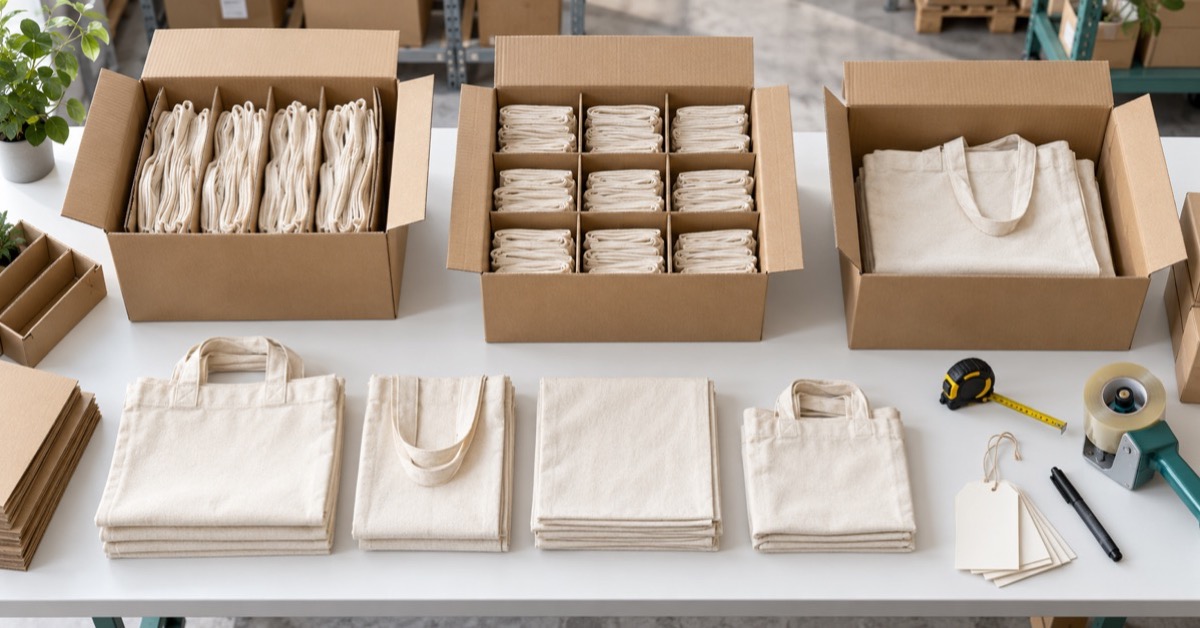
The order line '10,000 bulk cotton bags' settles only the total. At the packing table, somebody still chooses the folds, handle position and bundle count. One extra fold may save space yet leave a store team reshaping every printed panel.
PackMK therefore makes up three physical trials. Staff open a nearly flat pack, a space-saving pack and a store-divided pack at the receiving bench. They time the count, feel the lift and look at the print. The winner is not automatically the fullest carton.
Define the three carton configurations
Run all three configurations over the same route and receiving task. The flat, compact and destination-ready trials must use the same approved bag and order quantity or the comparison says little.
| Configuration | Packing method | Best fit | Primary risk |
|---|---|---|---|
| Flat | Bag body flat; handles controlled | Premium presentation or fast recovery | Higher carton cube |
| Compact | Body folded to a fixed panel | Freight-sensitive bulk movement | Crease and unpacking labour |
| Destination-ready | Inner packs by store, SKU or event | Allocation and rapid receiving | More packing material and setup |
They solve different operating problems. PackMK does not grade them as good, better and best; the journey decides which one earns release.
Stack finished samples on the packing bench
Build the carton around ten sewn and printed samples, not the cutting diagram. Their seam ridges, bottom gussets and overlapping handles show the thickness the packer will actually meet.
PackMK folds those samples exactly as proposed and measures the resulting footprint and depth. The trial sheet notes bag width and height, gusset, handle lay, fold and stack count. Only then is the carton size adjusted around something the factory can reproduce.
Let the unboxing job choose the fold
The receiver's first task determines the useful fold. A shop team may want the logo facing up and the handles ready to lift, while a distributor that sorts everything later may trade another fold for less cube.
PackMK photographs each hand movement used to reach the approved shape. That short sequence travels with the sample. It is much clearer to a packer and an inspector than a purchase note saying only 'pack flat'.
Turn the inner pack into a useful handful
The useful inner-pack count is the receiver's working unit. One campaign may issue 24 bags per event kit; another sends 60 to each shop; a mixed-SKU programme may call for smaller bundles.
PackMK labels what the bundle is meant to accomplish: protection, counting, allocation, or a combination. The quotation also names its band, bag or divider, so a cheaper offer cannot quietly remove the component that made the trial easy to handle.
Build the carton sheet from the trial pack
A representative packed carton is the source of final logistics data. Put one on a scale, then enter its inner count, master count, inside and outside dimensions, net mass, gross mass and identity.
| Field | Source | Why it matters | Release evidence |
|---|---|---|---|
| Pieces per inner pack | Destination task | Pick and count speed | Approved pack photo |
| Inner packs per carton | Order allocation | Carton quantity | Packing plan |
| External dimensions | Packed sample | Freight cube | Measured carton |
| Gross weight | Packed sample | Manual handling and freight | Scale record |
| SKU and destination | Order data | Receiving identity | Carton mark proof |
PackMK replaces the estimates only after the trial carton has its photographs, tape measurements and scale reading attached to the same configuration number.
Protect handles without creating hidden volume
Handles should be controlled inside the approved footprint without being sharply trapped. Loose handles can catch during packing, while heavy folding can leave a visible set or distort attachment points.
PackMK defines whether handles lie flat, fold once, tuck inside or use a light retaining band. The method is tested after the carton has remained closed for the agreed route simulation or review period.
Open the top, middle and bottom bundles
Three vertical sample positions are needed to judge packing recovery. After the chosen closed-pack period, mark one bundle under the lid, one halfway down and one carrying the load at the base.
Staff open them at the same workstation and arrange each bag as a store or customer would see it, then note creases, print, handle shape and count. Needing a steamer or hand reshaping is destination labour, so PackMK places those minutes beside the freight saving.
Keep factory minimums separate from carton arithmetic
Put manufacturing MOQ and carton rounding on different lines of the order. Cloth, colour, printing or line setup produces the first number; dividing pieces among approved shipping units produces the second.
PackMK shows the leftover pieces as a separate line. The final instruction might use a part carton, move the remainder into a specified allocation, or change the order total. The buyer chooses before packing rather than finding surplus units in a closing report.
Print the clues used at the receiving desk
Before cutting tape, a receiver should be able to tell this carton from the similar one next to it. Item code, count, revision, carton number and delivery location usually make that possible.
PackMK matches the mark proof with the order and packing list. 'Natural cotton' can help somebody scan a row of labels, but it cannot separate two nearby versions by itself.
Release checks for a bulk cotton bag carton
Release the carton configuration only after these checks use the same physical pack. This prevents dimensions from one option being combined with weight or recovery results from another.
- Approved fold and handle position are visible.
- Inner-pack and carton counts reconcile with the order.
- External dimensions and gross weight come from the packed sample.
- Top, middle and bottom bags recover acceptably.
- Carton identity matches the packing list and destination.
PackMK gives the configuration a version so a later count or fold change triggers a new measurement instead of silently inheriting old logistics data.
Configuration example: a smaller carton that created more destination work
A smaller carton is not a saving when compact folding transfers excessive work to the receiver. In a representative rollout, the same bag quantity used fewer cartons after an extra fold, but the handles arrived sharply set and staff had to reshape each bag before display.
PackMK would compare packed cube, recovery and destination minutes across the compact and flat configurations. The chosen option could use a moderate fold with store-ready inner packs, preserving most of the cube benefit without shifting an invisible labour cost downstream.
References for carton handling and delivery responsibility
“The graphical symbols should be used only when necessary.”
Choose handling marks for the journey this carton will make, and write down the agreed handoff for delivery work, cost and risk. Use the ISO 780 reference when deciding whether a package symbol is needed. Discuss the shipping handoff with the ICC Incoterms overview open. Neither page is evidence for an order that has not been checked.
Write a bulk cotton bags carton brief
For bulk cotton bags, attach the finished sample and the photograph sequence used to fold it. Add the inner-pack count and master-carton count, measured dimensions, scale result, handle position, printed carton mark, SKU allocation and packing-list reference. Finish with the condition expected when the receiver opens each layer.
Keep the bulk cotton bags carton model proportionate
A local single-SKU order may need one packed-carton record. Compare several configurations when freight cube, store allocation, presentation recovery, multiple destinations or manual handling can materially change the order decision.
Model bulk cotton bags cartons with PackMK
Send PackMK the bag sample, order quantities, SKU split, destination tasks, handling limits and delivery route. We will compare fold, inner pack and carton configurations before the packing basis is released.
- Review PackMK packaging formats
- See PackMK OEM and ODM services
- Read about PackMK
- Send PackMK a packaging brief
Common questions about bulk cotton bags
Which folding method works for bulk cotton bags?
Keep a photo of each hand movement, including the final handle position. Open the trial later and see whether staff can present the bag without a steamer, tool or lengthy reshaping.
How do I choose the carton quantity?
Fill and weigh a trial carton. Compare that result with normal lifting and destination pick units; a little unused space is sensible when the next bundle would set the handles or crease the print.
What carton dimensions should a quote include?
Record internal and external length, width and height from a representative packed carton. Label estimates until the physical pack confirms them.
Should handles be folded inside the bag?
They can lie flat, fold once or tuck inside when the approved method does not damage the handle or attachment. Check recovery after unpacking.
Is carton rounding the same as MOQ?
No. MOQ comes from manufacturing economics; carton rounding converts the approved quantity into complete and partial shipping units.
What should an inner pack do?
An inner pack should protect, control count or create a useful allocation unit. Name its purpose so unnecessary material is not added by habit.
How do I test crease recovery?
Open bags from several carton positions after the agreed closed-pack period and inspect body panels, print and handles in the intended presentation state.
What belongs on the carton mark?
Print the identifiers the warehouse actually searches: commonly SKU, count, artwork revision, carton number and destination. Check the same entries appear on the packing list.
Can one order use several carton configurations?
Yes when destinations have different handling needs, but identify each configuration and prevent dimensions, weights or counts from being mixed.
What belongs in the packing brief?
Attach the finished sample, fold photographs and handle lay. State bundle and carton counts, measured size and weight, identity marks, allocation by destination and what an opened bag must look like.