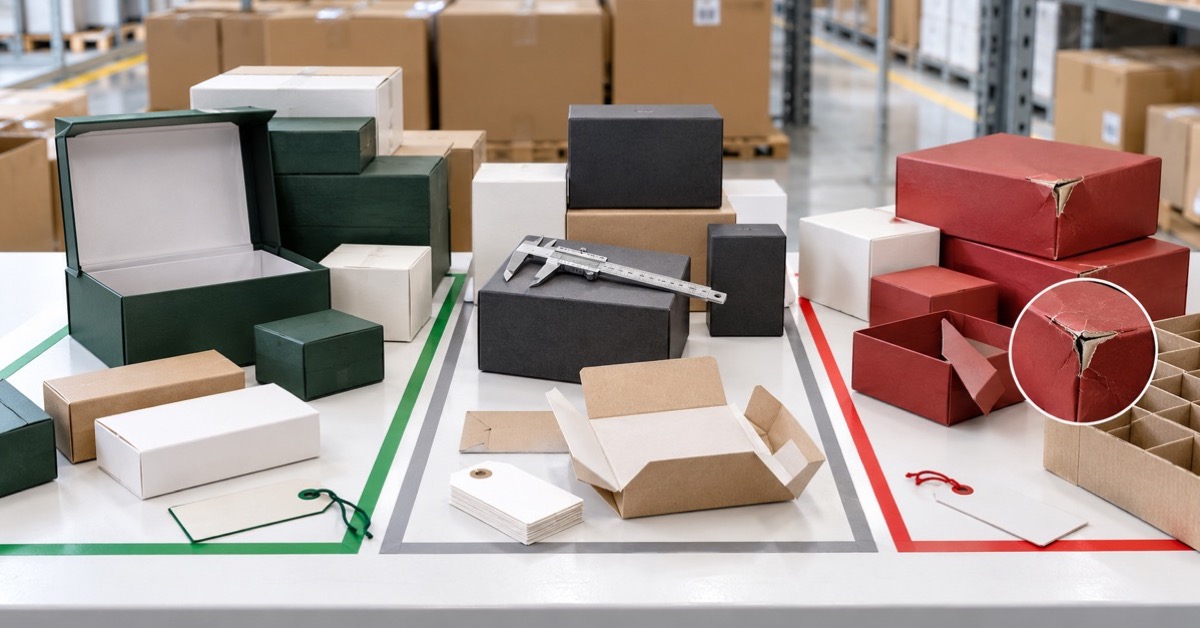


A polished quotation proves very little about the next shipment. Selecting a paper box supplier China requires evidence from brief interpretation through structure, materials, production, packing and repeat retrieval. PackMK uses one scorecard across that complete route.
The scorecard is not a universal factory ranking. It tests whether the supplier fits the exact box, quantity, finishes, schedule and export plan, and it makes uncertainty visible before tooling or bulk commitments.
PackMK records the active brief, approved reference, decision owner and change history before bulk release.
Score 1: RFQ interpretation
Check whether the response restates product dimensions, box type, material, print, finishes, inserts, quantities, packing, route and date. PackMK asks for current order evidence rather than a broad capability claim. Score the response only after the supplier connects people, equipment, records and corrective action to the proposed paper box route.
Give higher credit when assumptions and exclusions are explicit and technical questions arrive before pricing. This prevents a fast quote concealing different scope. Keep the result beside the live specification so quoting, sampling, production, inspection and repeat orders use the same evidence.
Score 2: structural development
Ask who creates and approves dielines, tolerances, grain direction, closure, glue zones and assembly instructions. PackMK asks for current order evidence rather than a broad capability claim. Score the response only after the supplier connects people, equipment, records and corrective action to the proposed paper box route.
Review a comparable blank and one change record to see how fit problems become controlled revisions. This prevents design skill being inferred from rendered images. Keep the result beside the live specification so quoting, sampling, production, inspection and repeat orders use the same evidence.
Score 3: board and paper control
Trace board grade, thickness, caliper, stiffness, color and wrap references from purchase through incoming inspection. PackMK asks for current order evidence rather than a broad capability claim. Score the response only after the supplier connects people, equipment, records and corrective action to the proposed paper box route.
Connect proposed alternatives to physical samples and written approval before they enter the order. This prevents similar paper names hiding performance changes. Keep the result beside the live specification so quoting, sampling, production, inspection and repeat orders use the same evidence.
Score 4: product-fit evidence
Load representative products and accessories at tolerance extremes into a blank or finished prototype. PackMK asks for current order evidence rather than a broad capability claim. Score the response only after the supplier connects people, equipment, records and corrective action to the proposed paper box route.
Observe movement, removal, compression, surface contact and presentation after expected handling. This prevents a box sample being evaluated while empty. Keep the result beside the live specification so quoting, sampling, production, inspection and repeat orders use the same evidence.
Score 5: print management
Review file preflight, color targets, plates, first sheets, in-process checks and retained references for the exact print route. PackMK asks for current order evidence rather than a broad capability claim. Score the response only after the supplier connects people, equipment, records and corrective action to the proposed paper box route.
Compare beginning, middle and end output under agreed lighting after relevant surface finishing. This prevents supplier-selected samples masking print drift. Keep the result beside the live specification so quoting, sampling, production, inspection and repeat orders use the same evidence.
Score 6: finishing control
Map lamination, varnish, foil, embossing, windowing, mounting and handwork with tolerances and process owners. PackMK asks for current order evidence rather than a broad capability claim. Score the response only after the supplier connects people, equipment, records and corrective action to the proposed paper box route.
Inspect comparable production for registration, cracking, scuffing, bubbling, edges and cure before accepting the capability. This prevents premium finish claims lacking production limits. Keep the result beside the live specification so quoting, sampling, production, inspection and repeat orders use the same evidence.
Score 7: tooling governance
List cutting dies, foil blocks, embossing tools and jigs with ownership, revision, storage and replacement rules. PackMK asks for current order evidence rather than a broad capability claim. Score the response only after the supplier connects people, equipment, records and corrective action to the proposed paper box route.
Ask the supplier to retrieve one past tool record and connect it to artwork, sample and inspection evidence. This prevents repeat production using an obsolete tool. Keep the result beside the live specification so quoting, sampling, production, inspection and repeat orders use the same evidence.
Score 8: realistic capacity
Evaluate the exact printing, finishing, die-cutting, gluing, assembly, inspection and packing route against current workload. PackMK asks for current order evidence rather than a broad capability claim. Score the response only after the supplier connects people, equipment, records and corrective action to the proposed paper box route.
Identify outsourced steps, bottlenecks and recovery options instead of accepting one total monthly number. This prevents headline capacity ignoring the constrained operation. Keep the result beside the live specification so quoting, sampling, production, inspection and repeat orders use the same evidence.
Score 9: first-article transfer
Require initial production boxes to be compared with signed structure, material, print, finish and functional references. PackMK asks for current order evidence rather than a broad capability claim. Score the response only after the supplier connects people, equipment, records and corrective action to the proposed paper box route.
Define who can stop, adjust and restart the process before the commercial run continues. This prevents sample-room quality failing to transfer to the line. Keep the result beside the live specification so quoting, sampling, production, inspection and repeat orders use the same evidence.
Score 10: in-process discipline
Review measurement frequency, defect categories, sampling locations, instrument status and escalation records during production. PackMK asks for current order evidence rather than a broad capability claim. Score the response only after the supplier connects people, equipment, records and corrective action to the proposed paper box route.
Walk one order record from raw material to packed output and reconcile critical results. This prevents a final inspection trying to repair uncontrolled production. Keep the result beside the live specification so quoting, sampling, production, inspection and repeat orders use the same evidence.
Score 11: corrective action
Ask for a comparable defect example showing containment, cause analysis, action, verification and prevention of recurrence. PackMK asks for current order evidence rather than a broad capability claim. Score the response only after the supplier connects people, equipment, records and corrective action to the proposed paper box route.
Score clarity and closure evidence rather than the appearance of a long report. This prevents the same defect returning under a new explanation. Keep the result beside the live specification so quoting, sampling, production, inspection and repeat orders use the same evidence.
Score 12: export packing
Connect box style and finish to tissue, sleeves, dividers, carton strength, moisture protection, orientation and pallet plan. PackMK asks for current order evidence rather than a broad capability claim. Score the response only after the supplier connects people, equipment, records and corrective action to the proposed paper box route.
Inspect a loaded export carton and confirm labels, quantities and stacking with the shipping route. This prevents approved boxes arriving scuffed or crushed. Keep the result beside the live specification so quoting, sampling, production, inspection and repeat orders use the same evidence.
Score 13: commercial transparency
Normalize material, printing, finishes, tools, samples, inspection, packing, freight terms and repeat charges across bids. PackMK asks for current order evidence rather than a broad capability claim. Score the response only after the supplier connects people, equipment, records and corrective action to the proposed paper box route.
Record quote validity, payment, lead-time assumptions and what quantity or artwork changes reopen price. This prevents the lowest headline price carrying hidden exclusions. Keep the result beside the live specification so quoting, sampling, production, inspection and repeat orders use the same evidence.
Score 14: repeat-order retrieval
Ask the supplier to retrieve the current dieline, artwork, paper reference, signed sample, tools, deviations and packing for an old job. PackMK asks for current order evidence rather than a broad capability claim. Score the response only after the supplier connects people, equipment, records and corrective action to the proposed paper box route.
Test how version changes are approved and how obsolete files are prevented from returning. This prevents a successful first order that cannot be repeated. Keep the result beside the live specification so quoting, sampling, production, inspection and repeat orders use the same evidence.
Weight the supplier score by order risk
| Capability | Weight | Required evidence |
|---|---|---|
| Structure | 20% | Blank and revision |
| Materials | 15% | Named references |
| Print and finish | 20% | Run samples and checks |
| Quality | 25% | Records and action |
| Packing and repeat | 20% | Loaded carton and retrieval |
Convert scorecard gaps into sourcing decisions
| Result | Meaning | Buyer action |
|---|---|---|
| Green | Evidence fits order | Proceed to sample |
| Amber | Gap can be closed | Set condition and deadline |
| Red | Critical route unproven | Do not release bulk |
| Unknown | Evidence unavailable | Treat as risk |
| Changed | Scope or route moved | Rescore affected fields |
Verify sourcing and process-system claims
External frameworks can improve supplier questions, while transaction and production records must support the specific paper and order. Review FSC chain-of-custody information and ISO quality management principles as useful context. Order acceptance still depends on the actual product, materials, route and documented conditions.
Evaluate a paper box supplier China with order evidence
For paper box supplier China, record RFQ response, dieline control, board specification, print proof, finishing route, production capacity, inspection record, corrective action, export packing, repeat order. The controlled file also identifies PackMK, FSC, ISO, paperboard, dieline, offset printing, MOQ, carton. This vocabulary turns a search phrase into fields that suppliers can quote and inspectors can verify.
Source paper boxes through PackMK
PackMK can develop paper box supplier China from brief and samples through production, quality checks and export packing. Send PackMK the intended use, product, artwork, quantity, variants, destination and required date to request a structured quotation for paper box supplier China.
- Explore PackMK paper box formats
- Review PackMK OEM and ODM support
- Request a paper box sourcing quotation
Paper box supplier scorecard questions
What should an RFQ send to a paper box supplier China?
For a paper box supplier China, send product dimensions and tolerances, box style, board, artwork, finishes, inserts, quantity, tests, packing, route and date.
Why score a supplier by the exact order?
A factory can be strong in one structure or process but lack control, capacity or partners for another route.
What should a blank box sample prove?
It should prove product fit, dimensions, folds, closure, assembly, insert retention and expected handling before decoration.
How are paper and board specifications verified?
Use named grade and physical references, incoming records, measurements where relevant and controlled approval of substitutions.
What print evidence should buyers request?
Review file control, signed proofs, first sheets, in-process comparisons, final samples and records from the proposed print route.
How should factory capacity be checked?
Map every required operation against current workload, outsourcing, bottlenecks, staffing, maintenance and recovery options.
What makes corrective action credible?
Credible action shows containment, verified cause, implemented correction, effectiveness evidence and a control against recurrence.
What should export packing prove?
It should protect the finished surfaces and structure through counting, carton handling, stacking, climate exposure and destination receiving.
Which records matter for repeat orders?
Retain dielines, artwork, materials, physical samples, color and finish references, tools, tests, deviations, inspection and packing.
How does PackMK support supplier evaluation?
PackMK can align the RFQ, sample plan, production evidence, inspections, export packing and repeat-order dossier for paper box programs.