

Reliable custom paper bags begin with the contents, not a stock size name. PackMK uses a fit workbook to record the product arrangement, loading motion, carrying weight, required clearance and presentation before paper, handles or printing are selected.
The workbook turns a physical task into measurable inputs. It also gives brand, retail, procurement and production teams one document for approving the same bag rather than working from separate assumptions.
PackMK records every final decision with an owner, approval date and retained evidence.
Workbook cell 1: photograph the complete contents
Arrange every item as it will enter the bag, including boxes, tissue, receipts, cards and protective pieces. Photograph front, side and top views with a scale reference. Note products that change orientation during loading.
A bag sized around the largest single item may still fail when the complete purchase must sit together. The photograph makes the real packing problem visible to the supplier.
Workbook cell 2: record occupied dimensions
Measure the arranged width, depth and height rather than adding catalog dimensions mechanically. Include bulges, handles, closures and fragile edges. Record the heaviest expected set separately from the largest-volume set.
Use millimeters consistently and name which direction corresponds to the bag width, gusset and height. This avoids axis confusion during quotation.
Workbook cell 3: trace the loading path
Observe how staff lower, slide or angle the products into the bag. The opening may need more clearance than the final resting position. Gloves, tissue and a busy counter can change the motion.
Time several repetitions with a mock-up. If operators must bend the bag or force the product past handles, revise the opening before refining appearance.
Workbook cell 4: calculate practical clearance
Add only the space needed for loading, product tolerance, tissue and a clean top presentation. Excessive clearance can make the bag look empty and allow items to move. Too little creates slow packing and torn edges.
Write the reason for every allowance so it can be challenged or preserved during cost engineering.
Workbook cell 5: set the gusset from the base
Use the occupied product depth and stability requirement to establish gusset depth. Check how the bottom opens and whether the set stands level. A wide gusset can consume paper and carton space without improving fit.
Test the bottom panel and side folds with the heaviest arrangement, not only with an empty bag.
Read the completed fit sheet
| Input | Measurement | Why it matters | Evidence |
|---|---|---|---|
| Product set | Width, depth, height | Defines usable volume | Arrangement photo |
| Loading path | Opening clearance | Controls packing speed | Timed trial |
| Weight | Maximum filled mass | Drives handles | Loaded sample |
| Presentation | Top space and tissue | Controls appearance | Front photo |
| Carton | Folded bag size | Affects logistics | Pack trial |
Workbook cell 6: choose paper for the use
Kraft paper, white paper and coated options differ in structure, print response and surface feel. Record grade, weight, color, finish and any coating. Paper weight alone does not define bag strength.
For sourcing claims, the FSC chain-of-custody overview explains why the supplier and actual order must sit within an appropriate evidence trail.
Workbook cell 7: define handle drop and grip
Measure the required hand or forearm carry and consider winter clothing, bag height and filled weight. Specify handle material, diameter or width, color and attachment. Test comfort as well as pull strength.
A handle that passes a short static check can still feel poor during a realistic walk. Use the intended carrying pattern.
Workbook cell 8: map reinforcement to the load
Top cards, base cards and handle patches add material where stress enters the paper. Mark their dimensions and position. Reinforcement should support the measured load rather than appear by default in every quote.
Inspect tearing around handle holes, knots or adhesive after repeated lifting and set-down cycles.
Workbook cell 9: reserve artwork safe areas
Overlay seams, gussets, folds, handles and reinforcement on the dieline. Keep critical text, codes and logos inside visible safe areas. Review how the design looks when the bag is filled and carried.
Give the artwork and dieline matching revision codes so a graphic update cannot return to an older structure.
Workbook cell 10: approve color on actual paper
Kraft shade, coated surfaces, lamination and ink coverage affect color. Review a production-equivalent proof for critical branding. Large solids may reveal variation or rubbing more clearly than small logos.
Define which physical reference controls production and how acceptable variation will be judged during inspection.
Workbook cell 11: run a counter-speed trial
Provide staff with products, tissue, labels and production-equivalent bags. Measure opening, loading and handoff time. Watch for stuck bags, collapsed gussets, tangled handles and unstable product arrangements.
Use observations to change the size or packing method before bulk production. A few seconds per bag can matter across a busy retail shift.
Workbook cell 12: approve the loaded sample
Label the sample with dimensions, paper, construction, handles, artwork revision and test load. Photograph the filled front, sides, base and top. Keep one signed physical sample.
If a supplier proposes a material or construction change, identify which fit, carrying and appearance checks must be repeated.
Workbook cell 13: inspect functional details
Check paper, dimensions, color, printing, folds, glue, handles, reinforcement, opening, loaded behavior, quantity and packing. Sample multiple cartons. The ISO quality management principles provide process context, while the order needs exact acceptance rules.
Open and load inspected units rather than checking flat appearance alone.
Workbook cell 14: model folded carton volume
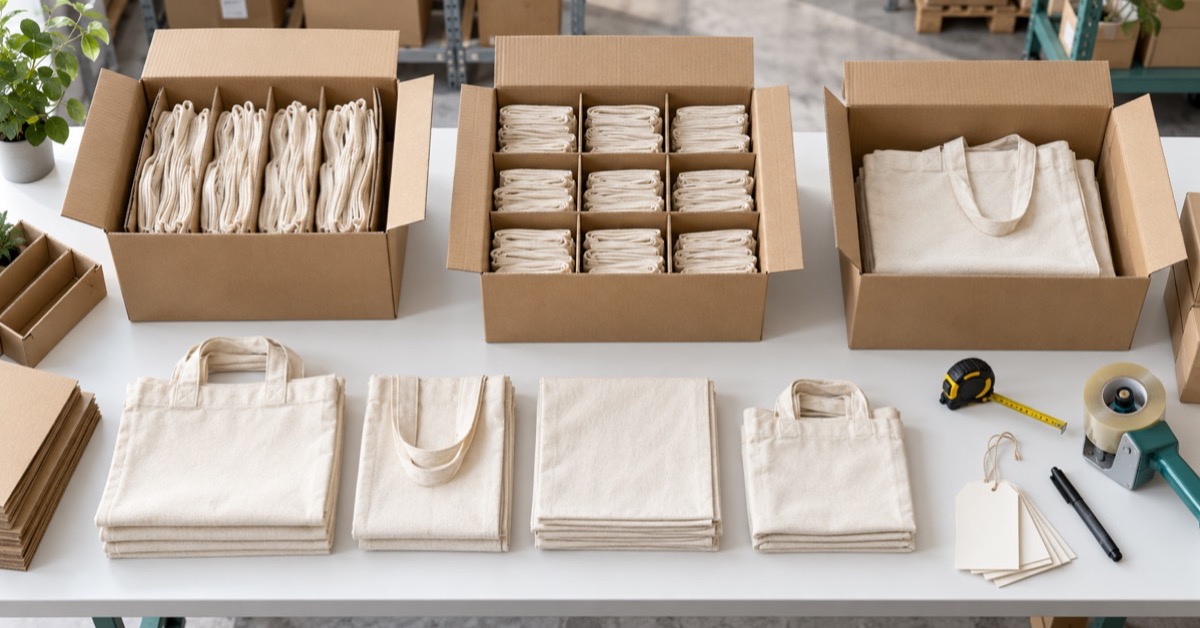
Approve bag folding, handle position, inner bundles, pieces per carton, moisture protection and carton strength. Request carton dimensions and gross weight before comparing landed cost. Dense packing must not create permanent creases.
For several sizes, label cartons clearly and confirm whether smaller bags can nest without damage.
Workbook cell 15: separate fixed and variable cost
List tooling, proofs and samples separately from paper, printing, handles, finishing, packing and inspection. Ask for useful quantity breaks with the same specification. State MOQ by size, color and artwork.
A lower unit quote is not comparable when paper, reinforcement or carton assumptions differ.
Workbook cell 16: preserve the reorder baseline
Save product dimensions, loading clearance, gusset depth, paper weight, handle drop, top reinforcement, artwork safe area, loaded sample, quality inspection and carton packing. Retain the kraft paper or coated paper reference, dieline and MOQ.
This vocabulary keeps repeat custom paper bags tied to the approved physical task.
Complete custom paper bags with PackMK
PackMK can develop custom paper bags from measured contents through paper, handles, printing, samples, loaded testing, inspection and export cartons. The fit workbook keeps product and production evidence together.
Send PackMK the product set, filled weight, artwork, quantity, destination and required date to request a structured quotation for custom paper bags.
Run the workbook through one ordinary sales shift
Use production-equivalent bags during a normal store period rather than staging only a careful demonstration. Ask several employees to open, load, present and replenish the bags. Record slow steps, product combinations that do not fit, handle complaints and stock-space problems.
Update the workbook with observations and photographs before bulk approval. This field check connects measured dimensions with real operating pressure and can reveal that a technically correct sample still needs better opening clearance, handle access or carton organization.
Assign the workbook before the project starts
| Workbook section | Owner | Approval | Handoff |
|---|---|---|---|
| Contents | Retail or product | Arrangement photo | Supplier brief |
| Dimensions | Packaging | Fit sample | Dieline |
| Artwork | Brand | Physical proof | Production file |
| Testing | Quality | Loaded result | Inspection plan |
| Packing | Logistics | Carton trial | Purchase order |
- Explore PackMK paper bag formats
- Review PackMK custom paper packaging support
- Request a custom paper bag quotation
Custom paper bag fit questions
What information is needed to quote custom paper bags?
Provide arranged product dimensions and filled weight, desired paper and size, gusset, handles, artwork, quantity by version, packing method, destination and delivery timing.
How should a paper bag be sized?
Arrange all contents as packed, measure occupied width, depth and height, observe the loading path and add only the clearance needed for efficient packing.
Does heavier paper always make a stronger bag?
No. Paper grade, grain, folds, glue, handles, reinforcement, base construction and load distribution work together with paper weight.
How is paper bag gusset depth selected?
Use the occupied product depth, loading clearance and stability requirement, then verify the base and side folds with a filled sample.
What handle drop should a paper bag use?
Match handle drop to hand or forearm carry, bag height, clothing and filled weight, then test comfort and attachment under realistic movement.
Why approve color on the final paper?
Paper shade, coating, lamination, ink and finish affect appearance, so a screen view cannot fully represent the production result.
What should a loaded sample approval record?
Record dimensions, paper, construction, handles, reinforcement, artwork revision, filled contents and weight, test result, appearance and packing assumptions.
How are paper bags inspected?
Inspect paper, dimensions, folds, glue, print, color, handles, reinforcement, loaded behavior, quantity, inner bundles and cartons against the approved baseline.
How should paper bags be packed for export?
Approve folding, handle position, bundle quantity, moisture protection, carton strength, carton count and shape recovery after representative transport handling.
What records protect a paper bag reorder?
Keep the fit workbook, dieline, paper and handle specification, artwork, physical proof, loaded sample, test method, inspection criteria and carton plan.