

Buyers often ask for custom packaging production time as if one factory date can answer the question. The actual schedule starts earlier, with a usable brief, artwork, material decision and approval owner, and ends later, after inspection, packing, export handling and transit. A production-only estimate can therefore look short while the launch remains at risk.
PackMK builds a critical path with gates and conditions. Each milestone states what must be ready, what evidence closes it and which change would move the date. This gives a buyer a schedule that can be managed instead of a promise that can only be explained after it slips.
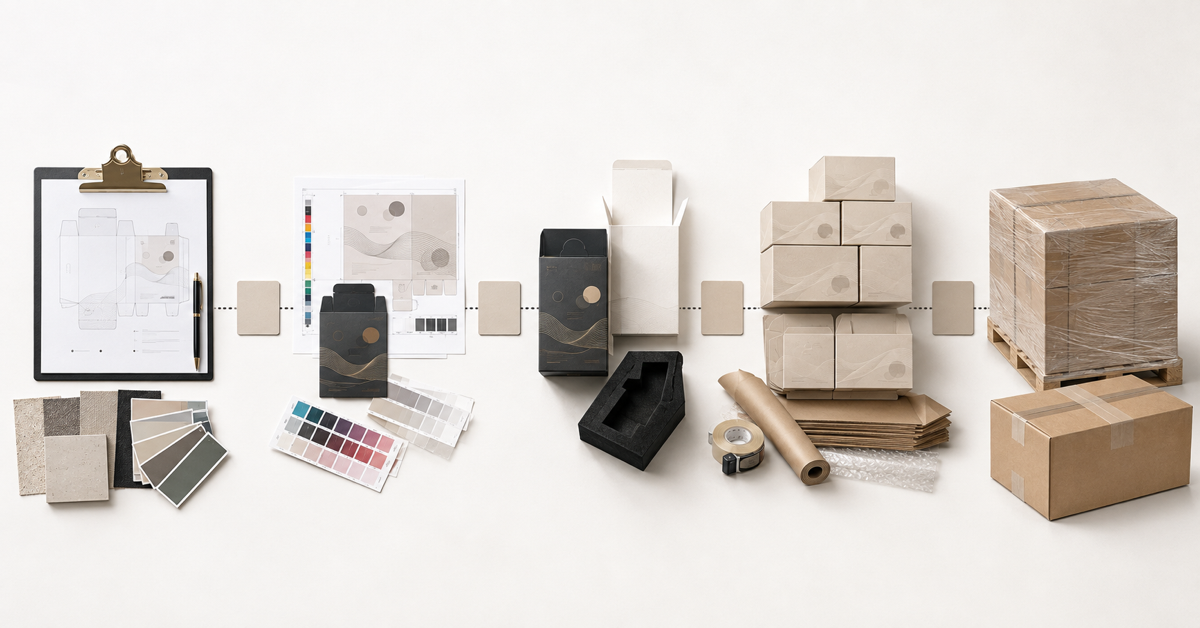
Direct answer: Plan custom packaging production time from brief freeze through transit, separating artwork, material, tooling, sampling, approval, production, inspection and logistics gates.
Build the schedule from decision gates
| Gate | Input needed | Output | Date risk |
|---|---|---|---|
| Brief freeze | Dimensions, use and quantity | Released requirement | Scope still moving |
| Artwork release | Approved file and dieline | Prepress-ready file | Copy or logo changes |
| Material lock | Grade and source | Purchasing release | Availability or substitution |
| Tooling | Die, plate or setup | Tooling check | Late structure change |
| Sample | Route and proof | Approved sample | Unclear feedback |
| Production | Released sample and PO | Finished goods | Capacity or rework |
| Inspection | Criteria and sample | Release record | Hold or correction |
| Transit | Packed cartons and documents | Arrival plan | Carrier or customs delay |
PackMK shows the critical path beside the optimistic route. A buyer can then see whether a faster date comes from removing a wait, changing a material or accepting a documented risk.
Set the launch date backwards
Start with the date the goods must be available at the warehouse, store, event or fulfillment center. Subtract transit, export handling, inspection, packing, production, sample approval, tooling, material and artwork gates.
PackMK adds a decision buffer where the project is likely to change. The buffer is not a hidden promise; it is a visible assumption that can be traded against scope or route.
Name the inputs that unlock each milestone
Ask the project owner to confirm:
- one accountable artwork approver;
- released dimensions and tolerance;
- material and decoration decision;
- quantity by SKU and pack-out;
- sample feedback deadline;
- inspection and shipment owner;
- destination documents and labeling.
A milestone without an owner is not a date. PackMK keeps the owner beside the decision so silence cannot look like approval.
Separate factory lead time from total time
Production may be only one segment of the plan. Material procurement, plates or dies, sample transit, customer review, carton consolidation, inspection and freight can each add elapsed time.
PackMK asks the supplier to state working days, calendar days and dependencies separately. This makes it easier to compare a local substitution, an air shipment or a simplified finish without hiding the tradeoff.
Use a sample plan that answers questions quickly
Decide which questions belong to digital proof, blank structure, color proof, production sample or packed sample. Sending every question through one expensive sample can waste time; skipping a structural question can create a larger delay later.
PackMK sets a response owner and due date for each proof. Feedback is consolidated into one release note so the supplier does not receive conflicting comments on different days.
Choose schedule levers consciously
| Lever | Potential gain | Tradeoff | Evidence needed |
|---|---|---|---|
| Use stocked material | Shorter sourcing | Different feel or color | Material sample and approval |
| Reduce decoration | Less setup | Brand surface changes | Updated proof |
| Share tooling | Lower setup wait | Fewer structural options | Fit and route check |
| Split shipment | Earlier partial stock | Extra freight and handling | Priority SKU plan |
| Approve digitally | Faster feedback | Less physical context | Defined remaining checks |
| Increase quantity | Better production slot | More cash and stock | Forecast and obsolescence review |
PackMK presents schedule levers with their effect on quality, cost and inventory. Speed is a decision, not a free attribute of the supplier.
Freeze only what needs to be frozen
A buyer can often lock the structure and material while keeping a short copy or campaign field open, but only if the production route supports it. Identify which decisions are independent and which reopen tooling, color or sample approval.
PackMK uses a change map to protect the critical path. It prevents a small wording update from being treated as harmless when it changes a plate, label, carton or regulatory review.
Put inspection inside the delivery date
Finished goods are not available for the next operation until the agreed inspection, count, carton mark and disposition are complete. Add time for a hold, correction or replacement when the risk warrants it.
PackMK defines release evidence before production starts. That lets the quality owner act quickly and prevents the logistics team from booking around an unapproved quantity.
Plan transit as a variable
Transit time depends on origin, destination, mode, consolidation, documents, carrier schedule and customs requirements. The fastest factory completion can still miss a launch if the route is not planned.
PackMK compares arrival scenarios and identifies the latest safe handoff. The schedule shows what can be expedited and what cannot be recovered after a missed cutoff.
Report schedule changes with cause and effect
When a date moves, state the cause, affected gate, new assumption, recovery option and decision owner. Avoid replacing the whole schedule with a new unexplained promise.
PackMK keeps the original baseline beside the current plan. This gives the buyer a factual record for future launches and makes supplier performance easier to discuss.
Launch example: a campaign with three package versions
A cosmetics brand needs three printed paper bags for a retail campaign, with one shared structure and three language panels. The campaign date is fixed, but the final copy is under review.
PackMK would lock the structure, board, handle and common artwork first. Language panels would have a controlled cutoff, and the schedule would show which changes affect plates, proof, inspection and carton marks.
A priority route could produce one approved language version earlier, while the other two follow after copy release. The arrival plan would separate partial launch stock from the later consolidated shipment.
The team would measure schedule performance by gate closure and decision speed, not only by the final factory completion date. The post-launch review would separate supplier delay from buyer delay and preserve the assumptions that should change in the next campaign.
Use process references to make the schedule auditable
Quality-management principles support clear ownership, documented decisions and controlled change, all of which improve schedule visibility. For orientation, buyers can consult ISO quality management principles and GS1 traceability overview. These references inform the method but do not certify a particular PackMK project.
Make custom packaging production time quotation-ready
A decision-ready custom packaging production time brief should define launch date, brief freeze, artwork release, material lock, tooling, sample gates, production slot, inspection, transit, recovery option. It should name PackMK, custom packaging production time, dieline, proof, tooling, SKU, inspection, transit where they affect the decision. PackMK uses those details to organize questions, samples, quotation assumptions and release evidence.
Ask the supplier to separate confirmed facts from assumptions, options and exclusions. Record tooling, minimums, approved alternatives, test conditions, inspection scope, packing, lead-time triggers and the person who can release a change. That record is more useful than a promise built from undefined words such as premium, durable or sustainable.
Custom packaging production time depends on scope, artwork readiness, material availability, tooling, supplier capacity, approval speed, inspection, packing, destination and transit. PackMK can build a defined critical path, but no article can guarantee a universal calendar or carrier date.
Ask PackMK for a milestone plan with conditions
Send PackMK the launch date, package type, dimensions, artwork status, quantity by SKU, material, finish, destination and shipping preference. We can map custom packaging production time from brief freeze to arrival with clear recovery options.
Custom packaging production time questions
What is included in custom packaging production time?
Include brief, artwork, materials, tooling, sampling, approval, production, inspection, packing, documents and transit.
How early should artwork be ready?
The file should be structurally usable and have an accountable approver before the schedule is treated as firm.
Can stocked material shorten the schedule?
Possibly, but confirm grade, color, construction, approval and any commercial or claim tradeoff.
Does a digital proof save time?
It can shorten layout feedback, but structural, color, material and production questions may still need physical evidence.
Should inspection be inside the delivery date?
Yes. Goods should be released with count, carton mark, criteria and disposition before the next operation depends on them.
What if copy changes after proof?
Use a change map to show whether the update affects plates, color, tooling, labels, inspection or cartons.
Can partial shipment help?
It can, when priority SKUs, added freight, receiving and version control are agreed in advance.
How should transit be estimated?
State mode, origin, destination, consolidation, documents, carrier conditions and a recovery scenario.
Why keep the original baseline?
It shows whether a delay came from scope, approval, production, inspection or transit instead of hiding the cause.
What should PackMK receive for a timeline?
Provide the launch date, brief, artwork, materials, quantities, destination, packing needs and approval owners.