

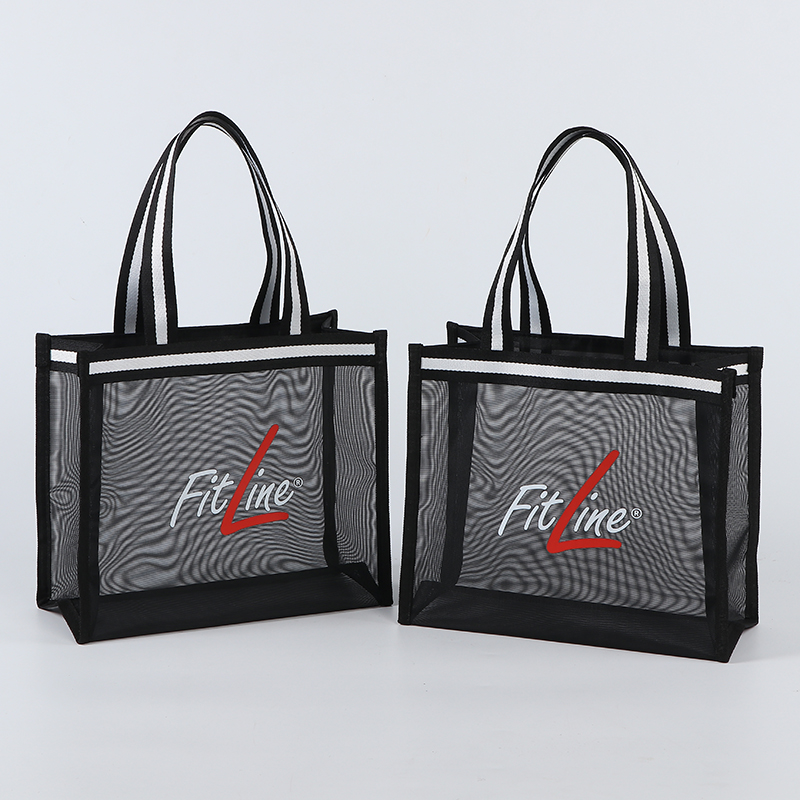
Mesh makes contents visible and allows airflow, but it also creates openings, stretch and concentrated seam loads. Buyers planning custom mesh bags should match the mesh, closure and reinforcement to the smallest item and the heaviest expected load.
Begin with the smallest item that must stay inside
List product dimensions after handling, not only when new. Small parts, cords and corners can work through openings as the bag moves. Test the full item mix and shake a filled sample in several directions.
Choose mesh openness from the job to be done
Open mesh supports visibility, drainage and ventilation. Finer mesh improves containment and print-area options but may hold more dust or dry more slowly. Define which benefit matters most before selecting by appearance.
| Use case | Primary risk | Sample focus |
|---|---|---|
| Produce or grocery | Small items escaping and handle stretch | Opening size and repeated carry |
| Laundry or sports | Wet contents and cord abrasion | Drainage, drying and closure cycling |
| Product organizer | Snagging and zipper stress | Edge binding and access test |
| Promotional kit | Logo distortion and mixed contents | Filled appearance and containment |
Trace the load from contents to carrying point
Weight moves through the mesh into seams, binding, handles or cords. Inspect every transition. Reinforcing one handle attachment will not solve a weak bottom seam or an edge that tears beside the reinforcement.
Cycle the closure under realistic filling
Drawcords can snag, zippers can catch mesh and hook-and-loop closures can collect fibers. Fill the bag, close it repeatedly and observe the user's hand position. A closure should remain accessible when the bag is full.
Plan a stable surface for branding
Fine artwork printed directly on open mesh may become hard to read. Consider a fabric panel, binding, tag or label area. Approve the logo while the bag is filled because stretching can change proportions and alignment.
Run a six-part sample protocol
- Containment shake with the smallest items.
- Static load hold with the heaviest intended kit.
- Repeated carry and handle inspection.
- Closure cycling while full.
- Wet or wash trial when relevant.
- Carton unpacking check for creases and deformation.
Confirm textile requirements for the intended market
Testing needs depend on material, use and destination. The OEKO-TEX Standard 100 overview provides context for harmful-substance testing of textiles. Confirm the correct requirements for the specific product.
Pack mesh without creating permanent distortion
Record folding, bundle quantity, carton dimensions and protection from hooks or sharp edges. Compressing custom mesh bags may reduce freight volume, but the unpacked product should recover to its approved shape.
Successful custom mesh bags contain the smallest item, carry the full load and keep closures, seams and branding usable after repeated handling.
Custom mesh bag questions
How large should mesh openings be?
Choose openings smaller than the smallest item or protruding part that must remain contained during movement.
Can a logo be printed directly on mesh?
Some mesh supports printing, but a fabric panel, tag or binding may provide better readability for detailed artwork.
How should mesh bag strength be tested?
Test the full load through static holding, repeated carrying, shaking and inspection of seams, edges and handle attachments.
Are custom mesh bags washable?
Washability depends on the mesh fiber, binding, thread, closure and decoration. Test the complete bag using the intended care process.