

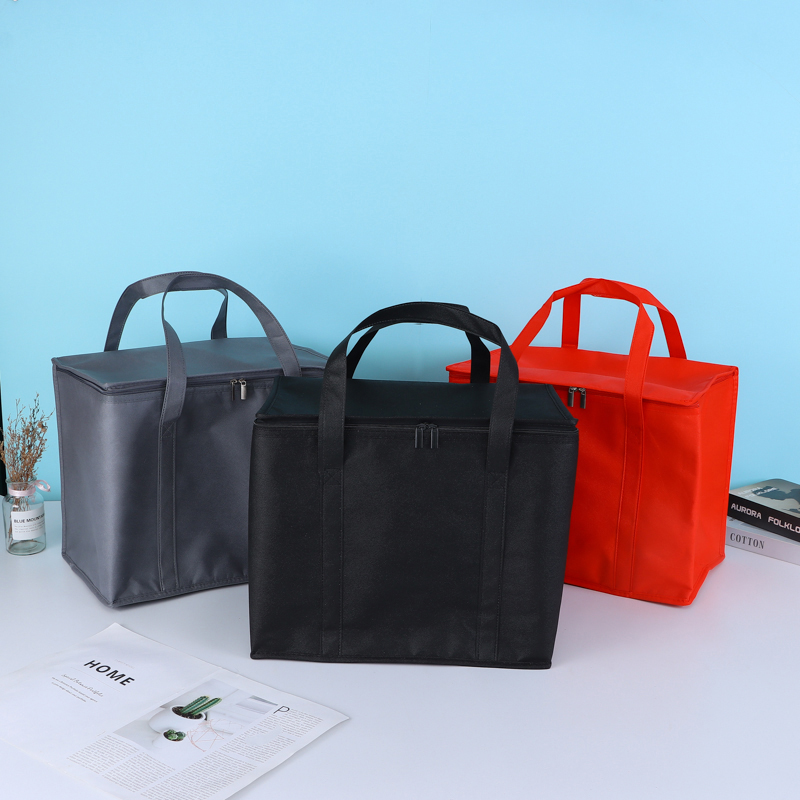
PackMK plans custom insulated bags around the real route: which containers go inside, how the bag closes, who carries it, how long handling lasts and what happens after use. The useful specification begins with workflow rather than a generic capacity label.
Draw the route before choosing the bag
Map packing, staging, vehicle loading, handoff and return or disposal. A bag used for a short takeaway handoff has different needs from one used repeatedly by delivery staff. Note where the bag may be compressed, stacked or opened.
Build capacity from complete container sets
| Use case | Test load | Design priority |
|---|---|---|
| Single meal | Main container, side and drink | Stable base and quick closure |
| Family order | Several containers with mixed heights | Internal clearance and handle strength |
| Catering | Trays or bulk containers | Wide opening and reinforced structure |
| Grocery delivery | Mixed packs and bottles | Dividing and leak isolation |
| Promotional use | Product kit or samples | Brand area and convenient reuse |
Match the outer layer, lining and joining method
The outer material affects print, abrasion and shape. The lining affects wiping and internal handling. Seams, binding and corners determine whether the layers remain aligned. Request construction details rather than relying only on a material name.
Test closure with an overfilled and normal load
Zippers, hook-and-loop strips, flaps and draw closures behave differently. Check whether staff can close the bag quickly, whether the top gaps under load and whether the closure catches on containers or lining.
Inspect handles at the attachment point
Load the sample with the heaviest expected order and carry it through normal movements. Look for handle stretch, seam distortion, bottom sag and uncomfortable grip. Handle length should also suit the intended hand or shoulder carrying method.
Plan for cleaning, condensation and mixed spills
Define whether the interior needs wiping, whether removable inserts are useful and how bags will dry between uses. Food handling requirements depend on the operation and market. The FDA Food Code resource offers broader context but does not replace a project-specific procedure.
Keep print zones away from structural stress
Large graphics may cross folds, seams or textured materials. Confirm the print method, color reference and visible area on a filled bag. PackMK recommends approving the assembled sample rather than evaluating flat artwork alone.
Run a route simulation before bulk approval
Pack, close, carry, place in the expected vehicle space and complete a normal handoff. Repeat with different container combinations. A practical simulation often exposes tipping, closure interference and awkward loading before production.
Record one repeatable insulated bag specification
PackMK can develop custom insulated bags with controlled dimensions, layers, closure, handles, artwork and carton packing. Save photographs of the approved loaded sample together with the written specification for future orders.
- Explore PackMK custom bag formats
- Review PackMK customization support
- Request a custom insulated bag quotation
Custom insulated bag questions
How should custom insulated bag capacity be measured?
Use the complete expected container set and include clearance for closing, carrying and normal packing variation.
Which closure is best for an insulated bag?
The best option depends on opening speed, load height, reuse, cleaning and whether staff wear gloves or work quickly.
Can logos be printed on custom insulated bags?
Yes. The suitable method depends on the outer material, artwork, print area, bag structure and order quantity.
What should be checked before a repeat order?
Compare dimensions, layers, closure, handles, artwork, carton quantity and a loaded sample with the approved reference.