

Why card printing matters more than many buyers expect
Card printing is one of those manufacturing jobs that looks simple from a distance and gets complicated the moment a buyer starts asking about color consistency, coating, pack structure, and how the finished deck will hold up in handling. That is especially true for product lines like tarot decks, collector sets, and retail gift packaging, where the printed card is not just a carrier for information but part of the product experience itself.
If you are sourcing business card printing, custom card printing, or a full deck-and-box package, the real decision is rarely “Can it be printed?” It is more often: what substrate, finish, and pack style will make the item feel credible in hand, survive repeated use, and still meet your budget. For products built around artwork, symbolism, or premium presentation, the printing quality becomes the product quality.
A quick read on the format: cards plus tuck-style boxes
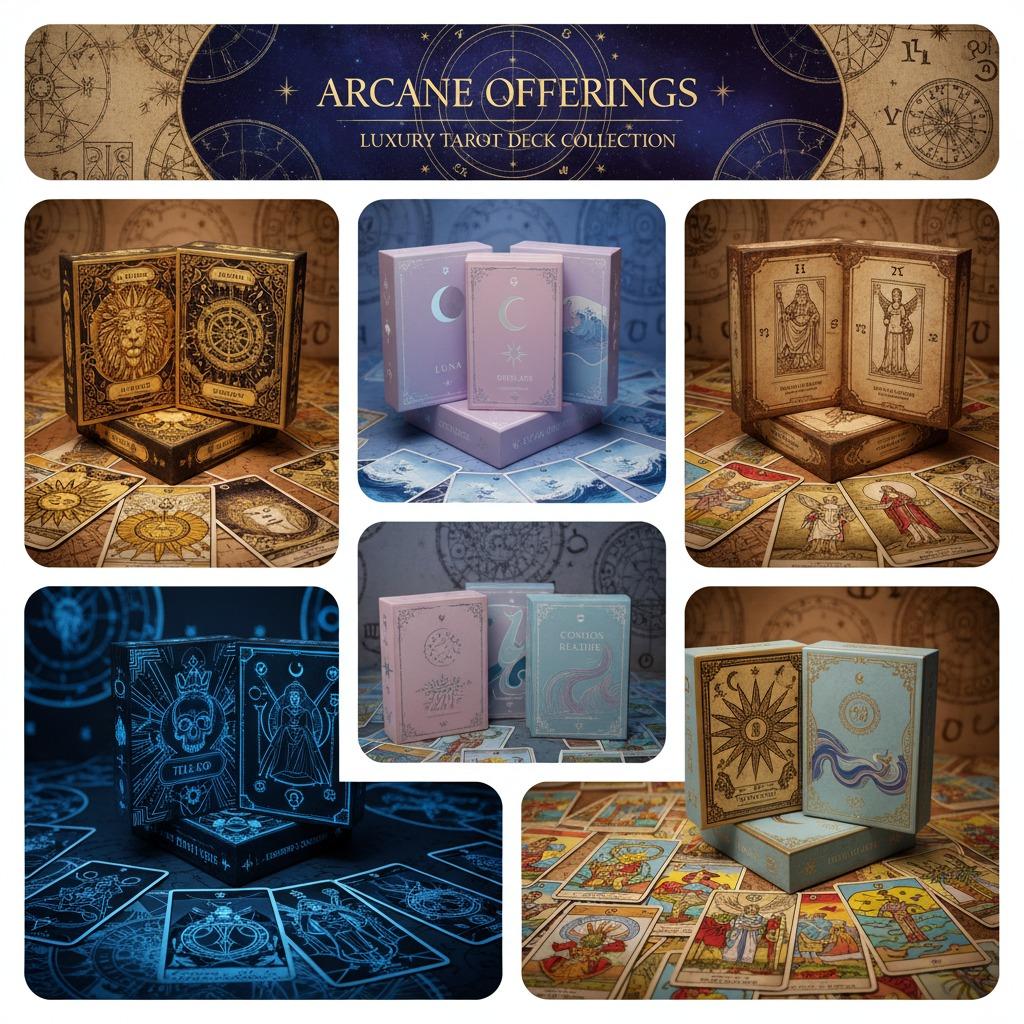
The product details here point to small rectangular card decks packaged in matching tuck-style boxes. That matters because the deck and the carton need to work together. The cards themselves carry illustrated tarot imagery, while the outer boxes provide branding, retail display value, and protection during shipping and shelf handling.
Several variants appear to use dark, high-contrast artwork with gold-look accents and ornate borders. From a manufacturing point of view, those are the kinds of visuals that can look strong on press but also expose weaknesses in color control. A slightly dull black, muddy metallic effect, or poor registration on fine line work will show up immediately. Buyers should treat these designs as a quality test, not just decoration.
What buyers should look for in high quality card printing
For card sets, high quality card printing usually comes down to four things: image sharpness, color stability, surface durability, and pack construction. The cards need clean edges and stable print density. The box needs to open and close neatly without crushing at the folds. And the finish has to support the intended use, whether that is frequent shuffling, collector display, or retail gifting.
In this type of product, laminated or coated surfaces are common because they help protect the print and improve handling. A matte finish can give tarot cards a more subdued, premium feel, while gloss can make artwork look more vivid. Neither is automatically better. The right choice depends on the artwork and how the cards will be used. A very glossy surface may feel less traditional in a divination product, while a very soft matte finish can mute detail if the artwork depends on contrast.
Practical caution on metallic effects
Some versions in the image show a gold metallic look. That effect can be achieved in several ways, including foil stamping, metallic ink, or even lighting in the rendering. Since the exact method is not confirmed, buyers should ask directly before approving artwork. The manufacturing method affects cost, turnaround, and how the effect will behave on dark backgrounds or small text. If your design depends on shine to carry the premium look, request a proof on the actual substrate whenever possible.
Production methods that are likely in play
For this kind of card set, offset printing or digital printing on paperboard/cardstock is the most likely base process, followed by cutting, folding, and box assembly. That sequence is standard for printed card packaging, but the details matter. Offset printing is often favored when large volumes and tight color control are needed. Digital printing can be more flexible for shorter runs, variable artwork, or product testing.
After printing, the board is typically die-cut to shape, scored for folding, and assembled into tuck boxes. If the project includes special effects, finishing steps may add lamination, varnish, foil, or metallic ink. None of those should be treated as automatic upgrades. Each one changes the feel of the product and the production risk profile.
How to choose between custom card printing options
When comparing custom card printing suppliers, start with the product’s end use. A retail tarot deck needs stronger shelf appeal than a private-label sample pack. A collector edition may justify extra finishing, while a mass-market deck may need a simpler structure that still looks polished. Professional card printing is not only about image quality; it is about matching the printed object to the sale channel.
Ask for clarity on substrate, coating, box style, and how the artwork will be prepared for production. Buyers sometimes focus only on the front face of the card and forget the box interior, tuck flap, or deck edge color. Those details can make the difference between a product that feels considered and one that feels rushed.
Common mistakes buyers make
The most common mistake is approving artwork on screen without thinking through print behavior. Dark designs can swallow detail. Fine borders can drift if the file setup is weak. Gold-toned effects can look rich in mockups and flat in production. Another frequent issue is treating the box as an afterthought, even though retail buyers notice packaging first.
There is also a temptation to over-spec everything. Not every card deck needs every premium feature. Sometimes the smarter move is to invest in one visible upgrade, such as better coating or a sharper box print, and keep the rest of the construction straightforward. That usually produces a more balanced result than piling on effects that do not support the design.
Buyer-facing questions worth asking before you quote
Before you place an order, ask the supplier to confirm the print process, finish options, die-cut structure, and whether the sample shown reflects the final production method. If you are comparing multiple vendors, request the same file treatment and the same output assumptions so the quotes are actually comparable. Otherwise, one price may look lower simply because it leaves out finishing or assembly details.
For packaging-driven products like tarot decks, the right supplier is usually the one that can explain how the cards, coating, and box work together rather than quoting only on sheet printing. That is a small but important distinction.
What this means for sourcing teams
If you are evaluating card printing for a branded deck, retail gift set, or collectible release, focus on the finished object, not just the printed sheet. The visual language in these tarot-style products depends on color depth, metallic accents, and compact packaging that still feels substantial in hand. Those are all achievable goals, but only if the print and finishing plan is matched to the artwork and use case.
A good next step is to compare supplier samples with the actual artwork style you plan to use. Ask how the cards are printed, how the box is built, and which finish is being used. That is usually enough to separate a capable production partner from a vendor who is only good at quoting.