


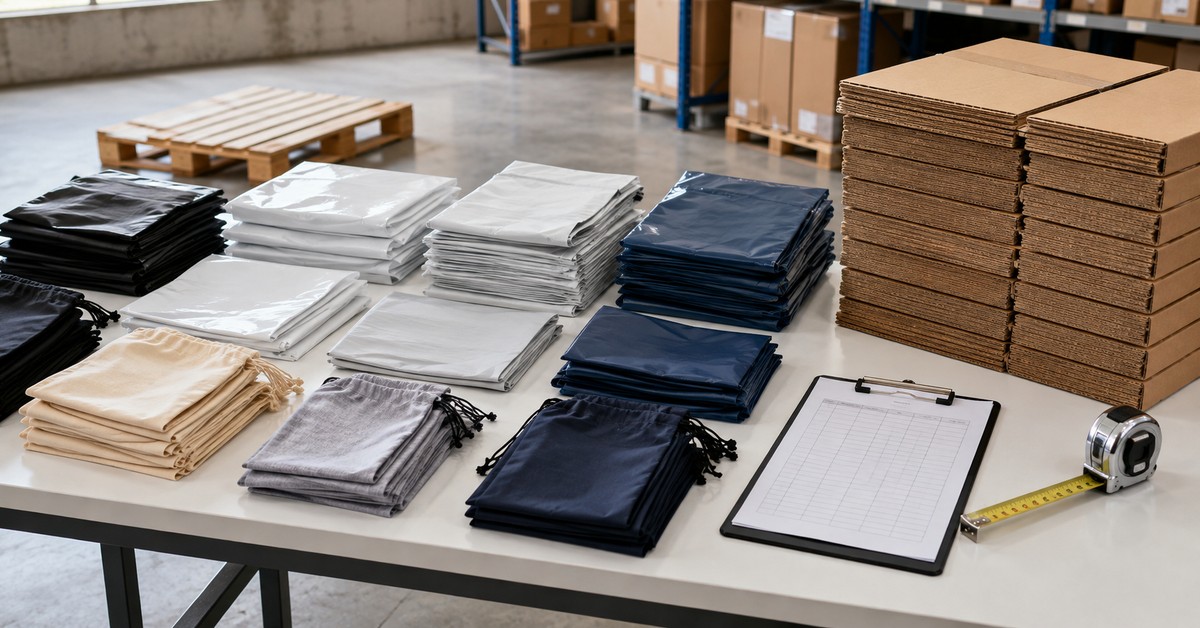
A bulk order can be physically simple and operationally messy. Several sizes, colors or customer marks may share one shipment, while cartons, pallets, storage bins and replenishment rules quietly determine whether the order arrives usable. Bulk packaging bags should be planned from the SKU mix and receiving process, not from a single total quantity.
PackMK builds a planning sheet that follows the bags from production allocation to carton, container, warehouse location and next reorder. It makes cube, counts, version identity and reserve stock visible before a buyer commits to a volume that looks efficient only on paper.
Short answer: Plan bulk packaging bags by mapping each SKU, pack-out, carton cube, shipment wave, receiving identifier and replenishment trigger, then reconcile the physical count against the same sheet.
Start with the SKU and quantity grid
| Field | Example entry | Why it matters | Owner |
|---|---|---|---|
| SKU | Bag-Black-M | Separates versions | Buyer |
| Quantity | 3,600 pieces | Drives run and cartons | Planning |
| Pack-out | 60 per inner, 10 inners | Sets case count | Factory |
| Carton | 6 cases, 18 kg | Controls handling | Logistics |
| Destination | Warehouse A | Sets allocation | Operations |
PackMK treats the grid as a control document. A total quantity can remain unchanged while the SKU split, carton count or destination wave changes the actual work.
Count versions before counting cases
List size, color, language, artwork, customer mark, material and any pack instruction that makes one bag different from another. Mark genuinely shared components separately from features that require a new run or a new carton identity.
PackMK asks the supplier to confirm minimums and overage by version. A shipment with 20,000 bags may still need ten separate reconciliations if each color or customer label is packed and received independently.
Capture the measurements that drive cube
For each finished and packed format, record:
- flat and folded bag dimensions;
- bundle count and bundle orientation;
- inner-pack size and compression;
- master-carton length, width, height and weight;
- pieces per carton and allowable variance;
- pallet or container loading assumption.
PackMK uses actual packed measurements where possible. A catalogue dimension cannot predict the cube of a coated bag, a bulky handle or a bundle compressed for export.
Choose a pack-out that receiving can count
A high pieces-per-carton figure may reduce freight while making a mixed shipment harder to identify or lift. Consider inner bundles, dividers, moisture protection, carton weight, opening method and the order in which cartons will be consumed.
PackMK tests the receiving action. The warehouse should be able to verify SKU, version, quantity and condition without unpacking every case. If a carton contains mixed variants, the rule and marks need to be explicit rather than left to a handwritten note.
Compare shipment strategies
| Strategy | Useful when | Main exposure | Control |
|---|---|---|---|
| Single mixed load | One destination and stable mix | Receiving confusion | Color-coded marks and allocation |
| SKU-separated cartons | Warehouse needs fast count | More cube | Case-level identity |
| Staged waves | Demand arrives in phases | Extra handling | Release calendar |
| Consolidated container | Large, steady volume | Cash and stock exposure | Forecast and reserve review |
| Partial shipment | One version is ready first | Split freight | Change and count record |
PackMK compares the warehouse consequence beside freight efficiency. The best plan is the one the receiving team can execute repeatedly, not simply the one with the fewest cartons.
Write the carton mark before production
State purchase order, SKU, artwork or version code, color or size, quantity, carton sequence, gross and net weight and destination marks required by the buyer. Keep the same identity on inner bundles and the packing list.
PackMK asks for a mark proof and a sample carton. A correct bag inside an ambiguous case is still a receiving risk. The proof also gives the factory a stable place to record reprints, short packs or replacement cartons.
Make the loading calculation transparent
Show how pieces, bundles, cartons, pallet positions or container volume are derived. Note whether dimensions are measured loose, nested, compressed or after moisture protection, and state any unused space that remains.
PackMK does not treat a cube estimate as a guarantee. We use it to compare options and identify where a packed-case trial is needed. A small change in fold direction can alter carton recovery, count and freight without changing the bag itself.
A practical reconciliation rule
Every accepted piece must appear once in an identified inner pack, carton and shipment allocation; any overage, shortage, rework or mixed case receives a separate recorded disposition.
PackMK places this rule on the packing sheet and inspection record. It turns a bulk count into a traceable handoff rather than a total that is assumed to be correct.
Protect the bags during long storage
Review moisture, compression, odor, dust, sunlight, temperature, carton stacking and the time between production and use. Fabric, coating, print, adhesive labels and handles can recover differently after a dense hold.
PackMK asks for a packed-case hold and a simple unpack inspection. The result should state the storage condition and the features checked. It is more useful than a broad claim that the bags are export ready without a defined route.
Set replenishment triggers by SKU
Define minimum station or warehouse stock, forecast review date, supplier lead-time assumptions, inspection time, freight window and the artwork freeze point. A total stock floor can hide a shortage of one high-velocity size.
PackMK uses a per-SKU trigger with a reserve reason. When a version changes, the buyer can see which inventory is still valid and which cartons need a controlled cutoff. This keeps a large order from creating silent obsolete stock.
Handle exceptions without losing identity
Decide how to record short packs, damaged cartons, mixed bundles, late versions, relabeled cases and partial releases. Give each exception an owner, replacement quantity and updated document reference.
PackMK keeps the original quantity and the disposition visible. A replacement carton should not erase the reason for the change, because that history helps explain a later count discrepancy or supplier corrective action.
Turn the sheet into the next order
After receiving, compare planned and actual cartons, cube, damage, count time, stockouts and reorder timing. Keep stable pack-out decisions, then change only the fields supported by evidence.
PackMK uses the result to improve the next bulk packaging bags release. A recurring SKU may justify a dedicated carton, while a slow version may be consolidated. The decision belongs to the operating data, not a default packing habit.
Planning example: four sizes across two warehouses
An accessories brand orders four bag sizes in two colors for two warehouses. The larger size is slow but takes most of the carton cube, while the small size moves quickly at both locations.
PackMK would build one SKU grid, then compare separated cartons with a mixed-load strategy. Carton marks would carry location, size, color, version and sequence, and the packing list would reconcile each allocation rather than only the grand total.
A packed-case hold would check compression and print recovery. Replenishment triggers would be set per size and warehouse, with the slow large bag reviewed before the next production release.
The next order could preserve the tested inner bundle while changing the carton mix. Because the sheet records the reason, freight and receiving teams can evaluate the change without reopening every specification.
Use traceability and handling references as context
Traceability and distribution guidance can help teams frame identity, packing and handoff questions. For context, buyers can consult GS1 traceability overview and International Safe Transit Association. These references do not certify a particular PackMK project.
Specify bulk packaging bags as an operating plan
A decision-ready bulk packaging bags brief should define SKU grid, quantity split, folded dimensions, inner bundle, carton cube, carton mark, shipment wave, receiving count, reserve stock, replenishment trigger. It should identify PackMK, bulk packaging bags, SKU, carton, pallet, container, packing list wherever they affect the decision. PackMK uses those fields to organize questions, samples, quotation assumptions and release evidence.
Keep the bulk plan conditional
Packed dimensions, carton cube, storage recovery, handling and replenishment depend on the exact bag construction, quantity mix, packing method and route. PackMK can organize a planning sheet and packed-case check, but no generic calculation guarantees freight capacity, warehouse labor or arrival condition.
Build the bulk plan with PackMK
Send PackMK the SKU list, quantities, bag dimensions, material, artwork versions, pack-out preference, destinations, storage limits and required date. We can turn bulk packaging bags into a countable shipment and reorder plan.
Bulk packaging bags questions
What is the first input for a bulk bag order?
Start with SKU, version, quantity by destination, finished dimensions, pack-out and required date.
Should variants share a carton?
Only when receiving can identify and count them reliably and the supplier confirms the mixed-pack rule.
How is carton cube calculated?
Use measured packed dimensions, pieces per case, compression method and the stated loading assumption.
What should a carton mark show?
Include purchase order, SKU, version, quantity, sequence, weight, destination and required handling marks.
Why use inner bundles?
They make counting, replenishment and version separation easier, although they can add cube or labor.
How should a packed-case hold be run?
Hold representative cartons under the expected storage and stacking conditions, then inspect recovery, count and condition.
What is a per-SKU reorder trigger?
A stock floor and release date based on that SKU's demand, lead time, inspection and freight window.
How are short packs handled?
Record the affected carton and SKU, disposition, replacement quantity, owner and updated document reference.
Can a large order reduce unit cost?
It may improve setup or freight efficiency, but compare cash, storage, obsolete versions and receiving effort too.
What does PackMK need for a quotation?
Provide SKU mix, dimensions, material, print, quantities, pack-out, destinations, timing and any warehouse rule.