


A gift box factory China project can jump from a beautiful concept to a bulk quotation too quickly. A box that looks right on a screen still needs to prove its board, fit, hinge, finish, insert and packing before a large run can be trusted.
PackMK uses a prototype-to-scale staircase. Each step has one job: the dummy proves proportion, the engineering sample proves construction, the decorated sample proves appearance, the pilot proves repeatability and the scale run proves the packing route.
Short answer: A gift box factory China development should move through five stages: white dummy, engineering sample, decorated approval, pilot run and scale release. Freeze only the decisions that the current stage can actually prove.
The five steps on the staircase
The staircase keeps an attractive sample from carrying decisions it has not yet tested.
| Stage | Primary question | Decision that can freeze |
|---|---|---|
| White dummy | Does the product fit and open? | Internal dimensions and structure |
| Engineering sample | Can the board, hinge and insert work? | Construction and hardware route |
| Decorated sample | Does the finish look right on the box? | Artwork, colour and finish |
| Pilot run | Can the route repeat across pieces? | Process settings and inspection |
| Scale release | Can cartons ship and arrive safely? | Quantity, packing and dispatch |
PackMK writes the stage name on every sample so the buyer knows whether it is a design reference or a production reference.
Step one: make the product fit the box
A white dummy is deliberately plain. It lets the buyer test product clearance, lid movement, tray depth and the amount of effort needed to open the box without the finish distracting from the structure.
Measure the product and the internal space, then record where tolerance is needed. PackMK retains the dummy with the dimension sheet so a later decorative sample cannot quietly change the usable space.
Step two: prove the construction route
An engineering sample replaces guesses with the proposed board, wrap, hinge, magnet, ribbon or insert. It does not need perfect decoration; it needs to show whether the selected materials can make the intended motion and hold the product.
Ask the factory to identify any handwork, tooling or assembly step that the sample uses. PackMK lists those operations before the decorated sample so a buyer does not approve an appearance that can only be made slowly or inconsistently.
Step three: approve decoration on the real surface
Foil, emboss, print and lamination behave differently on coated paper, wrapped board and textured stock. A colour approved on a flat proof may shift when it is wrapped over an edge or combined with a foil stamp.
PackMK approves the decoration on the actual box surface, records the finish sequence and keeps a signed panel or sample. The approval covers appearance only; the engineering decision remains attached to the earlier stage.
Questions before a gift box factory China pilot
A pilot is expensive enough that the buyer should know what it is supposed to prove.
- Which construction details are fixed from the engineering sample?
- Which finish settings are fixed from the decorated sample?
- What is the pilot quantity and inspection basis?
- Which handwork steps are measured for time or tolerance?
- How will pilot cartons be packed and identified?
PackMK puts the answers in the pilot release note so the pilot cannot become an unstructured mini production run.
Step four: use the pilot to find repeatability
A pilot is not a discount bulk run. It is a controlled check that the line, handwork stations, finish settings and inspection route can reproduce the approved box more than once.
Sample across the pilot rather than selecting one perfect piece. PackMK compares lid alignment, corner wrap, magnet position, insert fit and finish consistency, then records which variation is accepted and which requires a process change.
Pilot checks that matter to a gift box
Use checks that connect the buyer experience to the factory operation.
| Area | Pilot check | Release evidence |
|---|---|---|
| Fit | Product and insert sit without pressure | Measured sample and photos |
| Motion | Lid opens, closes and holds | Cycle result and disposition |
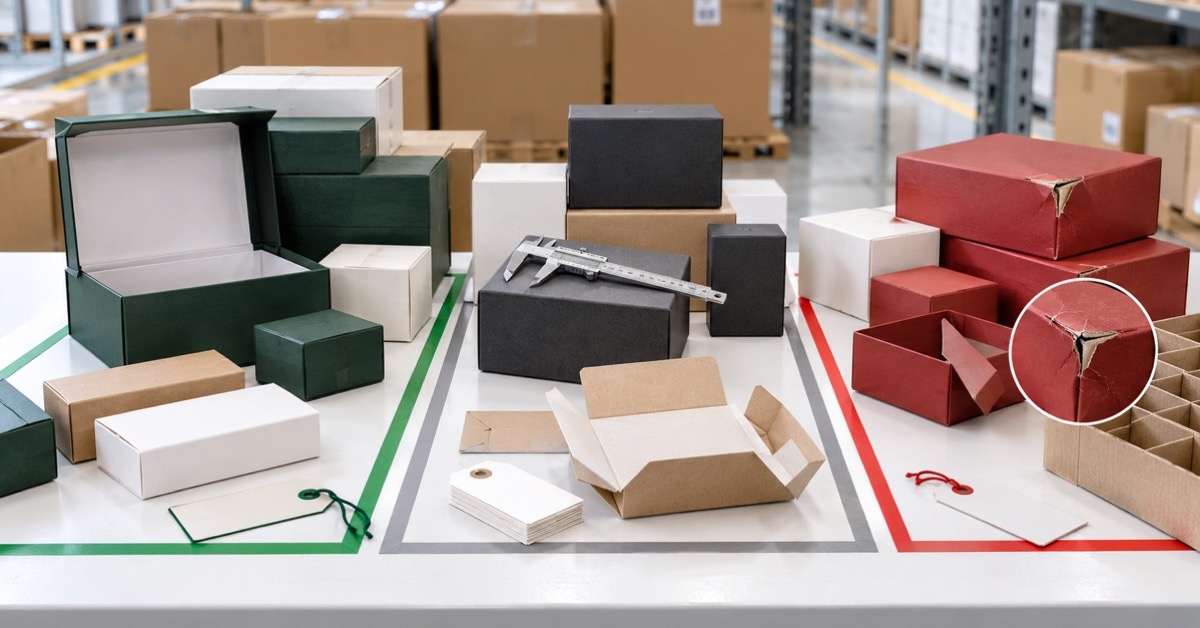
| Corners | Wrap is clean without lift | Sample set and defect rule |
| Finish | Colour, foil and emboss repeat | Signed comparison panel |
| Packing | Box survives inner and outer pack | Packed pilot carton |
PackMK keeps the packed pilot carton because a perfect box outside the carton is not enough evidence for a shipment.
Step five: release scale with a freeze list
A scale release should list what is frozen and what is still allowed within tolerance. Without that list, the factory may substitute a board, move a magnet or change the insert to protect the schedule.
PackMK separates acceptable process variation from a design change. The buyer can then approve the scale run knowing which differences are expected and which ones require a stop or re-sample.
Treat tooling as a stage decision
A magnetic closure, emboss plate, cutting die or special insert tool can be ordered too early. Tooling should follow a stable construction decision, because a change after the tool is made creates both cost and delay.
PackMK lists tooling release at the engineering stage and ties it to the drawing version. The decorated sample can then focus on finish without reopening the structural tool unless the pilot reveals a real issue.
Plan the carton around the finished box
Rigid gift boxes occupy more space than flat folding cartons and can be damaged by pressure at corners or magnets. Carton quantity, separator material and pallet pattern should be tested with the finished box, not guessed from the product size.
PackMK adds the carton cube and gross weight to the scale release. The delivery term and handling marks are recorded with the packing plan so the factory and buyer share the same shipment assumption.
Reasons to step back instead of pushing to scale
A staircase is useful because it gives the buyer a legitimate place to pause.
- The engineering sample needs a different hinge route.
- The decorated sample hides a board change.
- Pilot corners vary beyond the agreed tolerance.
- The insert holds the product too tightly.
- The packed carton damages the lid or finish.
PackMK treats a step back as a controlled decision, not as a failed project, because the cost is lower before the scale release.
Keep a staircase record for the next season
Gift box programmes often return with a new colour, product size or finish. Keep each stage record so the next season can begin at the correct step instead of repeating every development decision.
PackMK stores the white dummy, engineering drawing, decorated approval, pilot disposition and scale packing record as one development history. That history makes a new variant faster without making it less controlled.
Case example: a rigid gift box that failed at the pilot
A beauty brand approved a decorated gift box after the lid, foil and colour looked right. The pilot showed that the insert pressed the product against the hinge and several corners lifted when the packed cartons were stacked.
PackMK stepped back to the engineering stage, widened the clearance and changed the corner wrap sequence before repeating the pilot. The final decorated box was unchanged visually, but the scale release included a tested insert and a carton separator that protected the finish.
References for box development and handling
A staged quality process makes changes visible, while handling and shipment references help a buyer test the finished box beyond the studio sample. Buyers can consult ISO 780 packaging handling symbols reference and ICC Incoterms rules overview for additional context. These references do not certify a particular PackMK order.
Write a gift box factory China brief
A practical gift box factory China brief should name internal fit, board construction, decorated approval, pilot carton. It should also identify rigid box, foil stamping, insert, ISO 780 wherever they affect approval, production, packing or delivery. PackMK uses those fields to organize samples, quotation assumptions and release evidence.
Keep the gift box factory China staircase proportionate
A simple folding carton may combine the white dummy and engineering sample. Use all five stages when the box has rigid wrap, magnets, handwork, delicate finishes, a fitted insert or a shipment where carton damage is costly.
Develop a gift box with a factory in China through PackMK
Send PackMK the product, box style, finish, insert and launch date. We will place the project on the staircase, define what each sample must prove and set the freeze list for the pilot and scale release.
Common questions about a gift box factory China
What should a gift box factory China project prove first?
Start with internal fit, opening movement and the basic structure. A white dummy is useful because decoration cannot hide a clearance or hinge problem.
What is the difference between an engineering sample and a decorated sample?
The engineering sample proves board, wrap, hinge, closure and insert. The decorated sample proves print, colour and finish on that construction. Do not use a decorative sample to hide an unresolved structure change.
When should tooling be released?
Release cutting, emboss or closure tooling after the construction decision is stable and tied to a drawing version. Changing structure after tooling is made adds cost and time.
What is a pilot run for a gift box?
It is a controlled quantity made to test repeatability, inspection and packing before scale. It should have a stated purpose and release criteria rather than becoming an unstructured small production run.
How should foil and emboss be approved?
Approve them on the actual wrapped or coated surface, with the finish sequence stated. A flat proof may not show edge wrap, texture or the interaction between foil and coating.
Why does the insert need its own test?
The insert controls fit, product pressure, opening effort and carton movement. A box that looks correct can still damage the product if the insert is too tight or too loose.
What should a pilot inspection check?
Check fit, lid movement, corners, finish consistency, insert position and packed-carton performance. Record the accepted tolerance and the defect disposition.
How do I prevent carton damage?
Test the finished box in its inner and outer pack, record separators and carton quantity, and check stacking or handling marks. Product dimensions alone do not predict carton performance.
Can a gift box factory change board after approval?
Only through a stated change process. A board change can affect strength, colour, wrap, fit and freight cube, so it should be re-quoted or re-sampled as required.
What should a gift box factory China brief contain?
Include product fit, box structure, board, closure, insert, decoration, tooling, pilot quantity, inspection, packing, destination and launch date. PackMK uses those fields to build the staircase.