


A search for factory direct drawstring bags often stops at a low price and a factory-looking photograph. The useful question is what happens after the enquiry: who owns the drawing, who reserves the cord, who signs the first piece and who releases the cartons.
PackMK follows the order path from request for quotation to dispatch. The path makes a direct relationship visible because each step has a factory owner, a buyer decision and a record that can be checked without relying on a sales description.
Short answer: Factory direct drawstring bags are genuinely direct when the buyer can trace the quotation basis, sample record, material reservation, capacity slot, first-piece approval, inspection result and carton release to the same factory order.
Direct starts with a named production basis
A factory-direct quote should identify the bag material, finished dimensions, cord, print route, quantity band, packing and delivery term. A price without that basis may still be real, but it does not show what the factory has agreed to make.
PackMK asks the supplier to mark each line as confirmed, provisional or excluded. That makes a low price useful for comparison without pretending that an open assumption is already protected.
The order path from enquiry to carton
The path should be readable by a buyer who was not on the first sales call.
| Step | Factory owner | Buyer decision | Record |
|---|---|---|---|
| Quotation | Commercial lead | Accept basis or revise | Priced specification |
| Drawing | Product engineer | Confirm dimensions and cord | Versioned drawing |
| Sample | Sample room | Approve use and print | Sample disposition |
| Capacity | Planner | Release quantity and date | Slot confirmation |
| First piece | Line supervisor | Approve repeatability | Signed first-piece sheet |
| Dispatch | Packing lead | Accept carton release | Packing list and photos |
PackMK keeps the step names fixed even when the product is simple, because the buyer can see which evidence is still missing.
Check whether the cord is part of the factory route
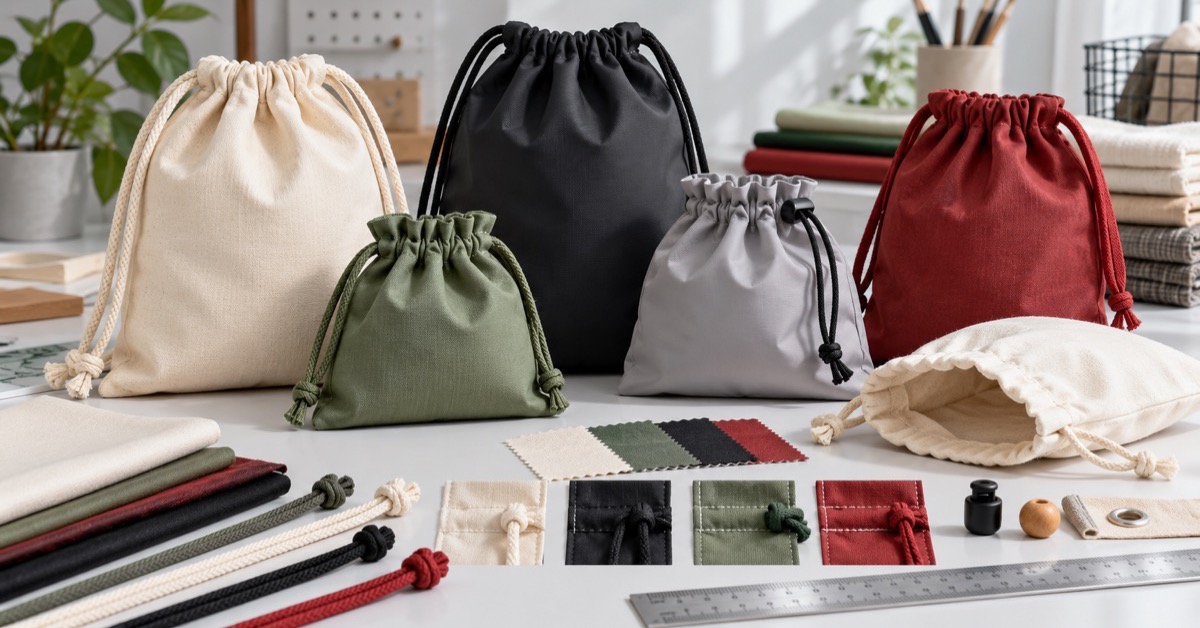
Drawstring bags fail at the cord more often than buyers expect. Cord diameter, braid, finish, length and the way it is threaded all affect the opening action and the load the top edge carries.
Ask whether the cord is made, sourced or substituted by the factory. PackMK records the cord reference and the threading method on the sample so a repeat order does not replace it with a visually similar but weaker option.
Use the drawing to expose a trader handoff
A trader can provide a good bag and still be unable to answer the factory questions that protect a repeat order. Ask who owns the pattern, who can approve a material substitution and where the first piece is inspected.
PackMK does not reject a trading route automatically. It makes the route explicit. A buyer can then price the service, lead time and communication risk instead of treating a trading layer as invisible factory capacity.
Questions that confirm factory ownership
Ask for a direct answer and a named person, not a general assurance.
- Who issues the production drawing?
- Who reserves the cord and fabric?
- Who signs the first piece on the line?
- Who records rejected or reworked bags?
- Who releases the carton list to the carrier?
If the answer changes by step, record the route. Direct buying is about traceability as much as it is about price.
Reserve capacity after the sample, not before it
A supplier may offer a production slot before the bag has a stable drawing. Holding a date can be useful, but the slot should show what quantity and basis it protects and when it expires.
PackMK separates a provisional slot from a released slot. The buyer can keep a campaign date visible without confusing a sales promise with a factory plan that has received material and first-piece information.
The first-piece decision
The first piece should confirm the repeatable route, not merely resemble the approved sample.
| Feature | Check | Release question |
|---|---|---|
| Bag body | Material and finished size | Does the cut match the drawing? |
| Cord | Length, braid and threading | Does the opening action match? |
| Seams | Stitch, bartack and edge | Will the load path repeat? |
| Position, colour and cure | Can the line hold the approval? | |
| Packing | Fold, inner count and carton | Can dispatch use the same basis? |
PackMK signs the first-piece sheet only after the production route and the approved sample are compared on the same page.
Make payment milestones follow evidence
A factory-direct relationship is easier to manage when payment milestones follow decisions: basis accepted, sample approved, first piece released and cartons dispatched. The exact terms depend on the agreement, but the evidence sequence should remain clear.
PackMK places the milestone beside the record that supports it. That does not eliminate commercial negotiation; it stops a payment date from becoming the only definition of progress.
Keep quality and packing in the same conversation
A drawstring bag can pass a visual check and still arrive mixed by colour or size. The final inspection and carton release should use the same variant names and quantities as the drawing and purchase order.
PackMK checks the first packed carton, then asks for a carton list and loading reference. The buyer can tell whether the direct factory order is complete before the carrier leaves.
Warning signs on a factory direct drawstring quote
These phrases need a follow-up before they can support a purchase decision.
- Cord is described as standard.
- Sample will follow after order confirmation.
- Capacity is available without a date or quantity.
- Quality will be checked as usual.
- Packing will be arranged by the warehouse.
PackMK turns each phrase into a field in the order path so a buyer can see who owns the answer and when it must be closed.
Close the path with a repeat-order pack
The direct relationship proves its value on the second order. Keep the approved drawing, sample, material references, first-piece sheet, inspection rule and carton list together so a repeat starts from evidence rather than from a sales chat.
PackMK returns that pack with the shipment record. A buyer can then compare a new quote or a new season against the same route and spot a substitution before it becomes a surprise.
Case example: a drawstring bag order with two cord suppliers
A buyer sourced factory direct drawstring bags for a skincare set. The sample used a soft braided cord, but the first quotation did not state whether the cord was reserved or substituted locally at production.
PackMK required the cord reference and threading method on the drawing, then approved the first piece against the sample. When the original cord became unavailable, the factory raised the substitution before cutting, and the buyer could approve a tested alternative rather than discovering a different opening action in the cartons.
References for a direct order path
A traceable order path relies on clear quality ownership and explicit delivery responsibility rather than on a supplier label alone. Buyers can consult ISO quality management principles and ICC Incoterms rules overview for additional context. These references do not certify a particular PackMK order.
Write a factory direct drawstring bags brief
A practical factory direct drawstring bags brief should name production basis, cord reference, first-piece sheet, carton release. It should also identify MOQ, bartack, AQL, Incoterms 2020 wherever they affect approval, production, packing or delivery. PackMK uses those fields to organize samples, quotation assumptions and release evidence.
Keep the factory direct drawstring bags path proportionate
A small repeat order with an unchanged drawing can combine several steps into one confirmation. Use the full order path when the cord, print, quantity, campaign date or delivery split creates a meaningful substitution or capacity risk.
Source factory direct drawstring bags with PackMK
Send PackMK the bag dimensions, cord preference, artwork, quantity, packing and delivery date. We will map the order path, identify the factory owner at each step and return the evidence needed for a clean release.
Common questions about factory direct drawstring bags
What does factory direct mean for drawstring bags?
It means the buyer can trace the production basis, material route, sample, capacity, first piece, inspection and dispatch to the factory making the order. A factory-looking website alone does not prove that route.
What should a drawstring bag quote include?
Include material, dimensions, cord, print method, quantity band, packing, destination and delivery term. Ask the supplier to mark each field confirmed, provisional or excluded.
How should drawstring cord be specified?
Record fibre or material, diameter or braid, finish, length, threading method and attachment or knot detail. Test the opening action and load rather than approving the cord by appearance.
Should I approve a sample before placing the order?
For a custom or campaign order, yes. The sample should be tied to a drawing and a material basis so the first production piece can be compared to it.
What is a provisional capacity slot?
It is a planning hold with a stated quantity, basis and expiry. It is not the same as a released production slot with approved material and first-piece requirements.
What should the first-piece check cover?
Check body material and dimensions, cord, seams, print, folding and packing. The first piece should prove that the approved sample can be repeated on the line.
How can I tell if a supplier is trading the order?
Ask who owns the drawing, material reservation, first-piece sign-off, rejected goods and carton release. If the route involves another factory, record it instead of treating it as invisible.
Should payment milestones follow production evidence?
They can. Tie milestones to agreed records such as basis acceptance, sample approval, first-piece release and dispatch, while keeping the exact commercial terms in the contract.
Why does packing belong in the order path?
Mixed sizes, colours or counts can make a correct bag order unusable. Carton names and quantities should match the drawing, purchase order and allocation list.
What should a factory direct drawstring bags brief contain?
Include the bag, cord, dimensions, artwork, print, quantity, capacity date, first-piece rule, inspection, packing, destination and delivery term. PackMK uses those fields to map the order path.