


When a buyer moves to factory direct canvas bags, the quotation usually drops and the workload quietly rises. The intermediary who used to handle inspection, consolidation, documentation and the awkward phone call is gone, and every one of those jobs now belongs to somebody. The useful question is not whether direct is cheaper. It is which line each cost moved to.
PackMK has quoted canvas bags both through traders and directly, and the pattern is consistent. Direct buying is genuinely cheaper when the buyer can absorb four specific costs, and genuinely more expensive when they cannot. This is the split we walk through before a direct order is confirmed.
Short answer: In a factory direct canvas bags order, four costs move to the buyer: incoming inspection, freight consolidation, documentation and quality risk. Three stay with the factory: material, production and packing. The order is worth running direct when the buyer can cover the first four with a named person, and it is better run through a trader when they cannot.
What a direct canvas bag order really changes
A trader adds a margin and removes a set of tasks. That is the entire transaction, and it is worth being precise about both halves, because a direct quote usually shows only the margin. The tasks are the part that decides whether the saving survives.
Canvas makes the split more visible than most materials, because the bag is heavy, the fabric is measured and often dyed to order, and freight is charged on volume rather than on value. Those three features push cost and risk toward whoever is organising the shipment.
The responsibility split, line by line
Read the table with your own team in mind. Any row where nobody on your side is named is a row that will be handled badly or not at all.
| Cost line | Who carried it through a trader | Who carries it in a direct order |
|---|---|---|
| Fabric selection and dye lot | Trader specified | Buyer specifies and approves |
| Incoming inspection | Trader arranged | Buyer arranges |
| Freight consolidation | Trader consolidated | Buyer or factory, as agreed |
| Export documentation | Trader issued | Factory issues, buyer checks |
| Quality claim handling | Trader absorbed the argument | Buyer claims directly |
Two of the five rows change the price rather than only the workload: inspection and consolidation. The other three change who spends time when something goes wrong.
Costs that move to the buyer
Inspection is the first. A trader who buys regularly inspects as a matter of routine, and that routine disappears in a direct order unless the buyer replaces it. On canvas bags the useful checks are weight per square metre, dye consistency across rolls, stitch density at the handle anchor, and the count of pieces per carton.
Consolidation is the second. A trader combines several orders into one shipment and one set of documents. Direct from a single factory means a single container or a shared booking, and the buyer either arranges it or accepts the factory's forwarder and its schedule.
Costs that stay with the factory
Material, production and packing remain factory responsibilities, and they are the three lines a buyer can most easily verify. Ask for the fabric specification in writing, the production schedule in weeks, and the packing list in pieces per carton.
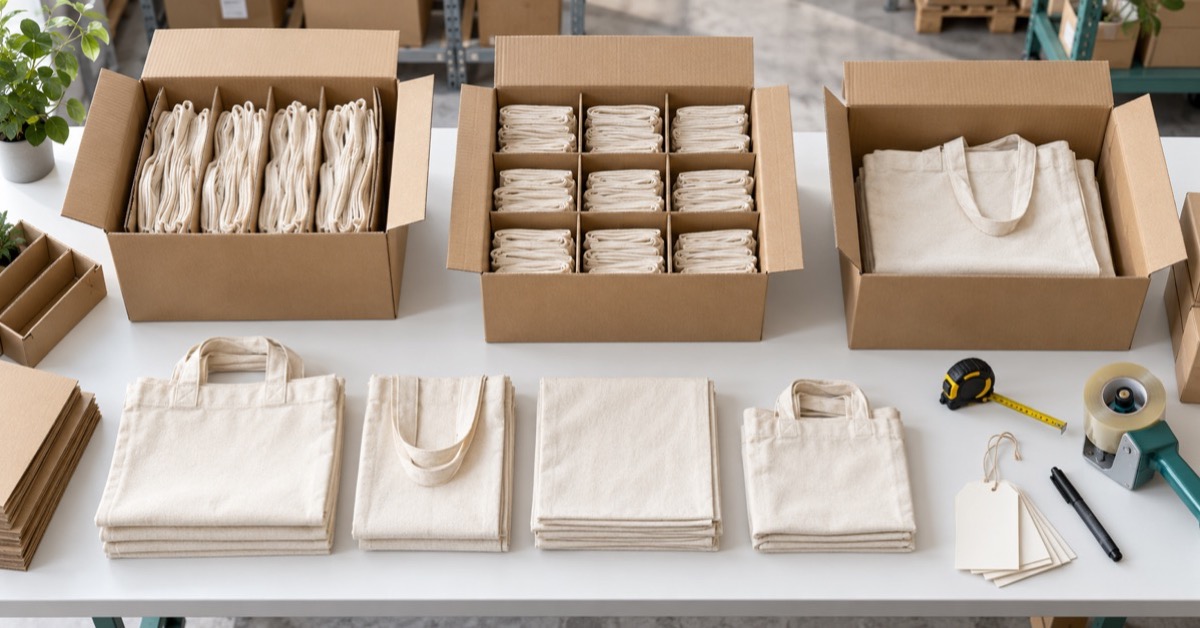
The packing line is often the quiet one. A factory that packs loosely fills a container early and the freight cost moves to the buyer without ever appearing on the bag quotation. PackMK confirms the carton count before the order is confirmed so the freight estimate and the production plan rest on the same number.
The four handover points in a direct order
A direct order fails at the points where one party stops working and another starts. Naming them before the order is confirmed is what keeps a saving from turning into a repair.
| Moment | What ends | What starts | Who owns it |
|---|---|---|---|
| Specification freeze | Design conversation | Fabric commitment | Buyer |
| Sample release | Sampling | Production booking | Shared |
| Packing | Production | Freight | Factory, then buyer |
| Arrival | Freight | Claim window | Buyer |
Three of the four moments belong to the buyer in a factory direct canvas bags order, which is the honest reason direct buying suits organised teams and frustrates unorganised ones.
The two costs that usually get missed
The first is the sample approval cycle. Through a trader, the buyer usually receives a single sample and a recommendation. Direct, the buyer receives samples from one factory with nobody to compare them against, and the second opinion has to be manufactured deliberately.
The second is the cost of a late change. A trader absorbs small changes inside a margin and passes large ones on with a conversation. Direct, every change is a negotiation with the party who already committed the fabric, which is why direct orders reward buyers who freeze specifications early.
Quality risk and who carries it
In a direct order the buyer carries quality risk in practice, even where the factory accepts it in principle. A claim is only worth what the released evidence supports, and evidence means the approved sample, the measurement record and the arrival inspection.
This is the strongest argument for keeping the inspection step alive even when the volume is small. A short arrival check with photographs and a measurement sheet turns a disagreement into a claim, and it costs a fraction of the value it protects.
Payment terms under a direct order
Traders frequently offer more relaxed terms because they hold a relationship and a margin. Factories often ask for a deposit before material is ordered and the balance before shipment, which shifts working capital toward the buyer.
The terms are negotiable but the logic is not. Someone has to fund the fabric. A buyer who wants goods released before the balance is paid should expect to explain why the factory should carry that risk, and to offer evidence rather than a promise.
Freight and the point of transfer
A direct order makes the transfer point explicit. Under the usual container terms the buyer's risk begins when the goods are loaded, and from that moment insurance, delay and damage belong to the buyer. A trader sometimes blurs that line, and a direct order does not.
PackMK names the term on every direct canvas quote and states what it does and does not include. Buyers who are new to direct buying often assume the factory's responsibility extends to arrival, and the quote is the moment to correct that assumption.
What a direct order does not make cheaper
Print setup does not become cheaper. A canvas bag printed with a wide design needs a screen or a transfer route regardless of who buys it, and the setup charge is the same number whichever door the order comes through.
Fabric does not become free of minimums either. A dyed-to-match canvas still carries a minimum per colour, and a direct buyer feels that minimum more sharply because there is no trader spreading it across several customers.
Red flags in a direct canvas quote
Five patterns that usually mean the saving is smaller than the headline.
- A direct price compared against a retail price rather than a trade price.
- No inspection line and no answer about who checks the goods.
- A carton count described as approximately right.
- A transfer point left unnamed, or written as to be advised.
- A lead time that starts somewhere other than where you assume.
Each one is answerable in a single email. A factory that answers all five clearly is usually a factory that will handle the order the same way.
How PackMK splits responsibility on a canvas order
PackMK issues a one-page responsibility sheet with every factory direct canvas bags order. It names the task, the owner and the evidence, and it covers inspection, consolidation, documentation and claims alongside the production lines.
The sheet is deliberately short. A direct order fails at the handover points rather than in the middle of a process, so the sheet focuses on the four moments where one party stops working and another starts.
Use a shared vocabulary for cost ownership
Firm price, price basis, transfer point and claim window mean specific things, and they are frequently used loosely in a quotation. Writing the four terms into the order removes most of the ambiguity that direct buying creates.
The same applies to the word direct. A factory that sells directly may still use a trading arm for export, and the buyer should know which entity issues the invoice before the deposit is paid.
Case example: a university order that went direct
A university alumni office ordered 8,000 canvas tote bags directly from a factory after comparing against a trader's price. The direct quote was eleven per cent lower, and the office planned to spend the difference on a larger print area.
Two problems appeared. Nobody had arranged arrival inspection, so a colour variation between rolls was noticed by students rather than by the buyer, and the claim window was already closing. PackMK rebuilt the order as a direct purchase with a named inspection step and a carton count agreed before production. The second run cost slightly more per piece and produced no claim at all.
Where the direct-buying references come from
Direct purchasing turns on the delivery term and on the quality system the factory can describe, so both references are worth reading before the order rather than after it. Buyers can consult ICC Incoterms rules overview and ISO quality management principles for additional context. These references do not certify a particular PackMK order.
Write a factory direct canvas bags brief
A practical factory direct canvas bags brief should name transfer point, inspection step, carton count, claim window. It should also identify Incoterms 2020, GSM, ISO 9001, OEKO-TEX wherever they affect approval, production, packing or delivery. PackMK uses those fields to organize samples, quotation assumptions and release evidence.
Keep the split in proportion
Direct buying is not automatically better or worse than buying through a trader, and the difference between the two narrows as the order gets smaller. For a first order in a new category, a trader's margin often buys something real. The split in this article is a way to price that something rather than a rule about which route to take.
Start a direct canvas bag order with PackMK
Send PackMK the quantity, the canvas weight, the print route and the delivery term you have in mind. We will return a direct quote with the four moved costs named, and tell you which of them we would handle and which would sit with your team.
Direct canvas bag questions
Are factory direct canvas bags always cheaper?
The piece price usually is. The total cost is cheaper only when inspection, consolidation and documentation are handled at a sensible cost. For a first order in a new category, the difference can vanish into the extra work.
Who inspects the goods in a direct order?
In practice the buyer, unless the order names someone else. Ask the factory what inspection they perform before packing and what they record. A factory that answers in detail is easier to work with directly than one that answers vaguely.
What does the transfer point mean?
It is the moment risk passes from the factory to you. Under the usual container terms that is when the goods are loaded. From that point, insurance, delay and damage sit with the buyer rather than with the seller.
How do I check canvas weight?
Ask for grams per square metre rather than a fabric name, and check the figure on the pre-production sample. A simple check is to weigh a known area of fabric and compare, which catches the common substitution of a lighter cloth.
Should I use a trader for the first order?
Often yes, if the category is new, the volume is small, or nobody on your team can inspect the goods. The trader's margin buys specification help, consolidation and a buffer on quality conversations that a first order frequently needs.
What payment terms are normal?
A deposit before material is ordered and the balance before shipment is common. Terms loosen with a trading history. A first direct order asking for release before payment should expect the factory to ask for evidence of past performance.
How much does print setup add?
It depends on the route and the print area rather than on who buys the bags. Screen setup is charged per colour and per screen, and a wide design may need two or three screens. The charge is the same whether a trader or a buyer places the order.
What is a claim window?
The period after arrival during which the buyer may raise a quality claim. It is usually short, and it starts when the goods arrive rather than when they are unpacked. Inspecting before the window closes matters more than the length of the window.
Can a factory issue export documents directly?
Usually yes. The factory issues the commercial invoice, packing list and the transport document, and the buyer checks them against the order. Naming the issuing entity in the order avoids confusion when a factory also has a trading arm.
What should a factory direct canvas bags brief include?
Quantity, canvas weight in GSM, dimensions, handle construction, print route and print area, packing count, transfer point and the date the goods must arrive. PackMK prices those fields directly rather than adding a contingency for each missing one.