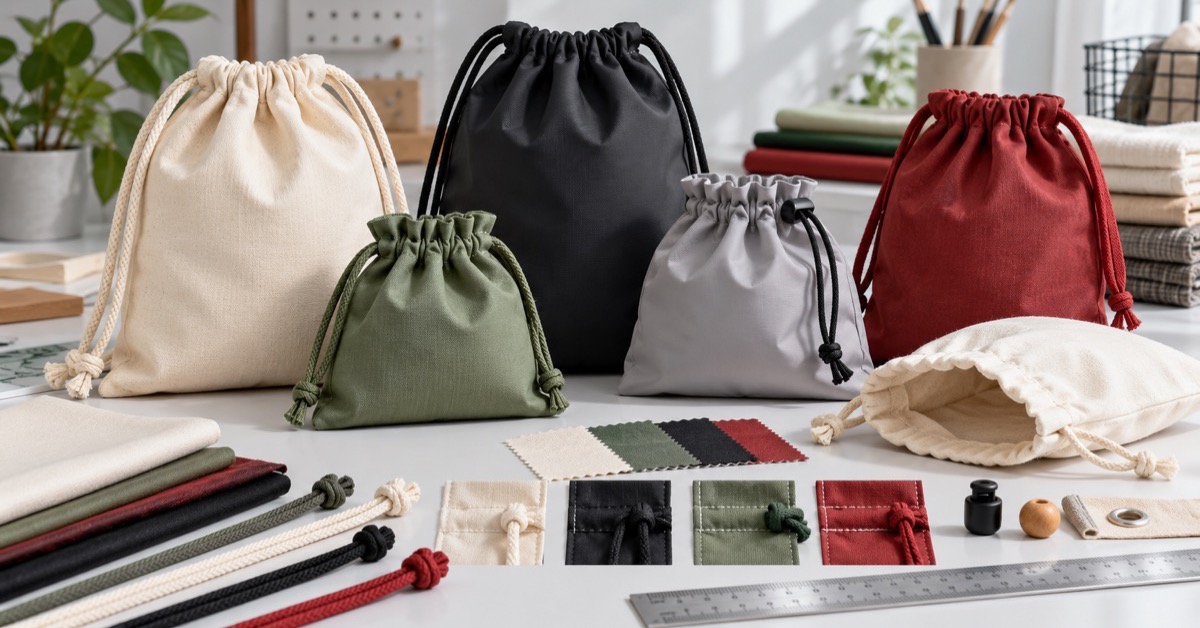


A bulk drawstring bags order is quoted as one number per piece, and that single number hides everything interesting. Volume does not simply make a bag cheaper. It changes which processes are worth setting up, which fabric weights make commercial sense, and how the finished pieces are packed before they leave the building.
PackMK quotes drawstring bags at 500 pieces and at 50,000 pieces, and the conversation is almost identical at both ends. The questions do not move. The answers do. What follows is the ladder we use when a buyer asks what a larger quantity would really change.
Short answer: Bulk drawstring bags change decisively at four points: 500, 5,000, 20,000 and 50,000 pieces. Below 5,000 the print method and cord assembly dominate the price. Above 20,000, fabric width utilisation and packing density take over. Ask for two quantities rather than one, and ask which processes are set up rather than merely run.
Why volume changes the bag, not only the price
At small volumes a drawstring bag is largely assembled by hand. Cord is cut and threaded in short batches, print comes off a small screen or a digital press, and fabric is cut from whatever width already sits on the shelf. Every one of those choices stays reversible.
At large volumes the same choices harden into tooling and setup. A rotary screen is engraved, a cutting die is made, a cord length is tied to a machine setting. Those commitments pull the piece price down, and they also make a late change expensive. That trade is the whole story of buying bulk drawstring bags.
The volume ladder at a glance
Four steps cover most drawstring programmes. The boundaries move with the factory and with the fabric, so treat them as decision gates rather than fixed rules.
| Volume | What it is called | Print route | Cord work | Packing |
|---|---|---|---|---|
| 500 to 1,000 | Sample scale | Digital or small screen | Hand threading | Loose cartons |
| 1,000 to 5,000 | Small bulk | Small screen frame | Semi-automatic | Standard cartons |
| 5,000 to 20,000 | Production bulk | Rotary screen | Automatic threading | Flat-packed cartons |
| 20,000 to 50,000 | Programme bulk | Rotary plus inline cut | Automatic threading | Palletised, mixed sizes |
Ask a supplier where their own gates sit before you fix a quantity. The answer tells you more about the factory than any capability page.
Step one: 500 to 1,000 pieces
This is the band where the bag is chosen rather than engineered. Buyers use it to test a design in a real store, hand a sample to a distributor, or check a colour against a shelf. Almost nothing is tooled, and almost anything can still change.
Two costs dominate. Setup is spread over very few pieces, so the piece price looks alarming next to a larger quote. Cord threading is slow and manual, which is why the cord specification is often simplified at this step without anyone saying so.
Step two: 1,000 to 5,000 pieces
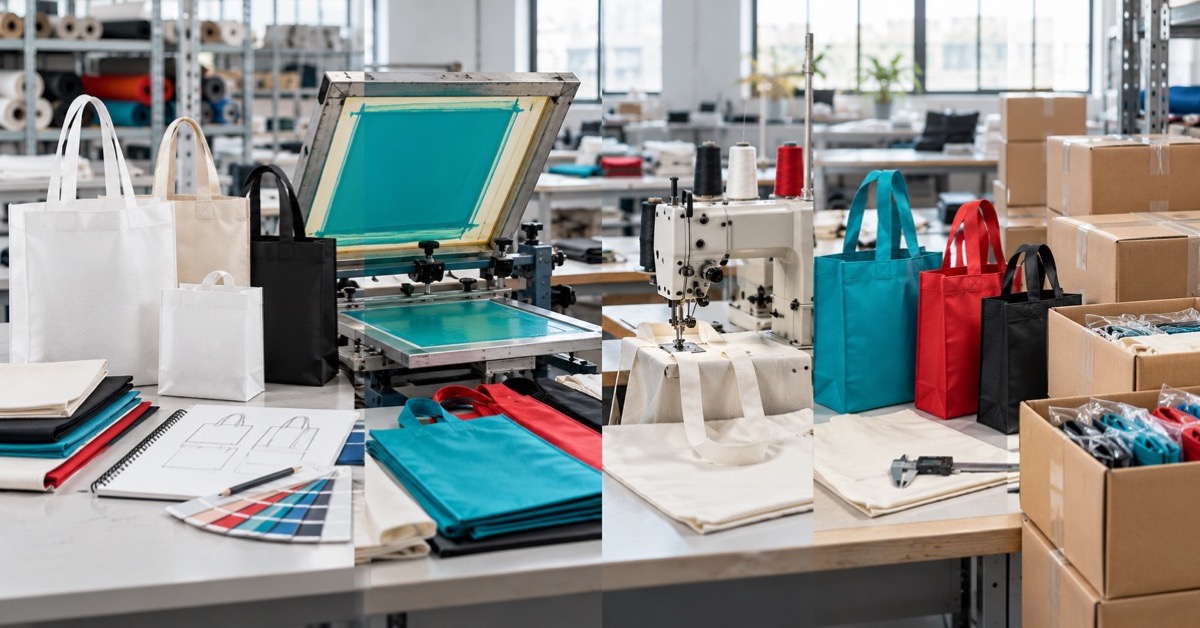
A small screen frame becomes economical here, and the print quality stops looking improvised. Edge registration tightens, ink coverage evens out, and a second colour starts to be affordable rather than indulgent.
Cord is still the quiet variable. Ask whether threading is semi-automatic at this quantity and whether the cord is cut to a fixed length, because a hand-cut cord is the most common reason two bags in the same carton feel different.
Step three: 5,000 to 20,000 pieces
A rotary screen changes the economics of print. Setup cost is higher, piece cost is lower, and the break-even against the previous step usually lands inside this band rather than at its start.
Fabric width now matters commercially. A bag pattern that wastes fifteen centimetres across a roll costs real money at 20,000 pieces and almost nothing at 500, which is why a factory may suggest a small dimensional change at this stage.
Step four: 20,000 to 50,000 pieces
At this volume the run is planned as a programme. Fabric is ordered to width, cutting is nested, and packing is designed so that cartons fill evenly instead of leaving air at the top. Mixed sizes inside one run become practical here and rarely before.
The risk profile also turns. Setup is now a small share of cost and the fabric order is a large share. A late colour change, a late size change or a late cord change costs far more than it did two steps earlier, because material has already been committed.
Where the cord decision sits on the ladder
Cord looks like a detail until quantity makes it a tooling decision. The table below shows where each option starts to work and where it stops being sensible.
| Cord option | Works from | Stops working at | What drives the change |
|---|---|---|---|
| Cut and knotted cord | 500 pieces | 5,000 pieces | Manual labour dominates the price |
| Moulded cord end | 5,000 pieces | No upper limit | Needs a tool, cheap once tooled |
| Reflective cord | 5,000 pieces | No upper limit | Material minimum per colour |
| Two-colour cord | 20,000 pieces | No upper limit | Spool change cost per run |
A factory that quotes one cord type at every volume is not necessarily wrong. It is usually telling you which cord their machines already handle.
Fabric weight and the point where it stops mattering
Drawstring bags are usually made between 190 GSM and 420 GSM. At the light end the bag folds small and costs little. At the heavy end it holds shape on a shelf and takes a heavier print load without distortion.
The useful question is not which weight is best but which weight stops changing anything. Above roughly 300 GSM the difference between two weights is often invisible to a shopper while remaining visible on the invoice, which is why a factory may propose spending the same money on stitching or a moulded cord end instead.
Print method changes at volume
Digital print favours small runs and unlimited colour changes. Screen print favours volume and simple colour counts. The crossover sits somewhere between 1,000 and 3,000 pieces, and it moves with artwork complexity rather than with quantity alone.
A gradient, a photograph or a fine line will push the crossover upward, because screens struggle with all three. If the artwork depends on any of them, compare the two routes at both quantities instead of assuming the larger run will be cheaper.
Packing and carton count at each step
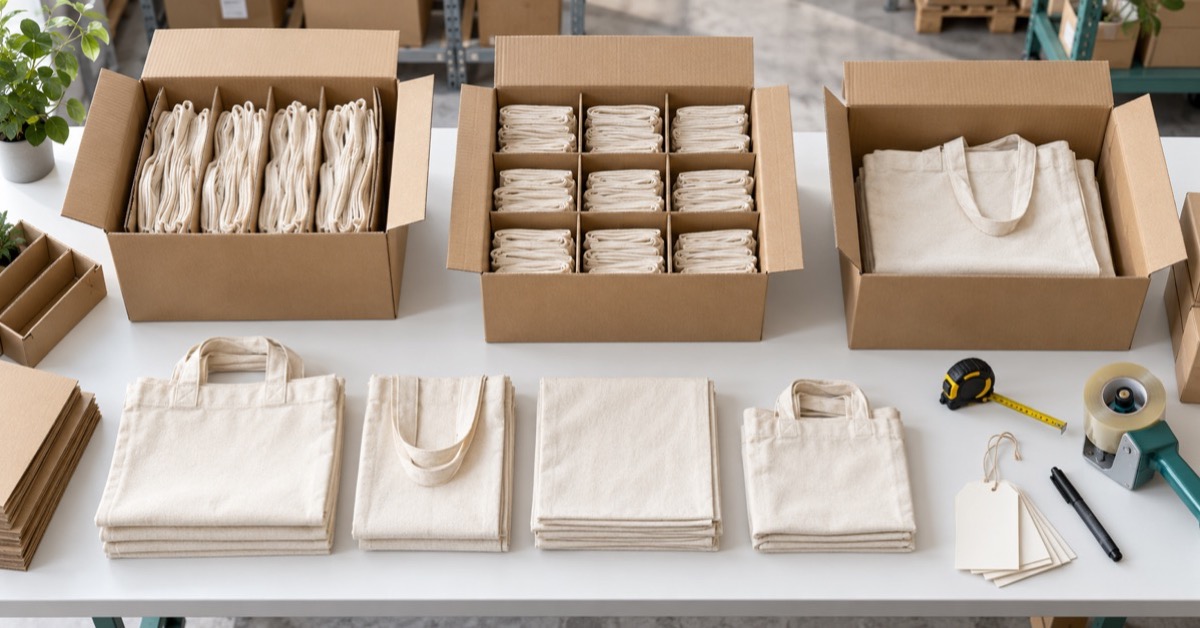
Packing is the least discussed line on a drawstring quote and the easiest place to lose money. A bag that packs flat uses a fraction of the carton volume of a bag packed loosely with its cord coiled.
At small volumes packing is whatever fits. At programme volumes it is designed, and the carton count per container becomes a planning number rather than a surprise. PackMK records the count at the sample stage so the freight estimate is built on the same assumption as the order.
What does not change with volume
The construction does not change. A drawstring bag has a body, a channel, a cord, and usually a bottom seam. Volume changes how each is made, not what they are.
The approval sequence does not change either. A first-off sample, a colour reference and a retained approval piece are worth having at 500 pieces and at 50,000. What changes is the consequence of skipping them.
How PackMK quotes a drawstring ladder
PackMK quotes two volumes rather than one and states which processes are set up at each. The quote names the fabric weight, the cord type, the print route and the carton count, because those four turn a price into a specification.
Where the two quotes cross, we say so. A buyer who knows that the print break-even sits at 3,200 pieces can decide whether to raise an order or accept a higher piece price, and either answer is fine as long as it is deliberate.
Red flags in a bulk drawstring quote
Five patterns are worth pausing on before a bulk drawstring bags order is confirmed.
- A single price for any quantity, with no setup line at all.
- A fabric weight quoted only as a thickness rather than in GSM.
- A cord type described without saying whether ends are knotted or moulded.
- A carton count left blank, or given as an approximate figure.
- A statement that the artwork can change freely after the run starts.
None of these is fraud. Each one means the quote is a starting point and the specification still has to be settled in writing.
Use a shared vocabulary for volume
Small bulk, production bulk and programme bulk are not formal terms, and two factories will place the boundaries differently. Write the quantity and the process on the same line instead of relying on a label.
The same habit helps on lead time. A factory that says four weeks may mean four weeks from confirmation, from deposit, or from artwork release. Naming the start point removes a fortnight of confusion.
Case example: a gym chain that split its order
A gym chain wanted 12,000 drawstring bags for a membership drive but needed 1,500 of them in three weeks for a single city launch. The factory priced the whole 12,000 as one rotary run and the 1,500 separately as a small screen run.
PackMK ran the small quantity first, using the same fabric weight and cord so the two batches would match in hand, and then released the balance once the launch artwork was confirmed. The chain paid a higher piece price on the small batch and avoided a change fee on the large one. The two numbers were shown side by side before the decision was made.
Where the drawstring references come from
Drawstring bag sourcing sits where textile safety, transport terms and shipment documentation meet, so the standard references are worth keeping close. Buyers can consult Buyers can consult ICC Incoterms rules overview and OEKO-TEX textile safety standards for additional context. These references do not certify a particular PackMK order.
Write a bulk drawstring bags brief
A practical bulk drawstring bags brief should name cord type, fabric weight, carton count, lead time. It should also identify GSM, OEKO-TEX, Incoterms 2020, polyester wherever they affect approval, production, packing or delivery. PackMK uses those fields to organize samples, quotation assumptions and release evidence.
Keep the ladder in proportion
The four steps in this article are commercial gates rather than engineering rules, and a factory with different machinery will place them elsewhere. Two volumes quoted side by side will always tell you more than a table, because the table does not know your artwork, your fabric or your delivery date.
Plan a bulk drawstring order with PackMK
Send PackMK the quantity, the artwork and the date you need the bags in hand. We will return two volume points, name the process set up at each, and show where the break-even sits so the quantity decision rests on a number rather than a feeling.
Bulk drawstring bag questions
What is the smallest quantity for bulk drawstring bags?
Most factories will run 500 pieces, and many will run 300. Below 1,000 pieces the setup cost is spread thinly, so the piece price is high and the print route is usually a small screen or a digital press rather than a rotary screen.
Do bulk drawstring bags get cheaper at every step?
No. The price usually falls sharply at the first gate, flattens through the middle volumes, and then falls again only when fabric is ordered to width. Between two adjacent steps inside the same band the difference is often small enough to ignore.
Which fabric weight is standard?
Between 190 and 420 GSM. Everyday promotional bags sit near 210 to 250 GSM, while bags meant to hold shape on a shelf tend toward 300 GSM and above. Above roughly 300 GSM the visible difference between two weights is often small.
Can I mix sizes in one bulk drawstring bags order?
Usually from about 20,000 pieces in total, and rarely below 5,000. Mixed sizes require separate cutting nests and separate cord settings, so a factory may accept the order but price it as two runs rather than one.
How long does a bulk drawstring order take?
Allow two to four weeks for production and one to two weeks for sampling and approval. Always ask whether the quoted lead time starts at order confirmation, at deposit, or at artwork release, because the three answers can differ by a fortnight.
Is hand threading a quality problem?
Not by itself. Hand threading is normal at low volume and can be excellent. The risk is inconsistency in cord length, so ask whether cords are cut to a fixed length and whether the ends are knotted, moulded or heat-sealed.
What cord type should I choose?
Cut and knotted cord works at any volume and is the cheapest. Moulded ends and reflective cord need a tool or a material minimum, so they usually start at 5,000 pieces. Two-colour cord rarely makes sense below 20,000 pieces.
How many bags fit in one carton?
It depends almost entirely on packing method. Flat-packed bags can double the count per carton compared with loosely packed bags of the same size. Ask for the count at the sample stage so the freight estimate and the order share one assumption.
Can the print change between volume steps?
The artwork can change freely between two separate orders. Inside one confirmed run, a print change after the screen is engraved carries a setup cost. That cost is why the artwork should be frozen before the run starts rather than during it.
What should a first bulk quote include?
Fabric weight in GSM, cord type, print route, setup cost stated separately, carton count, and lead time with its start point named. A quote missing any of those five is a useful starting point but not yet a specification.