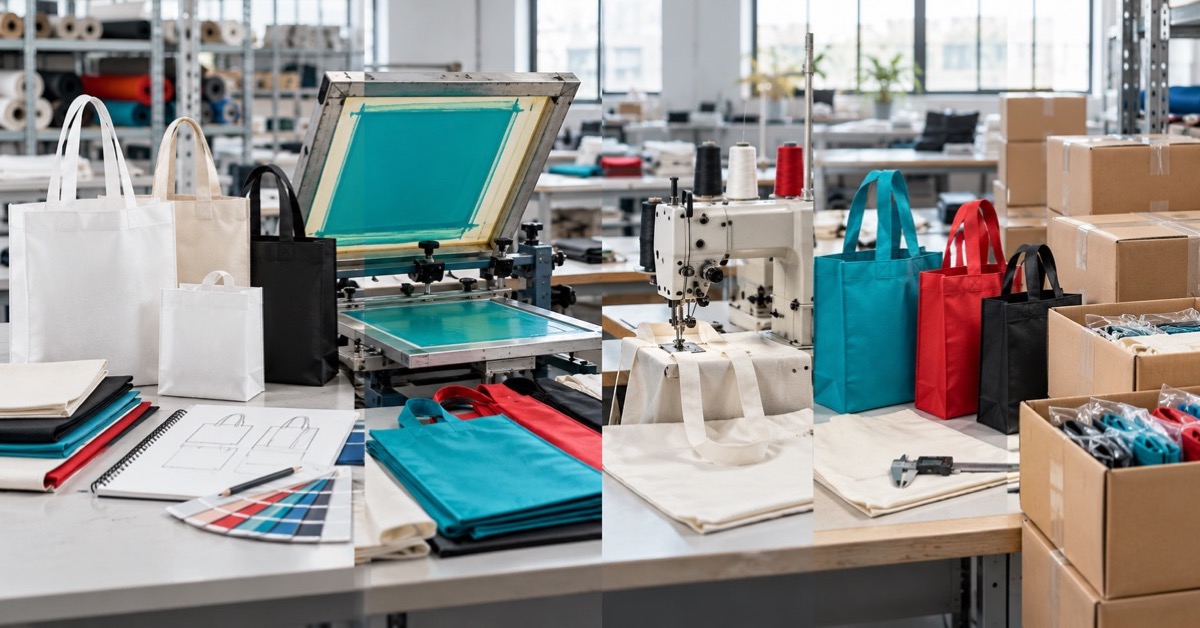


The print method should follow the bag, artwork and use route. Screen printing can be efficient and direct for suitable graphics and surfaces, while heat transfer can support other image and setup needs. Neither method wins without conditions. A useful screen printing vs heat transfer bags decision comes from four tests, not a list of generic advantages.
PackMK compares artwork fit, material interaction, production economics and use evidence on physical samples. The result is a documented route for the current order, with clear limits and a trigger for reopening the choice when artwork, fabric, quantity or handling changes.
Direct answer: Compare both methods using the exact artwork, production-equivalent fabric, realistic quantity and intended handling route, then score appearance, hand feel, adhesion, durability, process consistency, setup and reorder implications.
Test one: reduce the artwork to process demands
| Artwork demand | Screen question | Transfer question |
|---|---|---|
| Solid colors | How many screens? | Is a film needed? |
| Fine detail | Can mesh hold it? | Can edges stay clean? |
| Gradient | How is it separated? | How is tone reproduced? |
| Large area | What is the ink hand? | What is the film hand? |
| Variable version | What resets? | What file changes? |
PackMK asks for process-specific artwork, not one file assumed to behave identically.
Count colors, but also count boundaries
Simple color count does not capture trapping, registration, knockouts, gradients, fine lines or small negative spaces. Review the production-sized artwork and viewing distance.
PackMK uses a marked proof to identify which details are essential and which can be adapted. The approved change must remain visible to the buyer.
Test two: make the fabric an active variable
Record fiber, weave or non-woven texture, coating, color, stretch, thickness and surface variation. A smooth cotton panel and a textured reusable bag can respond differently.
PackMK samples the real bag material in the intended color. White laboratory fabric is not a substitute for a dark, coated or uneven production surface.
Prepare paired samples that answer one question
Hold these items constant where possible:
- same artwork and print size;
- same bag material and color;
- same placement and seam distance;
- documented process settings;
- same conditioning and handling;
- same viewing and acceptance rules.
PackMK changes one meaningful variable at a time so the comparison produces evidence rather than two unrelated samples.
Judge appearance at use distance
Review color, opacity, edge definition, registration, gradients and substrate show-through on flat and loaded bags. Observe indoor and relevant retail lighting.
PackMK records what differs from the artwork and why. Screen and transfer samples should be approved as physical outputs, not as names of processes.
Print hand is part of the product
Touch, fold and carry the printed area. Large ink or film coverage can affect flexibility, drape, noise and the way a bag packs or creases.
PackMK includes hand feel in the decision when it matters to the brand or use. This prevents appearance approval from hiding an unwanted tactile result.
Test three: build a use-evidence matrix
| Use stress | Observation | Decision boundary |
|---|---|---|
| Folding | Crack or permanent line | Pack-out method |
| Rubbing | Wear or transfer | Contact route |
| Stretch | Distortion or lift | Load zone |
| Moisture | Appearance change | Test condition |
| Cleaning | Loss or edge failure | Actual care route |
State cycles, conditions, sample count and acceptance observations. One successful sample is not a universal durability claim.
Do not invent a wash claim
If washing or cleaning matters, define the actual method, temperature, chemistry, drying and number of cycles with responsible product owners. Some promotional bags are not intended for repeated laundering.
PackMK reports observed results within the trial boundary. Care instructions and claims require product- and market-specific review.
Test four: normalize the cost structure
Separate artwork preparation, screens or transfer setup, sample work, printing, rejects, changeovers, inspection and packing. Compare at the actual variant and quantity mix.
PackMK avoids declaring one method cheaper in all cases. Setup, color count, print area, material and run structure can change the result.
Quantity affects risk as well as price
Small pilots, multi-SKU programs and large repeat orders create different setup, queue and consistency questions. Ask how each method handles version changes and replenishment.
PackMK uses the order profile rather than a generic volume threshold. Supplier capability and equipment matter too.
Approve a production-equivalent first article
Confirm bag material, construction, print size, placement, color, hand, curing or bonding evidence and pack-out. Include the hardest color or artwork variant.
PackMK retains the approved article and records settings or references the supplier can control. A development sample on different fabric cannot release production.
Inspect process-specific failure modes
For screen printing, review registration, coverage, pinholes, smearing, curing and consistency. For heat transfer, review edge lift, film marks, placement, heat effects and bonding.
PackMK samples across operators and production time. Defect language follows the selected process instead of using one vague print standard.
Reopen the method when an input changes
New fabric, coating, color, artwork, print area, care route, quantity or equipment can invalidate the original comparison. Record which triggers require a new paired trial.
PackMK keeps the screen printing vs heat transfer bags decision attached to evidence, not institutional habit.
Decision-lab example: a dark tote with a photographic event graphic
An event buyer wants a dark cotton tote with a large image, small sponsor marks and a short replenishment run. The artwork is visually complex, but the printed area must remain flexible when folded into kits.
PackMK would create production-sized paired samples and review opacity, detail, film or ink hand, folding, abrasion, setup and repeat consistency. The buyer could then decide whether to adapt the artwork or accept a different tactile result.
The decision record would state the selected fabric, method, artwork version and trial limits. A later switch to non-woven material would automatically reopen the comparison.
Use quality and marketing guidance to frame evidence
Quality principles and advertising guidance help buyers describe test conditions and avoid unsupported performance language. Use ISO quality management principles and FTC advertising and marketing guidance as context for supplier questions. PackMK still releases the actual order against the buyer brief, approved samples, production evidence and destination-specific requirements.
Compare screen printing vs heat transfer bags through four tests
A decision-ready screen printing vs heat transfer bags brief should define artwork complexity, fabric surface, color count, print hand, edge definition, abrasion trial, wash route, setup cost, production consistency, reorder control. It should also identify PackMK, screen printing vs heat transfer bags, screen ink, transfer film, cotton, non-woven, OEM, MOQ. PackMK turns those fields into a quotation scope, approval route and evidence list that purchasing, quality, operations and receiving can interpret consistently.
Require the supplier to state assumptions, exclusions, approved alternatives, tooling, minimums, inspection scope, packing and lead-time conditions. For screen printing vs heat transfer bags, a broad promise should become a sample question, measurable tolerance, priced option or release gate before the purchase order is confirmed.
Print behavior varies by equipment, ink or film system, fabric, coating, artwork, operator and care route. This comparison does not establish universal durability, safety or environmental claims.
A useful screen printing vs heat transfer bags choice is specific to the artwork, substrate, order and use route. PackMK makes the tradeoff visible on paired physical evidence.
Before approval, PackMK recommends a one-page decision record naming the selected route, rejected alternatives, evidence reviewed, open limitations, quantity basis, owner and review date. After delivery, add receiving observations, defects, user feedback, supplier response and retained references. This creates a practical learning loop and lets the next order reopen only the decisions affected by a new SKU, material, market, application or delivery route.
Run a paired print-method trial with PackMK
PackMK can support screen printing vs heat transfer bags from buyer brief and samples through production checks and export packing. Send the product or application, artwork, quantities, variants, destination and required date to request a structured quotation for screen printing vs heat transfer bags.
- Explore PackMK custom printed bag formats
- Review PackMK OEM and ODM support
- Request a paired bag printing quotation
Screen print and heat transfer comparison questions
Which method is always better?
Neither. The answer depends on artwork, fabric, quantity, hand feel, use route, supplier capability and evidence.
Why test both methods on the same fabric?
Substrate color, texture, coating and stretch can change appearance and bonding.
Does fewer colors always mean screen printing?
No. Print area, detail, variants, setup, quantity and tactile requirements also matter.
What is print hand?
It is the tactile and flexibility effect the printed area adds to the bag.
How should durability be compared?
Use the same stated folding, rubbing, stretch, moisture or care conditions and record observations.
Can a supplier promise washability?
Claims should follow defined product-specific tests, care methods and destination review.
How should quotes be normalized?
Compare artwork work, setup, screens or films, printing, rejects, inspection, packing and variant changes.
What belongs in first-article approval?
Include production fabric, construction, print, placement, hand, process evidence and pack-out.
When should the decision be reopened?
Reopen it after relevant changes to fabric, artwork, size, care route, quantity or equipment.
How does PackMK support print selection?
PackMK coordinates paired samples, evidence, quotations, first articles, inspection and reorder controls.