

Cotton feels natural, but the finished bag still has to carry a real product without stretching, tearing or losing its shape. OEM cotton bags should be approved by their complete load path, construction and production evidence, not by fabric weight or a logo mockup alone. PackMK starts with the use case and turns it into a repeatable brief.
The proof sequence below helps a buyer separate a material question from a sewing question, a print question and a packing question. That makes the first order easier to compare and the next order easier to repeat.
PackMK records the active brief, approved reference, decision owner and change history before any bulk release.
Proof 1: define the contents and carry route
List product dimensions, filled weight, sharp corners, moisture, carry distance, storage conditions and whether the bag must be reused. PackMK treats the point as a product-use decision. The approved answer must work with the real contents, handling route, artwork, production tolerance and repeat-order record, not only with an attractive sample.
Pack the largest and most common combinations and observe opening, balance, hand clearance and filled shape before selecting fabric. This prevents a fabric specification being approved for an unknown job. Keep the result beside the live specification so quoting, sampling, production, inspection and repeat orders use the same evidence.
Proof 2: name the cotton construction
State cotton type, fabric family, weave, finish, color and any recycled or certified-content requirement in a controlled specification. PackMK treats the point as a product-use decision. The approved answer must work with the real contents, handling route, artwork, production tolerance and repeat-order record, not only with an attractive sample.
Compare production-equivalent swatches for hand feel, opacity, stretch, fray behavior and print surface rather than trusting a generic material label. This prevents different fabrics sharing one friendly word. Keep the result beside the live specification so quoting, sampling, production, inspection and repeat orders use the same evidence.
Proof 3: measure weight and density together
Record target fabric weight, practical tolerance, measurement method and weave density at several positions. PackMK treats the point as a product-use decision. The approved answer must work with the real contents, handling route, artwork, production tolerance and repeat-order record, not only with an attractive sample.
Interpret weight with thickness, uniformity and finished function because two fabrics with similar numbers can carry differently. This prevents a single measurement hiding weak areas. Keep the result beside the live specification so quoting, sampling, production, inspection and repeat orders use the same evidence.
Proof 4: set finished dimensions
Define width, height, gusset, opening and handle drop on the sewn bag with tolerances and measuring conditions. PackMK treats the point as a product-use decision. The approved answer must work with the real contents, handling route, artwork, production tolerance and repeat-order record, not only with an attractive sample.
Measure relaxed samples and then load them to confirm the product clears seams, corners and closure areas. This prevents flat dimensions passing while the product does not fit. Keep the result beside the live specification so quoting, sampling, production, inspection and repeat orders use the same evidence.
Proof 5: follow the load path
Map force from contents to base, side seams, top edge, handles and reinforcement so the critical joints are visible. PackMK treats the point as a product-use decision. The approved answer must work with the real contents, handling route, artwork, production tolerance and repeat-order record, not only with an attractive sample.
Use a filled carry trial and inspect fabric distortion, stitch opening, handle balance and bottom shape after repeated lifts. This prevents the fabric passing while the attachment fails. Keep the result beside the live specification so quoting, sampling, production, inspection and repeat orders use the same evidence.
Proof 6: control seam and stitch construction
Specify seam allowance, stitch density, thread, backtack, edge finish and any boxed or bar-tacked reinforcement. PackMK treats the point as a product-use decision. The approved answer must work with the real contents, handling route, artwork, production tolerance and repeat-order record, not only with an attractive sample.
Inspect beginning, middle and end output and cut open selected samples when continuity is difficult to see externally. This prevents a neat seam hiding inconsistent sewing. Keep the result beside the live specification so quoting, sampling, production, inspection and repeat orders use the same evidence.
Proof 7: approve handles as a system
Choose webbing, self-fabric, rope or another handle with width, drop, attachment, reinforcement and comfort requirements. PackMK treats the point as a product-use decision. The approved answer must work with the real contents, handling route, artwork, production tolerance and repeat-order record, not only with an attractive sample.
Test the intended filled load at the expected carry distance, then review handle position and pressure on the top edge. This prevents strong material creating an uncomfortable carry. Keep the result beside the live specification so quoting, sampling, production, inspection and repeat orders use the same evidence.
Proof 8: develop print on the actual fabric
Confirm screen, transfer or other print method, ink coverage, artwork size, registration and curing on the selected surface. PackMK treats the point as a product-use decision. The approved answer must work with the real contents, handling route, artwork, production tolerance and repeat-order record, not only with an attractive sample.
Rub, fold and handle production-equivalent printed bags after curing and retain a signed visual reference. This prevents a flat proof failing when the bag is sewn or used. Keep the result beside the live specification so quoting, sampling, production, inspection and repeat orders use the same evidence.
Proof 9: account for shrinkage and conditioning
Identify washing, steam, humidity, heat or storage exposure that is credible for the product route and customer expectation. PackMK treats the point as a product-use decision. The approved answer must work with the real contents, handling route, artwork, production tolerance and repeat-order record, not only with an attractive sample.
Condition representative samples under stated limits and recheck dimensions, seams, print and loaded behavior. This prevents an unsupported care or size assumption. Keep the result beside the live specification so quoting, sampling, production, inspection and repeat orders use the same evidence.
Proof 10: control color and substitutions
Set a physical color range and list fabric, thread, handle, ink and carton elements that cannot change without approval. PackMK treats the point as a product-use decision. The approved answer must work with the real contents, handling route, artwork, production tolerance and repeat-order record, not only with an attractive sample.
Require an impact note and comparable sample before an availability-driven alternative enters production. This prevents a similar-looking substitute changing the brand or feel. Keep the result beside the live specification so quoting, sampling, production, inspection and repeat orders use the same evidence.
Proof 11: stage the sample ladder
Separate swatch, sewn blank, print trial, pre-production sample and first production article so each closes a distinct question. PackMK treats the point as a product-use decision. The approved answer must work with the real contents, handling route, artwork, production tolerance and repeat-order record, not only with an attractive sample.
Give each reference a code, date, approver and superseded status so the active standard is obvious. This prevents one attractive sample being stretched beyond its evidence. Keep the result beside the live specification so quoting, sampling, production, inspection and repeat orders use the same evidence.
Proof 12: inspect production across time
Check fabric, dimensions, seams, handles, print, loaded function, quantity, variants and packing across multiple cartons. PackMK treats the point as a product-use decision. The approved answer must work with the real contents, handling route, artwork, production tolerance and repeat-order record, not only with an attractive sample.
Use named defect categories and a stop or escalation rule for critical functional results. This prevents supplier-selected top samples hiding run variation. Keep the result beside the live specification so quoting, sampling, production, inspection and repeat orders use the same evidence.
Proof 13: make carton packing part of the brief
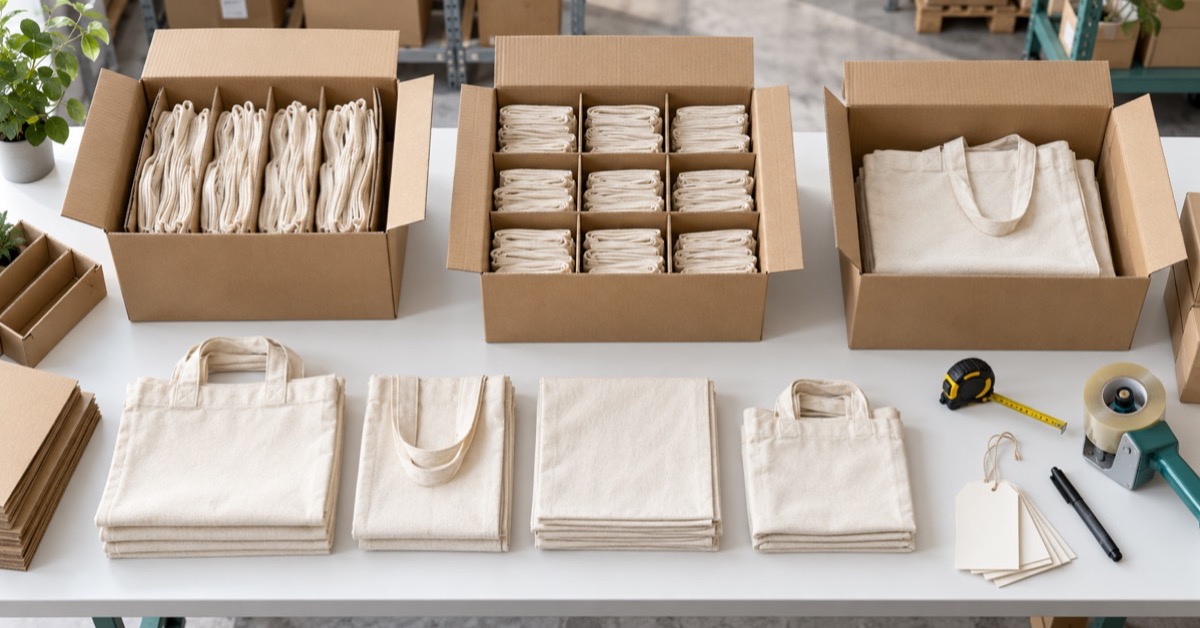
Define fold method, bundle count, moisture protection, carton strength, marks, SKU separation and pallet arrangement. PackMK treats the point as a product-use decision. The approved answer must work with the real contents, handling route, artwork, production tolerance and repeat-order record, not only with an attractive sample.
Open a production carton and repeat the receiving and counting steps that a warehouse will perform. This prevents a good bag arriving mixed, crushed or hard to count. Keep the result beside the live specification so quoting, sampling, production, inspection and repeat orders use the same evidence.
Proof 14: preserve the reorder file
Store the fabric and color references, measurements, artwork, sewn sample, tests, deviations and packing specification after shipment. PackMK treats the point as a product-use decision. The approved answer must work with the real contents, handling route, artwork, production tolerance and repeat-order record, not only with an attractive sample.
Compare receiving feedback with the retained reference and reopen only the field that evidence shows needs change. This prevents a repeat order rebuilt from memory. Keep the result beside the live specification so quoting, sampling, production, inspection and repeat orders use the same evidence.
Turn a cotton bag brief into proof points
| Field | Weak wording | Useful proof |
|---|---|---|
| Fabric | Premium cotton | Named construction |
| Strength | Heavy fabric | Loaded carry cycle |
| Handles | Strong straps | Attachment and comfort |
| Durable logo | Cured rub check | |
| Packing | Standard carton | Count and SKU trial |
Use the sample ladder before bulk release
| Reference | Closes | Does not prove |
|---|---|---|
| Swatch | Material and color | Sewn performance |
| Blank | Fit and construction | Print behavior |
| Print trial | Artwork and ink | Run consistency |
| Pre-production | Complete route | Every carton |
| First article | Production transfer | Final receiving |
Use textile and quality guidance with care
External resources can frame material and quality questions, but the approved bag and order-specific tests control acceptance. Review Textile Exchange standards overview and ISO quality management principles as useful context. Acceptance still depends on the actual product, material, route and documented conditions.
Specify OEM cotton bags with useful evidence
For OEM cotton bags, record fabric weight, weave density, seam allowance, stitch construction, handle attachment, load path, printing method, shrinkage test, quality inspection, carton packing. The controlled file also identifies PackMK, OEM, ISO, Textile Exchange, cotton, canvas, MOQ, carton. This vocabulary turns the search phrase into fields that suppliers can quote and inspectors can verify.
Develop OEM cotton bags with PackMK
PackMK can develop OEM cotton bags from brief and samples through production, quality checks and export packing. Send PackMK the intended use, product, artwork, quantity, variants, destination and required date to request a structured quotation for OEM cotton bags.
- Explore PackMK cotton bag formats
- Review PackMK OEM and ODM support
- Request an OEM cotton bag quotation
OEM cotton bag proof questions
What is needed to quote OEM cotton bags?
For OEM cotton bags, provide size, product load, fabric construction, handles, seams, artwork, quantity by version, packing, destination and date.
Does heavier cotton always mean stronger bags?
No. Weave, stitching, reinforcement, handle attachment, geometry and load distribution also determine finished performance.
How should fabric weight be checked?
Agree a measurement method and tolerance, sample several positions and interpret weight with density, thickness and a finished-bag test.
What should a handle test include?
Use the intended filled load and carry distance, then inspect comfort, attachment, reinforcement, top-edge distortion and balance.
How is cotton-bag print approved?
Approve final-size artwork on the selected fabric after curing, folding, rubbing and realistic handling.
Why test shrinkage?
Moisture, heat or care expectations can change dimensions and seams, so a stated conditioning trial protects the specification.
Can a supplier substitute cotton fabric?
Only through a written change process with a comparison sample, impact review and buyer approval before production.
What belongs in final inspection?
Check fabric, dimensions, seams, handles, print, loaded function, variants, quantities, bundles, cartons and marks.
What protects a repeat order?
Keep the specification, physical references, artwork, signed bag, test results, deviations and packing standard.
How does PackMK support OEM cotton bags?
PackMK can coordinate the brief, samples, construction evidence, production checks, export packing and repeat-order records.