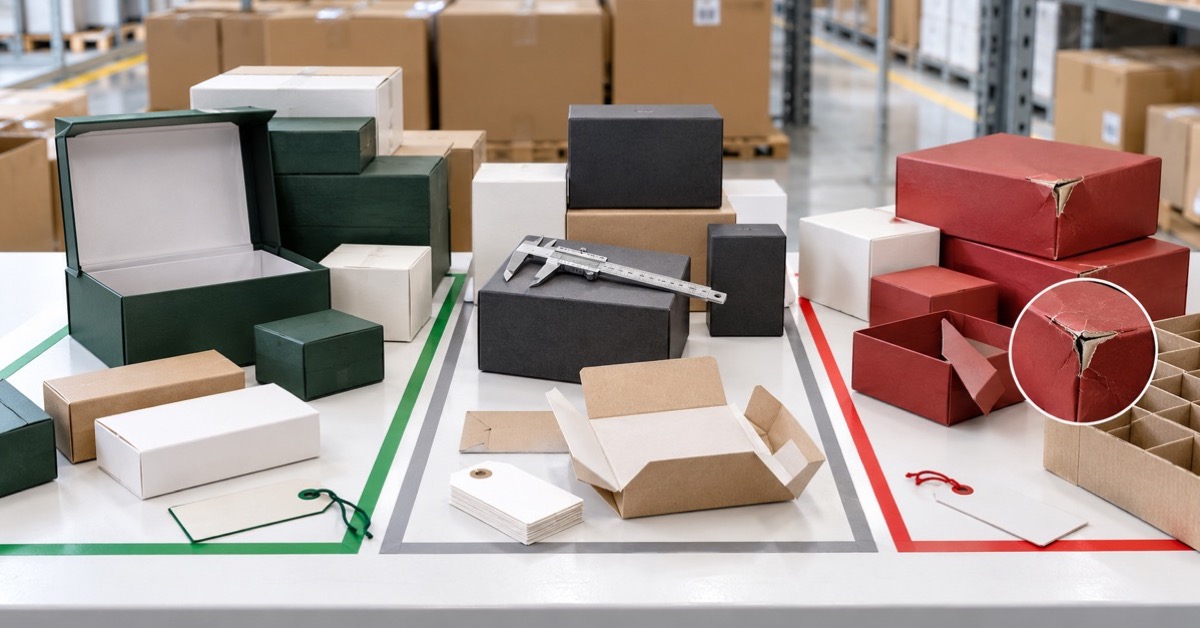


Jewelry packaging has to protect a small valuable object while making that object feel intentionally presented. If protection dominates, the customer may struggle to remove the piece. If display dominates, movement, tangling or surface contact can appear during handling. Jewelry packaging boxes must hold both jobs together.
PackMK evaluates every design through a custody-and-reveal map: where the piece sits, who handles it, what can move, what the recipient sees first and what evidence releases production. The approach works across rings, necklaces, earrings and mixed gift sets without pretending that one insert fits all products.
Direct answer: Design the box by tracing the piece through product loading, closure, retail handling, transport, opening, first reveal and removal, then approve the insert and pack-out with real product range extremes.
Give every interface a custody question
| Interface | Risk | Evidence |
|---|---|---|
| Piece to insert | Movement or marks | Loaded fit trial |
| Insert to box | Lift or rotation | Assembly sample |
| Box to closure | Opening or pressure | Cycle observation |
| Box to carton | Rub or crush | Pack-out trial |
| Recipient to piece | Difficult removal | Unboxing trial |
The box is a chain of interfaces, not one decorative object.
Begin with the piece, not the outer dimensions
Record product envelope, weight, chain length, protrusions, vulnerable finishes, allowable contact and presentation orientation. Include minimum and maximum production dimensions.
PackMK uses actual range samples or controlled dummies. A cavity built around one ideal ring can loosen or pinch when product tolerances change.
The insert must restrain and release
Check slots, tabs, cushions, elastic, carding or formed cavities for transport retention and customer access. Observe finger clearance, removal direction and whether the piece bends or rubs.
PackMK approves the removal motion as well as the static look. A secure insert that requires force transfers risk to the jewelry or customer.
Build a size family around product behaviors
Group SKUs by:
- product envelope and weight;
- chain or component movement;
- display orientation;
- insert construction;
- box footprint and depth;
- retail and carton allocation.
PackMK prefers a rational family over many nearly identical sizes that multiply tools, stock and packing errors.
Create the opening cue before adding decoration
Test lid grip, drawer pull, hinge resistance, magnets, tabs and hand position on undecorated structures. The recipient should understand the opening direction without forcing the box.
PackMK uses white samples to resolve geometry first. Foil and texture cannot rescue an awkward motion.
Control the first reveal as a loaded composition
Review product height, centering, visible gaps, orientation, accessory placement and how the lid frames the piece. Check the view from the user's angle rather than only overhead.
PackMK records the approved loaded arrangement. An empty box proof cannot release the visual hierarchy of the finished gift.
Treat surfaces according to contact risk
| Surface | Contact question | Trial |
|---|---|---|
| Jewelry finish | Can insert mark it? | Loaded dwell |
| Wrapped edge | Can handling lift it? | Opening cycles |
| Printed panel | Can neighbors rub it? | Packed interval |
| Window | Can it scratch or haze? | Handling review |
| Lining | Can fibers transfer? | Cleanliness check |
PackMK asks for condition-specific evidence and avoids universal scratch-proof claims.
Decide which security signals are real
A closure, sleeve, seal or tamper-evident feature can support process control, but its role must be named. Do not imply theft prevention or protection beyond the tested construction.
PackMK separates presentation closure from custody controls used by retail staff. Claims remain narrow and evidence based.
Rehearse store loading and customer handling
Observe how staff identify sizes, load pieces, add documents, close boxes, apply outer labels and stage stock. Include gloves or tools if the actual operation uses them.
PackMK records time, common errors and difficult SKUs. The packaging should not depend on an untrained workaround.
Approve finishes on converted corners
Review color, wrap, foil, embossing, debossing, varnish, texture and edge alignment after the structure is fully formed. Open, stack and rub representative samples.
PackMK retains a physical finish reference with tolerances. Flat print sheets cannot show wrapped-edge behavior or hinge stress.
Release production with a custody first article
Check identity, dimensions, construction, insert, product fit, opening, reveal, removal, closure, finish and pack-out. Name every approved deviation.
PackMK uses the first article to release both protection and presentation. Matching color alone is insufficient.
Inspect by defect consequence
Separate critical identity or product-contact issues from functional opening and fit problems and from appearance variation. Sample different operators, production periods and size variants.
PackMK ties defects to custody or reveal consequences so teams can make consistent decisions instead of debating vague cosmetic language.
Pack the boxes against compression and rubbing
Define inner protection, orientation, units, void control, carton construction, marks and stack assumptions. Inspect loaded boxes after representative packed handling.
PackMK treats the master carton as part of the product's custody. A perfect factory sample cannot compensate for an undefined export pack.
Keep jewelry packaging boxes traceable at reorder
Retain approved structure, insert, loaded sample, artwork, finish reference, carton plan, deviations and receiving feedback. Link each record to the active SKU family.
PackMK reopens only affected interfaces when a new piece, lining, closure or market enters the program.
Custody example: one necklace family with three chain lengths
A brand wants one presentation box for three necklaces. The pendant position is consistent, but longer chains create hidden loops beneath the insert and can tangle in transit.
PackMK would test routing and retention with all three chain lengths, then decide whether the insert needs a controlled storage zone or separate cards. The reveal should remain consistent without compressing the longest chain.
The size family record would state which necklace routes use the shared box. Inspection would include routing and product removal, not only outer appearance.
Quote comparison would include insert conversion, product loading, cleaning, outer sleeves, inspection and the effect of different SKU allocations. The buyer could then see whether one shared box genuinely reduces total complexity or merely transfers labor and error risk into retail packing.
Use quality and marketing guidance to keep claims narrow
Quality principles and advertising guidance can help teams define evidence, ownership and accurate performance language. Use ISO quality management principles and FTC advertising and marketing guidance as context for supplier questions. PackMK still releases the actual order against the buyer brief, approved samples, production evidence and destination-specific requirements.
Specify jewelry packaging boxes through custody and reveal
A decision-ready jewelry packaging boxes brief should define product custody, insert fit, opening cue, surface protection, size family, closure, retail handling, master carton, inspection sample, reorder reference. It should also identify PackMK, jewelry packaging boxes, ring, necklace, paperboard, foam insert, OEM, MOQ. PackMK turns those fields into a quotation scope, approval route and evidence list that purchasing, quality, operations and receiving can interpret consistently.
Require the supplier to state assumptions, exclusions, approved alternatives, tooling, minimums, inspection scope, packing and lead-time conditions. For jewelry packaging boxes, a broad promise should become a sample question, measurable tolerance, priced option or release gate before the purchase order is confirmed.
Jewelry surfaces, security needs, product obligations, material claims and destination requirements vary. Qualified teams should confirm product-contact, legal and environmental requirements.
Good jewelry packaging boxes protect the piece without hiding or trapping it. PackMK connects the intended reveal to product fit, production evidence and transport control at every physical handoff.
Before approval, PackMK recommends a one-page decision record naming the selected route, rejected alternatives, evidence reviewed, open limitations, quantity basis, owner and review date. After delivery, add receiving observations, defects, user feedback, supplier response and retained references. This creates a practical learning loop and lets the next order reopen only the decisions affected by a new SKU, material, market, application or delivery route.
Build a custody-and-reveal brief with PackMK
PackMK can support jewelry packaging boxes from buyer brief and samples through production checks and export packing. Send the product or application, artwork, quantities, variants, destination and required date to request a structured quotation for jewelry packaging boxes.
- Explore PackMK gift box and paper packaging formats
- Review PackMK OEM and ODM support
- Request a jewelry packaging box quotation
Jewelry box sourcing questions
What product information starts the brief?
Provide dimensions, weight, chain or component behavior, vulnerable surfaces, orientation and range extremes.
Why use real products during sampling?
Real tolerances and surfaces reveal movement, rubbing, tangling and removal problems that drawings miss.
What should an insert prove?
It should restrain the piece during handling and allow clean, controlled removal.
How many box sizes should a range use?
Use the fewest rational sizes that protect and present distinct product behaviors without chronic compromise.
When are white samples useful?
Use them before decoration to approve dimensions, opening, fit, reveal, removal and assembly.
How are finishes approved?
Review converted physical samples on corners, edges, hinges and handled panels.
What belongs in a first article?
Include real product, insert, closure, finish, documents, outer labels and final pack-out.
What should inspection classify?
Classify identity, product-contact, functional and appearance defects by consequence.
Why qualify the master carton?
It controls compression, rubbing, counts, orientation and identity during shipment.
How does PackMK support jewelry boxes?
PackMK coordinates size families, inserts, samples, finish evidence, inspection, packing and reorder records.