

When buyers ask about custom packaging sample time, they often want one calendar number. In practice, the clock starts at different moments depending on whether dimensions, artwork, material and approval ownership are ready. A quick paper mockup can answer a fit question, while a production-equivalent sample may require sourcing, tooling, print and conversion steps.
PackMK uses a milestone map so a supplier can state what each sample will prove, what is included, what can block it and who accepts the result. The map helps teams plan a launch without treating an estimate as a guarantee.
Direct answer: Define the question each sample must answer, freeze the inputs that affect it, and count time by milestones from brief acceptance through approved handoff rather than quoting one unexplained number.
The sample clock in eight milestones
| Milestone | Output | Typical blocker |
|---|---|---|
| Brief | Decision-ready request | Missing dimensions |
| Structure | Dieline or mockup | Unclear fit |
| Materials | Stock and components | Substitute search |
| Artwork | Released proof | Open comments |
| Build | Physical sample | Tooling queue |
| Review | Logged decisions | No owner |
| Handoff | Approved baseline | Unresolved risk |
PackMK separates elapsed time from waiting time. A supplier can then explain whether a delay came from inputs, sourcing, production capacity or buyer review.
Count from a named start line
Write the start event: accepted brief, complete artwork, approved dimensions, deposit, material confirmation or another objective point. Avoid starting the clock at the first email if key decisions are still open.
PackMK records the start line on the sample request. This makes supplier comparisons fairer and shows which preparation work the buyer can control.
Choose the fastest sample that answers the question
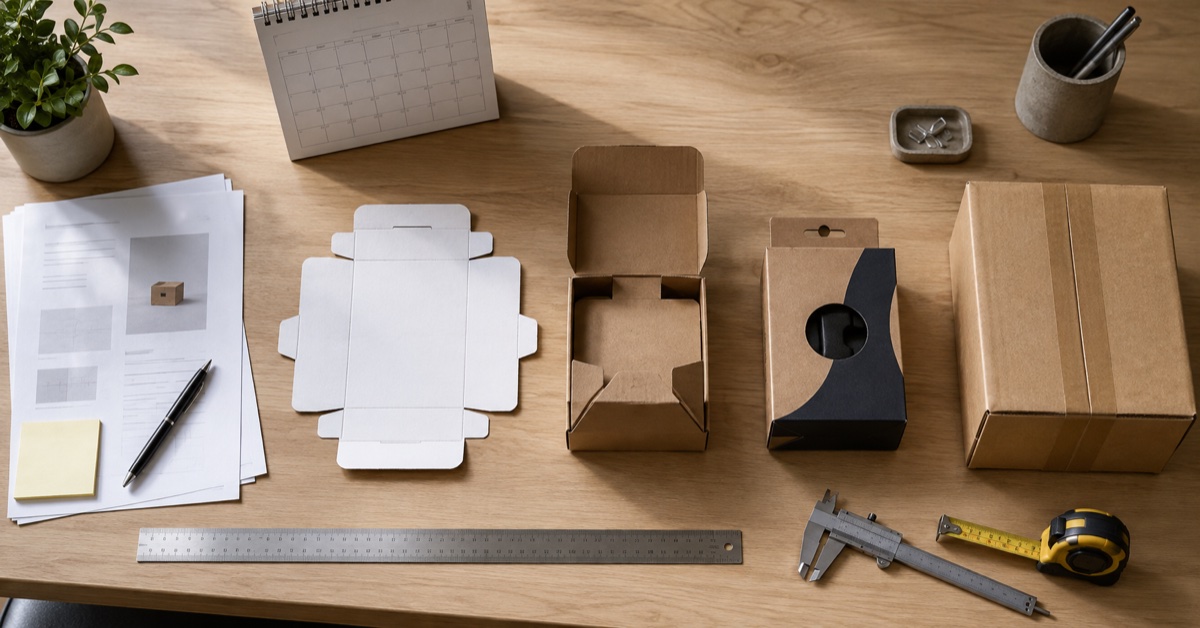
A white mockup may answer size and opening. A digital proof may answer layout. A printed sample may answer color and finish. A production-equivalent build may be needed for fit, assembly or handling.
PackMK names the boundary of each sample. A fast mockup is useful when it prevents a wrong dieline; it is not evidence for every later risk.
Prepare a sample-ready brief
Include the details that prevent avoidable pauses:
- product dimensions and orientation;
- pack-out sequence and protection need;
- artwork status and variable fields;
- material preference and allowed alternatives;
- quantity, destination and required date;
- the question the sample must answer;
PackMK uses the brief to turn a sample into a decision, not a decorative surprise.
Separate structure time from decoration time
Dieline, board, insert, closure and fit decisions may be solved before color, foil, varnish or specialty print. Ask whether the sample is structural, visual or production-equivalent.
PackMK sequences the work so a decorative revision does not hide an unresolved fit issue. The right order can shorten the calendar without skipping evidence.
Ask what is already on the supplier floor
Check stock availability, machine queue, digital or offset route, die availability, sewing capacity, finishing schedule and packing window. Note which parts are standard and which are made for the project.
PackMK asks suppliers to state assumptions rather than promising a universal turnaround. Availability can change, so the quote should include a review date and substitute path.
Build revision time into the map
Define who consolidates comments, how many revision rounds are assumed and what constitutes a new sample. Separate a copy correction from a dimension or material change.
PackMK logs the reason and impact of each revision. A clean comment list is often faster than several partial messages that reopen already-settled decisions.
Revision impact by change type
| Change | May reopen | Record |
|---|---|---|
| Typo | Artwork proof | Corrected file |
| Panel size | Dieline and fit | New mockup |
| Board | Color and structure | Material sample |
| Finish | Print route | Decorated proof |
| Handle | Load and sewing | Physical trial |
| Quantity | Setup and packing | Revised quote |
PackMK uses the table to keep a small change from being treated as a full restart, while still reopening the evidence it can affect.
Give one person approval authority
Name the owner for structure, artwork, brand, quality, purchasing and final release. Set a response window and a single comment channel.
PackMK treats approval ownership as part of sample time. A sample sitting in an inbox is elapsed time, but it is not supplier production time.
Inspect the sample against the stated question
Use a short checklist: fit, opening, protection, print, color, code, assembly, dimensions, finish, carton or route. Photograph the result and note the condition.
PackMK avoids vague approvals such as looks good. Each accepted feature gets a boundary, and each open risk gets an owner and next action.
Treat tooling as a visible gate
Ask when a die, plate, screen, mold, sewing template or special setup becomes necessary. State whether a mockup bypasses the tool and whether the final route will use it.
PackMK puts setup and tool implications beside the calendar. This helps buyers choose between learning quickly and proving the final construction.
Protect the handoff to production
Retain the approved sample, artwork, material code, dimensions, finish, inspection scope, packing marks, quantity and change log. Identify what is illustrative and what is production-equivalent.
PackMK links the handoff to the purchase order. A fast sample has value only when the production team knows exactly what it did and did not prove.
Use calendar ranges with conditions
Present an earliest, expected and risk-adjusted date with the assumptions behind each. Flag holidays, material search, approval windows, tooling and freight separately.
PackMK prefers a transparent range to a precise promise. The buyer can then move a decision, accept an alternative or adjust the launch plan knowingly.
Review sample time after the order
Compare planned and actual dates by milestone. Note which delay came from the brief, supplier, approval, material or logistics.
PackMK turns the record into a better next brief. Sample time becomes a process capability conversation rather than an argument about a single date.
Timeline example: a rigid gift box with a paper sleeve
A buyer needs a box for a seasonal gift set and has six weeks before a retailer review. The product dimensions are stable, but artwork and sleeve finish are still under discussion.
PackMK would start with a white mockup to settle fit and insert position, then release the dieline. A digital proof could resolve copy while board and sleeve stock are sourced in parallel.
The printed sample would answer color, sleeve friction, opening and retail presentation. A separate load and assembly check would confirm the insert before the production handoff.
The calendar would show buyer approval windows and a risk-adjusted date. If foil is removed, the finish gate can close earlier without reopening the box fit decision.
Use project planning references as context
Project planning references can help teams discuss dependencies, but supplier sample time remains specific to inputs, capacity, materials and approval behavior. For general context, review Atlassian project planning concepts and ISO quality management principles. PackMK still bases a quotation on the buyer brief, samples, process evidence and destination requirements.
Turn custom packaging sample time into a milestone brief
A decision-ready custom packaging sample time brief should define sample brief, dieline readiness, material sourcing, digital mockup, printed proof, revision loop, tooling, inspection, approval owner, production handoff. It should also identify PackMK, custom packaging sample time, dieline, mockup, proof, OEM, ODM, MOQ. PackMK turns those details into a quotation basis, approval path and evidence list shared by purchasing, quality, operations and receiving.
Ask the supplier to state assumptions, exclusions, approved alternatives, tooling, minimums, inspection scope, packing and lead-time conditions. For custom packaging sample time, broad adjectives should become a sample question, tolerance, priced option or release gate before the order is confirmed.
Sample time varies with brief completeness, material availability, tooling, process route, quantity, supplier capacity, approval speed, holidays and shipping. The map does not guarantee a date or replace a supplier's current quotation.
Clear custom packaging sample time starts with a clear question. PackMK helps buyers see the gates, waiting points and evidence behind a sample calendar.
Keep a one-page decision record with the selected route, rejected alternatives, evidence reviewed, open limitations, quantity basis, owner and review date. After delivery, add receiving observations, defects, user feedback, supplier response and retained references so a reorder reopens only changed decisions.
Build a realistic sample calendar with PackMK
PackMK can support custom packaging sample time from buyer brief and samples through production checks and export packing. Send the product or application, artwork, quantities, variants, destination and required date to request a structured quotation for custom packaging sample time.
- Explore PackMK custom packaging samples
- Review PackMK OEM and ODM support
- Request a sample-time packaging quotation
Custom packaging sample time questions
When does sample time begin?
Use a named start event such as an accepted brief or complete artwork, not an informal first email.
Is a white mockup enough?
It can answer fit or opening, but not every print, material or production risk.
What commonly blocks a sample?
Missing dimensions, unresolved artwork, material sourcing, tooling, capacity and slow approvals.
How many revision rounds should be planned?
State an assumed number and define which changes require a new sample.
Why separate structure and decoration?
Fit and opening can often be solved before color or finish, reducing avoidable rework.
Who should approve the sample?
Name owners for structure, artwork, brand, quality, purchasing and final release.
Should tooling be included in the calendar?
Yes. State when a die, plate, template or special setup is required.
How should dates be quoted?
Show earliest, expected and risk-adjusted dates with their assumptions.
What should be retained after approval?
Keep the sample, artwork, material code, dimensions, inspection scope and change log.
How does PackMK improve future estimates?
PackMK compares planned and actual milestones to refine the next brief and supplier discussion.