

Insulation is only one part of a delivery bag's performance. Payload, starting temperature, pack arrangement, closure, ambient conditions, opening frequency and transport time can change the result. A buyer who orders custom insulated bags from a material description alone may be unable to explain why the same bag behaves differently in the field.
PackMK uses a field-test protocol that defines the use condition before the bag is finalized. The protocol separates thermal observations from construction checks, so a zipper, seam, liner or handle issue is not hidden behind a broad promise such as keeps cold.
Direct answer: Validate custom insulated bags with representative payloads, starting conditions, closure, route duration and acceptance rules, then connect the results to construction and packing controls.
Write the use condition in plain language
Before sampling, record:
- product type and payload mass;
- starting temperature or conditioning method;
- expected ambient range and exposure;
- target hold time and opening frequency;
- ice pack or insert arrangement;
- delivery orientation and handling route;
- what result counts as acceptable.
PackMK does not treat a generic thermal claim as a test condition. The use statement determines which sample and evidence are meaningful.
Separate bag layers from the user result
| Layer | Typical choice | What to inspect | Failure signal |
|---|---|---|---|
| Outer | Polyester, non-woven or coated fabric | Abrasion, seams, print | Wet-through or tearing |
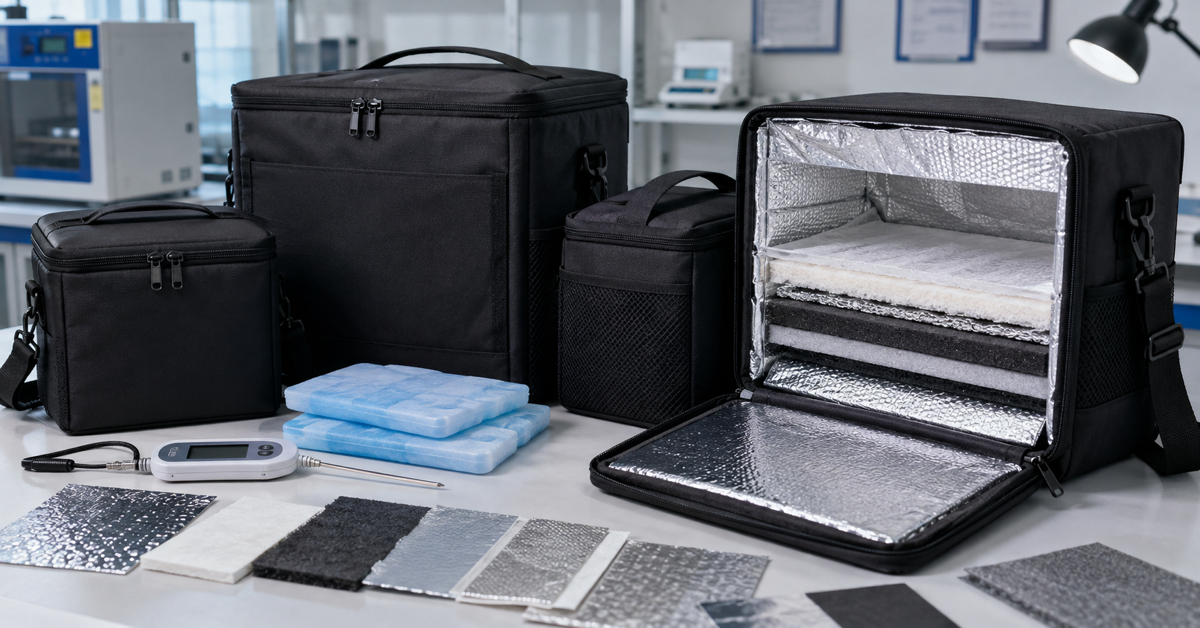
| Insulation | Foam or fiber stack | Thickness, continuity | Thin spot or compression |
| Liner | PEVA or foil laminate | Seams, cleanability | Leak or delamination |
| Closure | Zipper, hook-and-loop or fold | Seal path, operation | Gap or snag |
| Handle | Webbing and attachment | Load and comfort | Stretch or pull-out |
| Pack-out | Carton and folded shape | Protection and cube | Crease or deformation |
PackMK records the layer decision beside the field result. A good thermal observation does not cancel a construction weakness that will shorten service life.
Choose a test matrix, not one lucky trial
Test the difficult but realistic combination: maximum payload, least favorable opening pattern, expected ambient condition and the intended insert arrangement. If there are multiple sizes, select the size with the tightest insulation-to-volume ratio as well as a normal-use size.
PackMK keeps the matrix small enough to run but broad enough to explain variation. The objective is to learn which variables change the result, not to produce a single impressive number.
Load the bag like a packer
Place products, dividers, ice packs and void fill as a real operator would. Note whether the closure can be fully engaged, whether corners press against seams and whether the liner is folded or pinched.
PackMK times the loading action and records awkward steps. A bag that performs in a lab but slows a route or invites incorrect loading may not meet the commercial need.
Record thermal and handling observations together
| Observation | Method | Record | Decision |
|---|---|---|---|
| Starting state | Condition payload | Time and temperature | Accept or reset |
| Closure | Close as used | Gap, effort, alignment | Pass or revise |
| Hold | Measure at intervals | Time, location, conditions | Compare to target |
| Opening | Open and reseal | Count and effect | Keep route or adjust |
| Condensation | Inspect liner and seams | Location and amount | Cleanability action |
| End state | Unload and inspect | Product and bag condition | Release or hold |
The record protects the interpretation. PackMK avoids turning a thermal reading into a universal product claim when the use condition was not controlled.
Treat closures as thermal and operational controls
A zipper, fold-over, hook-and-loop strip or roll-top changes the seal path and the time needed at the station. Test the closure after repeated use, with a full payload and with a gloved or hurried operator when that reflects the route.
PackMK checks alignment, snagging, pull tabs, corner behavior and the visual cue that tells the packer the bag is closed. A clear close signal reduces both heat loss and handling error.
Inspect condensation and cleanability
Cold payloads can create moisture on the liner, seams, base and closure. Record where water appears and whether the construction can be wiped, dried and returned to service without trapping residue.
PackMK distinguishes a material choice from a care process. If the bag is intended for repeated routes, the cleaning step, drying time and inspection owner belong in the brief. The team should also note how a wet liner is isolated, where used bags are stored and which observation sends a sample back for construction review.
Connect the test to transport packing
A finished bag may be compressed, folded, stacked or stored before use. Check whether the packed carton changes insulation thickness, zipper alignment, handle shape or liner appearance.
PackMK reviews a sample after a representative hold and movement. The test is not complete if the bag performs only before it reaches the distribution team.
State what the data does not prove
A short route trial does not prove every season, carrier, payload or opening pattern. It also does not certify a food, medical or environmental claim without the responsible technical review.
PackMK puts the boundary next to the result. Clear limitations make a report more credible and show what additional work is needed before a claim or specification is expanded.
Freeze a repeatable construction
Once the field test passes, record outer, insulation, liner, closure, handle, dimensions, seam method, artwork, packing and inspection photos. Identify which alternatives are approved and which require a new trial.
PackMK uses that release record for reorders and supplier changes. It keeps a material substitution from being treated as equivalent without evidence. Keep the signed result with the approved sample so a future team can see the tested boundary.
Route example: chilled subscription boxes across two climates
A meal-kit brand ships a chilled starter set in two seasons. The bag must hold a standard payload, accept two ice-pack layouts and be reused by a small delivery fleet.
PackMK would test the tightest size and the most demanding route first. Operators would load the bag, close it, carry it, open it at delivery and clean it after return.
The record would include temperature observations, condensation locations, closure effort, base wear, carton compression and a disposition rule for bags that fail inspection.
The construction would be released with a defined payload and route boundary. A larger size or a different liner would trigger a new test rather than inherit the old result.
Use test method references with care
Published quality and material guidance can help define repeatability and documentation, while the actual route still needs a project-specific protocol. For orientation, buyers can consult ISO quality management principles and ASTM standards directory. These references inform the method but do not certify a particular PackMK project.
Turn custom insulated bags into a testable specification
A decision-ready custom insulated bags brief should define payload, starting condition, ambient range, hold time, opening pattern, insulation stack, liner, closure, condensation, cleaning, packed carton. It should name PackMK, custom insulated bags, PEVA, EPE, foil laminate, zipper, ice pack, thermal trial where they affect the decision. PackMK uses those details to organize questions, samples, quotation assumptions and release evidence.
Ask the supplier to separate confirmed facts from assumptions, options and exclusions. Record tooling, minimums, approved alternatives, test conditions, inspection scope, packing, lead-time triggers and the person who can release a change. That record is more useful than a promise built from undefined words such as premium, durable or sustainable.
Thermal and handling performance depends on payload, conditioning, ambient environment, opening pattern, construction, route and test method. PackMK can develop a defined test plan and supply route, but cannot promise one universal hold time or certify regulated claims through an article.
Give PackMK the route before choosing the insulation stack
Send PackMK the payload, starting condition, expected route, ambient range, opening pattern, cleaning needs, dimensions, quantity and destination. We can turn custom insulated bags into a field-test and production-release plan.
Custom insulated bags questions
What information is needed to test custom insulated bags?
Provide payload, starting condition, ambient range, hold time, opening pattern, inserts, route and acceptance rule.
Is thicker insulation always better?
Not automatically. Thickness affects capacity, weight, foldability, pack-out and station handling as well as thermal behavior.
Which liner should I choose?
Compare cleanability, seam performance, flexibility, temperature exposure and route requirements for the exact construction.
How should ice packs be positioned?
Use the real loading method and test the most difficult product placement, not an ideal arrangement only.
Why test closure effort?
A closure that is hard to align or reseal can create heat loss and operator errors even when the material insulates well.
What does condensation tell me?
It shows where moisture forms and whether seams, liner, base and cleaning process can handle it.
Can a route trial prove food safety?
No. Food, medical and other regulated claims need the responsible technical and regulatory review.
How should reorders preserve performance?
Release the full construction, route boundary, inspection photos, approved alternatives and change triggers.
What if the bag passes one climate?
State the tested boundary and run an additional trial before extending the claim to another season or route.
What should PackMK quote?
Provide the use condition, dimensions, materials, print, quantity, packing route, destination and required date.