

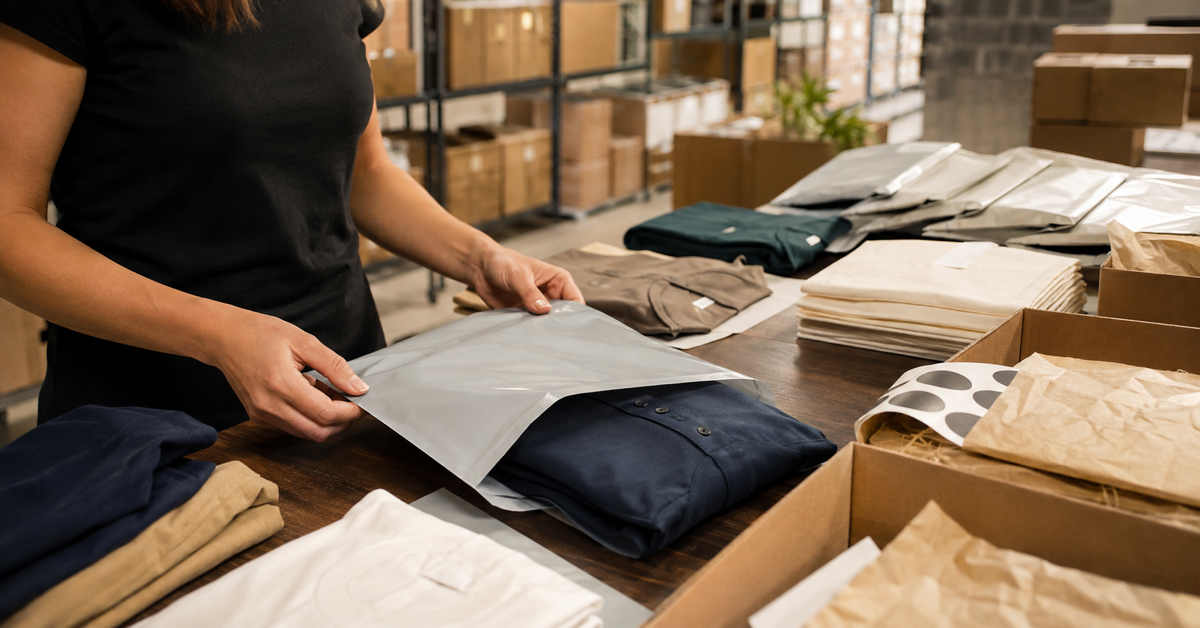
An apparel mailer has to protect a garment while moving through several hands and systems: folding, picking, packing, labeling, shipping, opening and sometimes returning. Apparel packaging bags work best when the bag, label and pack-station action are designed together rather than chosen from a size chart.
PackMK maps the garment journey from warehouse bin to customer wardrobe. That view surfaces practical decisions about clear versus printed film, resealability, air volume, size selection, tissue, barcode placement and the way old stock is retired when a collection changes.
Direct answer: Choose apparel packaging bags by simulating the garment, pack-station and returns route, then release the bag with size, label, closure, protection and reuse controls.
Map the garment journey before selecting the bag
| Stage | User | Decision | Evidence |
|---|---|---|---|
| Storage | Warehouse | Bin footprint and SKU visibility | Shelf trial |
| Pick | Picker | Size and version selection | Error observation |
| Fold | Packer | Garment presentation | Timed fold |
| Pack | Packer | Air, closure and label | Station trial |
| Ship | Carrier | Abrasion and moisture | Packed sample |
| Open | Customer | Easy access and presentation | Opening review |
| Return | Customer and team | Reseal and inspection | Return simulation |
PackMK uses the journey map to avoid improving one stage while creating friction in another. The bag is part of the fulfillment system, not a silent envelope.
Group garments by actual risk
Sort products by fabric sensitivity, hardware, folds, color transfer, bulk, moisture exposure and return rate. A lightweight shirt, embellished dress and padded jacket may all be apparel but require different clearance and closure behavior.
PackMK chooses a difficult representative from each family. The test should include the garment as folded for shipment, not only laid flat for photography.
Run a pack-station rehearsal
Ask a real operator to repeat the route with representative SKUs:
- find the correct bag size from the bin;
- fold or insert the garment;
- place the size or shipping label;
- close the bag without trapping fabric;
- move the parcel to the outbound tote;
- open and reseal a return.
PackMK records time, errors, awkward reaches and label placement. The fastest bag is not useful if it increases mis-picks or garment damage.
Control air and movement
A bag that is too large allows the garment to move, wrinkle or shift the label. A bag that is too tight can crush trims, trap fabric in the adhesive or slow the packer.
PackMK defines usable internal dimensions and a decision rule for the next size. The rule belongs in the SKU board so new staff do not choose by guesswork.
Place labels where systems can read them
Shipping labels, size stickers, barcode windows and collection marks compete for a clean surface. Folds, glare, seams and dark prints can make a code hard to scan or a size hard to verify.
PackMK tests the longest realistic label and the smallest code on a filled bag. The acceptance rule should say what happens when a scan fails or a label overlaps the closure.
Compare common bag routes by operational tradeoff
| Route | Useful strength | Watch point | Best starting question |
|---|---|---|---|
| Clear poly mailer | Visibility and low cube | Claim and plastic rules | Can the garment be protected and identified? |
| Recycled-content film | Material story and visibility | Evidence and sealing | What content and test support the claim? |
| Paper mailer | Print and fiber feel | Moisture and garment bulk | Will folds and returns work? |
| Reusable textile bag | Repeat use and presentation | Cube and reverse logistics | Who collects and inspects it? |
| Hybrid mailer | Balanced surface and protection | More components | Which layer solves which risk? |
PackMK treats material names as a starting point. The route decision must include garment, label, carrier, return and destination requirements.
Design the opening and return behavior
Customers may cut, tear, peel or reseal the bag. If returns are expected, specify a second adhesive strip or a clear instruction while protecting the garment from a blade or exposed adhesive.
PackMK simulates an imperfect opening and a real return. The result should show whether the bag can be inspected, closed, sorted and reused without hiding damage.
Plan storage and replenishment
Film mailers, paper mailers and textile bags have different bin footprints, moisture sensitivity and replenishment patterns. Separate sizes and campaigns with readable carton and inner-pack marks.
PackMK tests the shelf location and replenishment path. A bag specification is incomplete if the warehouse cannot find the right version quickly. Record the reorder point and the person who checks slow-moving seasonal stock.
Protect collections from obsolete stock
A date, season, influencer name or temporary claim can shorten the life of leftover bags. Before approving a print, decide which elements are evergreen and which are controlled by forecast.
PackMK keeps an old-version disposition rule. It names whether stock is consumed, relabeled, moved to another channel or retired when a collection changes.
Release the bag with a line-side record
The final record should show size, material, closure, print, label zone, pack-out, inspection, return route and approved alternatives. Attach a filled reference photograph that a new operator can understand.
PackMK uses the record for onboarding, quality checks and reorders. This turns apparel packaging bags from a purchasing item into a repeatable fulfillment component.
Retail example: a fashion brand with store and online orders
A fashion brand ships folded knitwear online and uses the same core packaging for store transfers. Online parcels need a reseal path, while store teams need fast size recognition and clean presentation.
PackMK would test a shared bag family with different labels and pack-out rules. The trial would cover bin storage, picking, folding, label scan, carrier handling, customer opening and a store return.
Evergreen artwork would be separated from seasonal marks. The release board would identify which bag versions can be mixed and which must remain channel-specific.
The brand would measure packing time and return inspection, not only the finished bag's appearance. That evidence would set the next order and storage quantity. A short operator interview after the trial would capture which size was chosen incorrectly, which label was hard to scan and whether the bag stayed clean enough for a second use. The team would also compare folded volume before and after returns, because a bag that cannot be stored efficiently can create a hidden labor cost even when it protects the garment well.
Use packaging and traceability references as practical inputs
Quality and identification principles can support consistent SKU, label and change-control decisions across a fulfillment network. For orientation, buyers can consult GS1 barcode standards overview and ISO quality management principles. These references inform the method but do not certify a particular PackMK project.
Define apparel packaging bags around the operation
A decision-ready apparel packaging bags brief should define garment family, folded dimensions, bin footprint, size rule, label zone, closure, moisture, return path, carton mark, obsolete stock. It should name PackMK, apparel packaging bags, poly mailer, paper mailer, barcode, SKU, reorder, returns where they affect the decision. PackMK uses those details to organize questions, samples, quotation assumptions and release evidence.
Ask the supplier to separate confirmed facts from assumptions, options and exclusions. Record tooling, minimums, approved alternatives, test conditions, inspection scope, packing, lead-time triggers and the person who can release a change. That record is more useful than a promise built from undefined words such as premium, durable or sustainable.
Garment protection and fulfillment performance depend on fabric, hardware, fold, bag construction, carrier route, label system and return process. PackMK can organize a defined packaging workflow, but no general bag type guarantees protection, reuse or customer satisfaction for every apparel program.
Let PackMK test the bag at the pack station
Send PackMK your garment families, folded dimensions, label requirements, order quantities, channel mix, return policy, destination and timeline. We can develop apparel packaging bags around a real fulfillment and inspection route.
Apparel packaging bags questions
How should I size apparel packaging bags?
Use folded garment dimensions, clearance, closure allowance and the movement risk of the exact product family.
Is clear film always the best option?
It improves visibility, but material rules, print, moisture, claim evidence and garment protection still need review.
Where should the barcode go?
Choose a flat, readable zone that remains visible after folding, closure, label application and carrier handling.
How can I reduce pack-station errors?
Use a simple size rule, readable bin and carton marks, and a timed trial with real operators.
Should the bag be resealable?
If returns are common, test a second adhesive strip or another reseal method with an imperfect customer opening.
How do I protect embellished garments?
Test hardware, sharp edges, folds, clearance and liner or insert choices with the difficult representative garment.
Can one bag serve store and online orders?
Sometimes, if the pack-out, label, presentation and return route are tested for both channels.
How should seasonal packaging be controlled?
Separate evergreen and campaign elements, then define stock disposition when a collection or claim changes.
What should a line-side record contain?
Include size, construction, closure, label zone, pack-out, inspection photo, return path and approved alternatives.
What should PackMK quote?
Provide garment families, dimensions, materials, print, quantities, channel route, packing details, destination and date.