


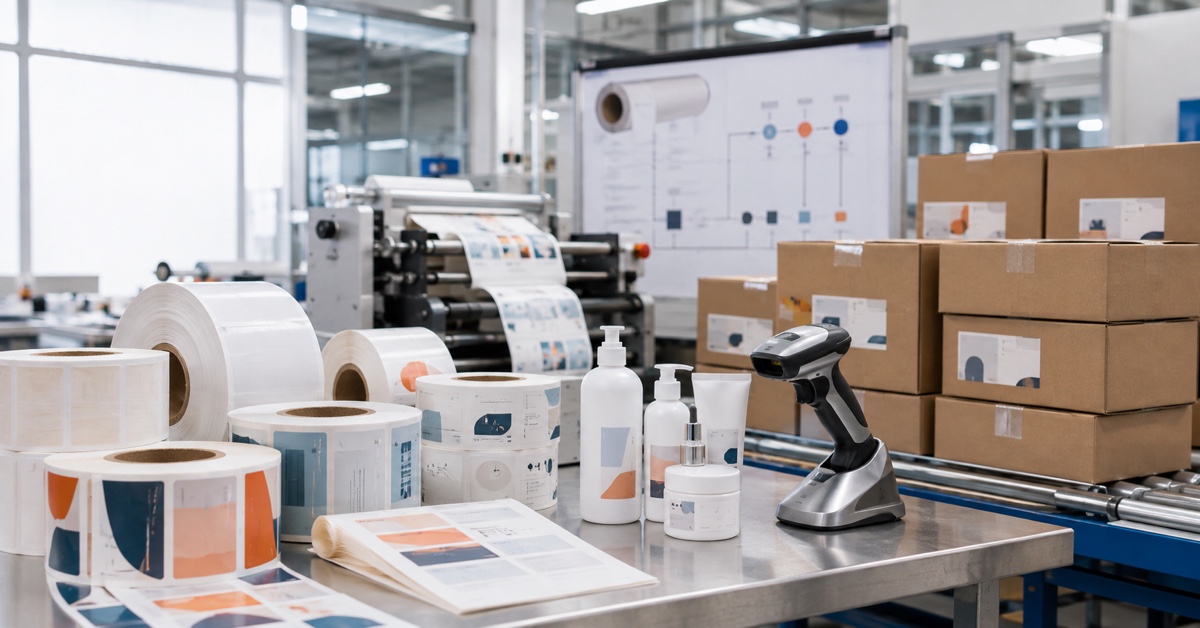
An exported label order can fail after printing is complete. The file may contain an old code, rolls may unwind in the wrong direction, cartons may mix versions, or a correct label may not adhere to the buyer's surface. Choosing an adhesive label exporter China therefore means checking the chain from data source to receiving, not only the print sample.
PackMK builds a shipment dossier around that chain. We connect source data, artwork, substrate, adhesive, die-cut, roll geometry, scan result, inspection, carton mark and export document. The dossier gives the buyer a way to contain a wrong version or surface issue before it spreads across a shipment.
Short answer: Assess an adhesive label exporter China by tracing one label from approved data and material through application, roll conversion, scan verification, carton identity and destination receiving records.
Follow the label through the export chain
| Handoff | Identity to carry | Evidence | Failure if skipped |
|---|---|---|---|
| Data to artwork | SKU, copy, code and revision | Approved source and proof | Wrong version |
| Artwork to material | Size, adhesive and surface | Construction record | Lift or residue |
| Print to roll | Color, cut, pitch and winding | First-off and roll log | Line stop |
| Roll to carton | Count, orientation and lot | Packing record | Mixed shipment |
| Carton to destination | Marks and documents | Packing list and receiving | Untraceable exception |
PackMK keeps the same identity at every handoff. A shipment is not ready merely because the printed face looks correct.
Start with the data owner
List SKU, product name, market, language, fixed copy, variable fields, barcode or QR data, artwork revision and approval owner. State which fields may change after the first proof and where the cutoff occurs.
PackMK asks the exporter to return a preflight or marked proof that can be reconciled with the source. A label with perfect typography can still carry the wrong batch rule or an outdated destination statement.
Put the construction in the shipment dossier
Record these physical fields:
- facestock, coating, thickness or grade;
- adhesive family and liner reference;
- finished size, corner radius and die;
- print process, colors and finish;
- roll core, winding, pitch, gap and splice rule;
- application surface, method and environment;
- carton count, marks, lot and destination.
PackMK uses the dossier to connect a printed label to its actual use. The exporter can price and pack the right construction instead of relying on a broad label name.
Test the application surface before export
Send representative containers or surface samples when the label is curved, coated, textured, cold, damp or exposed to handling. Define cleaning, pressure, dwell, temperature, storage and the observation period.
PackMK keeps the result tied to the exact stack and route. If the buyer changes a coating, bottle, pouch, application machine or speed, the prior evidence may stop at that boundary and a new trial may be needed.
Check a production-equivalent roll
| Roll field | What to verify | Why it matters | Record |
|---|---|---|---|
| Core and winding | Size and unwind direction | Feeds the equipment | Roll diagram |
| Pitch and gap | Spacing and sensor target | Controls dispense | Measured sample |
| Cut and matrix | Kiss-cut and waste removal | Prevents double feed | Conversion log |
| Count and splice | Labels and joins | Supports reconciliation | Roll label |
| Print and code | Color, data and scan | Protects identity | Inspection result |
PackMK asks for a roll sample in the orientation the buyer will use. A flat label sample cannot prove feeding, counting or sensor behavior.
Reconcile source data with printed codes
Use the approved data set, the longest realistic value and the smallest or most difficult code. Scan applied and unapplied samples with the intended verification method, then record rejects, reprints and waste.
PackMK separates data correctness from print and application performance. A valid source can be printed too small, distorted by curvature or damaged by finish, so the scan result belongs in the release record.
A useful export release statement
The cartons contain the approved SKU and artwork revision in the stated roll format; code, count, orientation, marks and destination documents reconcile before loading.
PackMK uses this as a short gate before shipment. It makes the exporter, buyer and forwarder responsible for the same identity without implying that a document alone proves adhesion.
Inspect packing at the version boundary
Define inner roll count, protective wrap, core protection, carton quantity, carton sequence, gross weight, marks and mixed-version rules. Photograph the first and last roll in a representative case.
PackMK asks receiving to verify one carton against the dossier. If a replacement or partial roll is added, it receives a new identity linked to the reason, approval and updated packing record.
Prepare the document handoff early
List the commercial and shipping records required by the buyer, forwarder and destination. Confirm product name, quantity, carton count, marks and version identity across the documents before loading.
PackMK keeps document review beside physical inspection. A paperwork mismatch can pause a correct shipment, while a physical mismatch can pass through a perfect document set if no one checks the carton.
Handle partial releases and exceptions
State how short packs, damaged rolls, reprints, late data, mixed cartons, rejected codes and changed destinations are contained. Assign an owner, replacement quantity, new mark and approval date.
PackMK preserves the original event in the dossier. This makes a corrective action auditable and prevents the replacement from becoming an untraceable extra roll in the next carton.
Compare exporters by handoff strength
Ask candidates to show data control, material identity, application trials, roll diagrams, scan records, inspection, carton marks, document review and escalation. Compare what each can prove for the current order, not just equipment or gallery images.
PackMK scores unanswered questions separately from price. A clear handoff can protect a launch when a small unit saving would otherwise be lost to a wrong version, line stop or receiving delay.
Keep the dossier useful for reorders
Retain source data, artwork, material and adhesive, applied sample, scan result, roll log, inspection, carton marks, documents, deviations and receiving feedback. Mark stable fields and change triggers.
PackMK uses the record to shorten the next adhesive label exporter China review. A new surface or market can reopen the right test while the proven roll and packing controls remain available.
Shipment example: two languages and one shared bottle
A personal-care brand exports labels for one bottle family in two languages. Batch codes are printed after filling, the bottle has a shoulder radius, and cartons are split between two destinations.
PackMK would connect the language and code matrix to separate artwork revisions, a shared construction record and destination-specific carton marks. Applied filled bottles would be tested and scanned before the roll format is frozen.
The exporter would pack rolls by language and destination, with core, winding, count, lot and version on each label. The packing list and commercial documents would use the same identity as the cartons.
If one destination changes its copy after approval, the dossier would identify the affected rolls and document cutoff. Stable adhesion evidence could remain only if surface, construction and application route stayed unchanged.
Use barcode and traceability references as context
Barcode and traceability guidance can help teams define identity and verification points, while the buyer's product, market and application owners control final acceptance. For context, buyers can consult GS1 barcode standards overview and GS1 traceability overview. These references do not certify a particular PackMK project.
Specify an adhesive label exporter China shipment dossier
A decision-ready adhesive label exporter China brief should define data owner, artwork revision, facestock, adhesive, application surface, roll winding, barcode scan, carton mark, shipping document, exception record. It should identify PackMK, adhesive label exporter China, SKU, barcode, QR code, liner, roll, carton wherever they affect the decision. PackMK uses those fields to organize questions, samples, quotation assumptions and release evidence.
State the export dossier boundary
Label performance, data requirements, documents and destination rules vary by product, surface, market and route. PackMK can organize a traceable export dossier and application trial, but it does not replace qualified customs, regulatory, safety or claims review.
Build the label export chain with PackMK
Send PackMK the SKU and data matrix, container samples, artwork, label construction, roll format, application method, quantities, carton plan, destination and required date. We can turn an adhesive label exporter China search into a documented shipment route.
Adhesive label exporter China questions
What should I send an adhesive label exporter China?
Provide SKU and data matrix, artwork, container or surface, construction, roll format, quantity, packing, destination and date.
Why does the data owner matter?
It prevents outdated copy, codes or language from reaching artwork and production without an accountable approval.
What proves adhesive suitability?
Use a representative surface with stated cleaning, pressure, temperature, dwell, storage and observation conditions.
Which roll fields must be frozen?
Approve core, winding, diameter, pitch, gap, splice rule, orientation and count for the intended equipment.
How should codes be verified?
Scan applied and unapplied samples with the real data, size, finish, curvature, lighting and verification method.
What should a carton mark contain?
Use SKU, artwork revision, language or destination, quantity, roll or lot identity, sequence and required handling marks.
How are reprints controlled?
Give replacement rolls a new identity linked to the original lot, reason, approval and updated packing record.
When should a new application trial run?
Repeat after changes to surface, coating, adhesive, liner, size, finish, application method, speed or storage.
Can one packing list cover mixed versions?
Only if each version and destination allocation is clearly identified and reconciled at carton level.
How does PackMK support label exports?
PackMK coordinates data release, proofs, construction trials, scans, roll checks, packing, documents and reorder control.