

ODM Drawstring Bags: Diagnose Closure Failure Before Scale
Direct answer: ODM drawstring bags should be released only after a filled bag closes, holds, opens and repeats the intended user action without cord slip, channel damage or product escape. Diagnose a failure in order: product fit, opening geometry, cord, channel, seam, user action and cycle count.
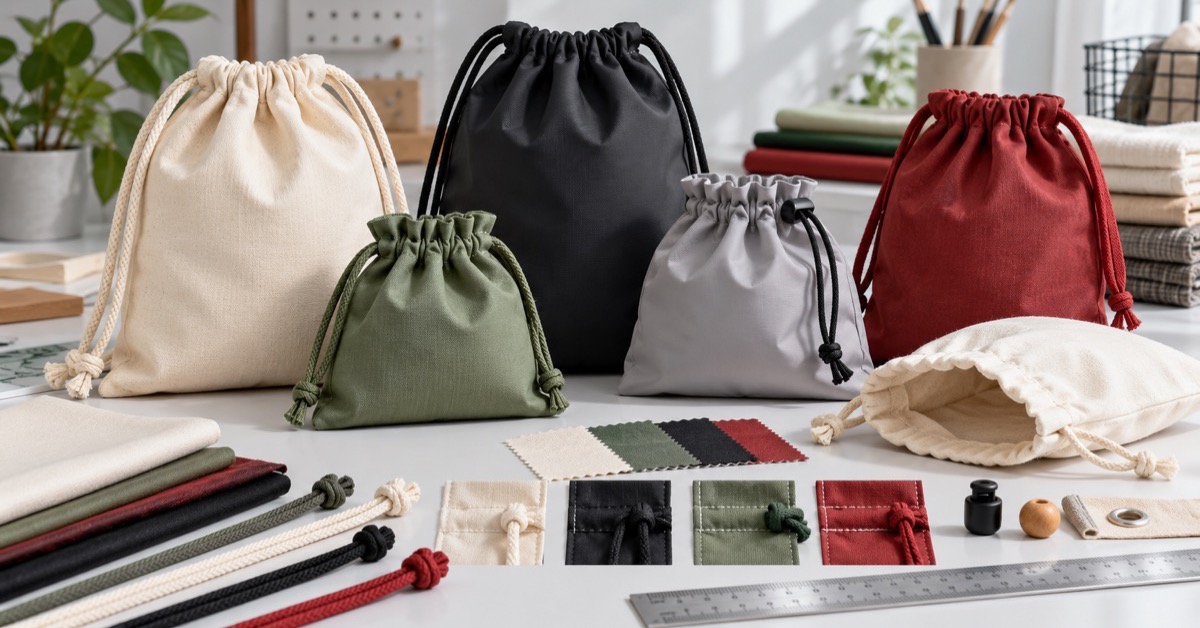
For ODM drawstring bags, changing a logo is the easy part. The awkward failures come from the relationship between the product, its weight, the cord, the sewn channel and the way somebody actually pulls it shut.
PackMK follows a short fault-finding tree. Look at what failed, run the check for that symptom, and move to the next branch only if the evidence points there. That keeps one sticky cord from turning into a wholesale redesign.
Name the failure before suggesting a fix
Begin with what the user cannot do. Won't close, slips open, jams on reopening and lets the product escape are separate faults; changing the cord by default is guesswork.
| Observed failure | First question | Evidence to retain |
|---|---|---|
| Will not close | Can the largest product clear the opening? | Filled opening measurement |
| Will not stay closed | Does the cord hold after movement? | Loaded hold check |
| Will not reopen | Is friction concentrated at the eyelet or channel? | Repeated action record |
| Product escapes | Is the gathered mouth smaller than the product path? | Closed opening gauge |
PackMK writes down the symptom before touching the construction. The next sample then has one job: show whether that change fixed it.
Node one: try loading the hardest product
Try the largest or most awkward product first. No cord can rescue a mouth that the product cannot clear. Measure across the real loading angle, allow for the user's hand, and compare that path with the sewn opening.
PackMK also loads the everyday product in the same bag. If just the difficult combination catches, attention stays on clearance and loading technique rather than shifting to every seam and component.
Node two: separate cord slip from channel friction
Cord slip and channel friction require opposite corrections. Slip appears when the closure relaxes after pulling; friction appears when excessive force is needed to gather or reopen the mouth.
PackMK marks the cord at a fixed point, closes the filled bag and observes movement after handling. It also records the pull action instead of substituting an unsupported force claim. The comparison shows whether cord surface, diameter, channel width or an eyelet is controlling the result.
Node three: inspect the channel and seam together
The channel and its seam must be inspected as one load path. A wide channel can still bind when seam allowance enters the path, while a smooth empty sample can tighten around a filled product and pull on the stitch line.
PackMK opens a retained sample at the failed area when necessary and compares the intended construction with the sewn result. The record identifies channel depth, seam position, stitch route and any reinforced point before a new sample is requested.
Put one filled bag through all four actions
Close it, carry it, open it and do the sequence again on the same sample. A fresh bag for every step can conceal the abrasion or knot movement that accumulates during use.
- Pull it closed exactly as the user will, with one hand or two.
- Move the filled bag through the agreed handling route.
- Open it again without tugging an unrelated seam or panel.
- Repeat to the project target; note the first thing that changes.
The sample record keeps the count and the first failure together. That tells PackMK whether the action works once and whether it remains usable.
Route each diagnosis to one sample change
Change one primary variable per diagnostic round whenever practical. Holding the other variables steady makes the result attributable and prevents an improved appearance from hiding a new functional loss.
| Diagnosis | Primary sample change | Hold constant | Release check |
|---|---|---|---|
| Opening too small | Opening or bag dimensions | Cord and channel | Largest product loads |
| Cord slips | Cord surface or stop | Opening and seam | Loaded hold |
| Channel binds | Channel depth or eyelet route | Cord material | Close-reopen action |
| Seam distorts | Seam allowance or reinforcement | Cord and product | Filled cycle |
| Mouth leaves a gap | Gather ratio or stop position | Bag body | Escape gauge |
PackMK numbers each round and states the single question it is intended to answer before the factory builds it.
Give each sample a single question
Write one question on the sample record. Improved is not a question, and it gives no clue whether clearance, holding power, seam behaviour or repeat use changed.
A useful entry might read: does this wider channel stop binding with cord C2? Record yes, no or unclear, attach the observation, then choose the next branch.
Add moisture or rubbing only when the route has it
Do not add exposure tests out of habit. A laundry pouch or outdoor giveaway may face damp fabric and rubbing; a dry gift pouch on an indoor shelf probably does not share that route.
PackMK names the condition, how long it lasts and whether the pouch is filled. That gives two material options a fair comparison without making a vague waterproof or durable promise.
Define the stop condition before scaling
Scaling stops when any critical user outcome remains unproven. The minimum release record should show that the largest product loads, the mouth closes, the closure holds, the bag reopens and the agreed cycles do not create a critical defect.
PackMK also records open questions that do not block the chosen order, such as a future colour branch. This keeps the release proportionate without converting an unresolved closure failure into a production risk.
Five approval notes that should stop the order
Pause if the file contains one of these notes but no supporting check. They all leave the approved sample detached from real loading or use.
- The sample was approved empty.
- The cord changed together with the channel and seam.
- The largest product was never loaded through the opening.
- The closure was pulled once but not reopened.
- A material claim has no named condition or document.
For each gap, PackMK sends the sample back to the smallest useful check rather than rerunning everything.
Diagnostic example: a bag that looked closed but released in handling
The correct diagnosis for a mouth that reopens during movement is closure retention, not appearance. In a representative sourcing scenario, a filled pouch gathered neatly in a photograph but the smooth cord moved through the channel after the bag was placed in a larger carry bag.
PackMK would hold opening geometry and seam construction constant, mark the cord position and compare one cord or stop change under the same filled handling route. The decision would come from movement at the mark and product retention, not from a second studio image.
References for closure diagnosis and evidence
“Evidence-based decision making is a quality management principle.”
Here, the useful evidence is a filled closure check under the route the buyer described. It is not a blanket performance claim for every drawstring construction. Buyers can consult ISO quality management principles and ISO 780 packaging handling symbols reference for context. These references do not certify a particular PackMK order.
Write an ODM drawstring bags diagnostic brief
A practical ODM drawstring bags brief should name filled product, opening clearance, cord and channel, closure cycles. It should also identify drawstring, seam allowance, eyelet, retained sample wherever they affect approval, production, packing or delivery. PackMK uses those fields to organize samples, quotation assumptions and release evidence.
Keep the ODM drawstring bags test proportionate
A light, dry giveaway pouch may only need loading plus a close-and-hold check. Reuse changes the job. So do weight, moisture, awkward loading and small contents that can work through a loose mouth; add those checks only when they belong to the route.
Diagnose ODM drawstring bags with PackMK
Send PackMK the product dimensions, filled weight, loading action, cord preference, use route and required repeat cycles. We will define the first diagnostic branch, sample variable and release evidence before scale.
- Review PackMK packaging formats
- See PackMK OEM and ODM services
- Read about PackMK
- Send PackMK a packaging brief
Common questions about ODM drawstring bags
What is the first test for ODM drawstring bags?
Load the largest and most difficult product through the usable opening. If it does not clear comfortably, correct opening geometry before testing cord retention or repeated closure.
Why did the closed mouth loosen?
Mark the cord before handling the filled pouch. Movement at that mark separates cord slip from a moving stop, a relaxing gather or a channel pulled by the load.
How much opening clearance is needed?
Set clearance from the largest product, its loading angle and the user's hand access. Do not use external bag width as a substitute for the usable sewn opening.
Should I change the cord and channel together?
Change them together only when the diagnosis requires a paired construction change. For troubleshooting, changing one primary variable makes the next result easier to attribute.
How many closure cycles should be tested?
Choose a cycle target from intended reuse, not a universal number. Record the first visible or functional change and define which change becomes a failure.
Does a thicker cord always hold better?
No. Diameter also changes channel friction, gathering and knot or stop fit. Test it with the approved channel, filled product and user action.
Does this pouch need a damp-condition check?
Add one for an outdoor, laundry, sport or storage route where dampness could change cord or fabric behaviour. Write down the exposure and time instead of making a general claim.
What should a retained drawstring sample include?
Keep the filled or representative sample, construction version, cord reference, dimensions, cycle result, failure notes and approval owner together.
What failure should block production?
Block production when the product cannot load, the closure will not hold or reopen, a critical seam is damaged, or the agreed repeat-use result is not proven.
What should an ODM drawstring bags brief contain?
Include product, load, usable opening, material, cord, channel, seam, user action, route condition, cycle target and proof owner. PackMK uses these fields to build the failure tree.