


A bulk shopping bags order rarely arrives as one shipment to one place. It arrives as a container that has to be divided across regions, then stores, then counters, and the division is usually done after the bags land rather than before they are made.
PackMK builds the allocation into the order instead, because carton counts and store lists are cheap to align before production and expensive to reconcile afterwards. This is the model we use, and the three inputs it needs before a run is confirmed.
Short answer: Bulk shopping bags allocate cleanly when the order is planned in cartons rather than pieces, weighted by store traffic rather than store size, with a named buffer and a reorder point. PackMK asks for the store list, the carton count per size and the delivery split before production is booked.
Why one order becomes many shipments
Retail groups buy centrally and distribute locally. The buyer places one order, the warehouse receives one container, and the stores receive whatever the allocation decides. If the allocation is designed after arrival, the people doing it are working from a full container and a deadline.
Designing it before production changes what the factory is asked for. Cartons can be marked by region, sizes can be packed in a fixed sequence, and a store that needs a small quantity can be grouped with its neighbour rather than opening a full carton for six bags.
The allocation model
Three layers, each with one input. Working in this order keeps the arithmetic from getting ahead of the data.
| Layer | What it decides | Input it needs |
|---|---|---|
| Region | How the container is split | Regional store list and past volume |
| Store group | How cartons are marked and bundled | Traffic weighting per group |
| Counter or till | How a store consumes its share | Pieces per week and reorder point |
The middle layer is the one most often skipped, and it is the layer that decides whether a store can distribute its own share without repacking.
Start from cartons rather than pieces
Pieces are how a buyer thinks and cartons are how a warehouse works. A store that needs 900 bags and receives 850 because the carton holds 50 is a solved problem, while a store that receives 900 loose bags has created one for whoever unpacks them.
Ask the factory for the carton count per size before confirming, then allocate in whole cartons and record the remainder as a shared buffer. PackMK puts the count on the packing list so the allocation sheet and the shipment share one number.
Weighting stores by traffic rather than by size
Floor area is the easiest figure to obtain and the least useful for allocation. A small store on a busy street can consume more shopping bags than a large one in a retail park, because consumption follows transactions rather than shelf space.
Use transactions per week where they are available, and fall back on the previous order's consumption rather than on size. Where neither exists, allocate the first run evenly and treat it as a measurement exercise, then weight the second run from real figures.
Holding back a buffer, and where it lives
Every allocation needs a buffer, and the buffer needs a home. If it stays in the container, it goes to whichever site unloads it. If it sits at a regional warehouse, it can be moved to a store in two days rather than in two weeks.
Size the buffer from the delivery lead time rather than from a percentage. A region with a two-week replenishment lead needs a larger reserve than one with a two-day lead, and a fixed ten per cent buffer is generous in one case and useless in the other.
Mixed sizes in one allocation
Most shopping bag programmes carry more than one size, and the sizes do not run out at the same rate. A large bag is consumed by big baskets and a small one by single-item purchases, so the ratio between them moves with the store's customer mix.
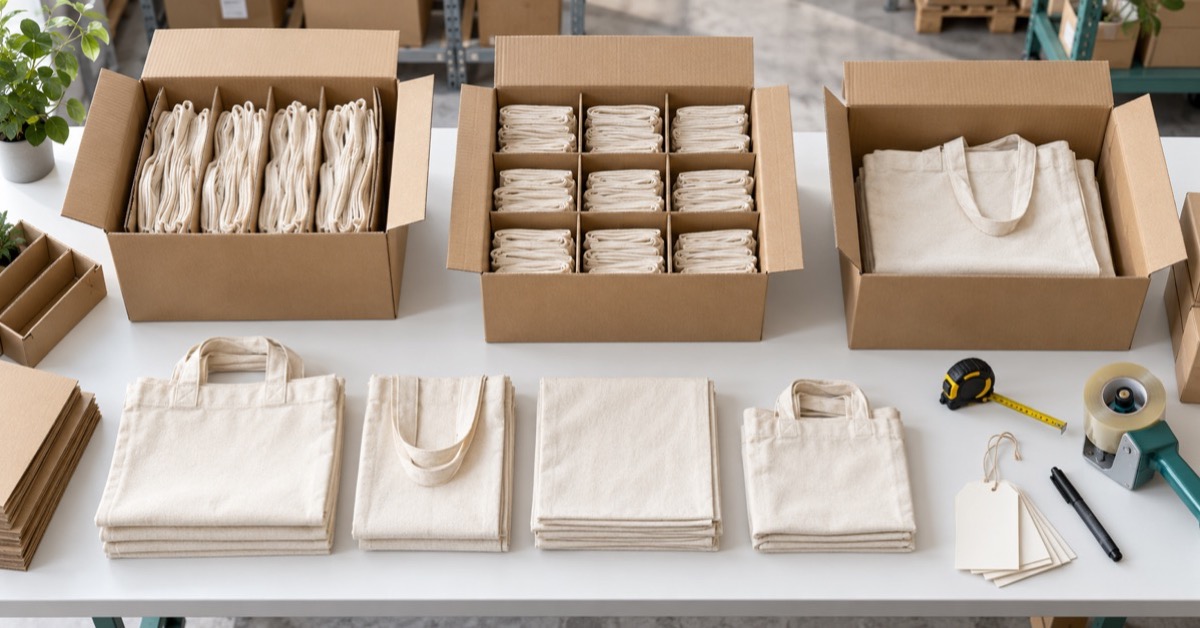
Allocate each size separately rather than applying one ratio to the whole order, and pack the sizes in separate cartons. A store that has to open a mixed carton to reach one size will report a shortage that is really a packing problem.
Reorder rhythm and the second run
The first run measures, and the second run adjusts. Record the date each store group exhausts its allocation rather than only the quantity it consumed, because the timing is what sets the reorder point for the following season.
Where a programme repeats, the reorder point should be expressed in weeks of cover rather than in pieces. Ten weeks of cover in a quiet month is a surplus, and the same figure in December is a shortage, which is why the calendar belongs in the model.
Allocation example
An illustration rather than a formula. The point is the shape: whole cartons per group, one named buffer, and a stated cover.
| Store group | Share of transactions | Cartons allocated | Buffer held |
|---|---|---|---|
| City centre | 40 per cent | 48 cartons | 6 cartons at depot |
| Suburban | 35 per cent | 42 cartons | 5 cartons at depot |
| Retail park | 25 per cent | 30 cartons | 4 cartons with the group |
Numbers this tidy rarely survive a real season. A model that shows its arithmetic can be adjusted; a single percentage applied to the whole order cannot.
Keeping the model honest after the first run
A first allocation is an estimate and should be described as one. What matters is that the second allocation uses the first season's figures, including the stores that ran short and the groups that finished with cartons left over.
PackMK asks for the consumption record after the first delivery, because it converts a recurring guess into a recurring calculation. The same record also tells a buyer whether the pack count per carton should change for the next run.
Red flags in an allocation plan
Five signs that a bulk shopping bag order will be re-balanced on a warehouse floor.
- An allocation expressed only in pieces.
- A carton count that arrives after the order is confirmed.
- A buffer with no named location.
- One ratio applied to every size in the order.
- No record of when each group ran out.
Each of these is a planning gap rather than a supply problem, and each of them is fixable in a single call before production.
When a single shipment is the better answer
Not every programme needs a model. A single store, a single region or a promotional drop with one destination is simpler as one shipment, and adding allocation layers to it only adds handling.
The model earns its place when bags are consumed continuously across many locations and the cost of a shortage is visible to customers. Below that threshold, a straightforward delivery with a generous carton count is usually cheaper than a careful split.
Case example: a supermarket group and a bulk shopping bags shortage
A supermarket group ordered 900,000 shopping bags for a twelve-week period and allocated them evenly across 240 stores. The allocation was expressed in pieces, and the carton count was confirmed after the order was placed.
City centre stores ran out in the ninth week while two retail park stores finished with cartons in reserve. Moving stock between them took eleven days and two transfers. For the following order, PackMK allocated in whole cartons weighted by transactions, placed a named buffer at the regional depot, and moved the reorder point to twelve weeks of cover for the December period.
Where the dispatch references come from
Carton handling symbols and the delivery term both decide what happens between the factory gate and a regional depot, and both are worth fixing before the allocation is finalised. Buyers can consult ISO 780 packaging handling symbols reference and ICC Incoterms rules overview for additional context. These references do not certify a particular PackMK order.
Write a bulk shopping bags brief
A practical bulk shopping bags brief should name carton count, store group, buffer stock, reorder point. It should also identify Incoterms 2020, pallet, case code, GSM wherever they affect approval, production, packing or delivery. PackMK uses those fields to organize samples, quotation assumptions and release evidence.
Keep the bulk shopping bags allocation model proportionate
A store-level model is more planning than many programmes need. A chain with fewer than ten outlets, or a programme that delivers to a single warehouse, is usually better served by a simple order with a generous carton count and one named buffer location.
Allocate bulk shopping bags with PackMK
Send PackMK the store list, the sizes, the carton count you can accept and the delivery split you need. We will return an allocation sheet in whole cartons with a named buffer, and a packing list the warehouse can work from without repacking.
Questions retailers ask about bulk shopping bags
What is a bulk shopping bag order?
Usually a tiered order placed centrally and distributed across many locations. The bags are made to one specification and packed in cartons that are marked and bundled by region, rather than being shipped as a single undivided block.
How many bags fit in a carton?
It depends on the bag size and how it is packed. A flat-packed standard bag can be counted in hundreds per carton, while a larger bag is counted in tens. Ask for the count before confirming the order, because the allocation depends on it.
Should I allocate in pieces or cartons?
Whole cartons. A store that receives 850 rather than 900 bags is fine, while a store that receives 900 loose bags has handed the unpacking problem to staff. Allocate in cartons and record the remainder as a named buffer.
How large should the buffer be?
Size it from the replenishment lead time rather than from a fixed percentage. A region that can be restocked in two days needs a small reserve, and one that takes two weeks needs a larger one. Express the buffer in weeks of cover.
How do I weight stores fairly?
Use transactions per week where the data exists, and the previous order's consumption where it does not. Floor area is the easiest figure to obtain and the least reliable predictor, because consumption follows transactions rather than shelf space.
Should sizes be mixed in one carton?
No, wherever it can be avoided. Sizes run out at different rates, and a store that must open a mixed carton to reach one size will report a shortage that is really a packing decision.
What is a reorder point in this context?
The stock level at which a store group should receive its next delivery, expressed in weeks of cover rather than in pieces. Cover in weeks travels across seasons while a piece count does not, because consumption moves with the calendar.
Does packaging need handling symbols?
Yes, on the shipper rather than the bag. Standard handling symbols are understood across languages, which matters when a container is split across regions. Print them rather than writing them, because a handwritten mark rarely survives two journeys.
How do I fix a shortage after delivery?
Transfer from the buffer rather than from another store's allocation, and record the transfer date. The record tells you whether the buffer is the right size and whether the group's weighting was wrong, which is what the next order should correct.
What should a bulk shopping bags brief contain?
The sizes and quantities, the bag specification in GSM, the carton count per size, the store list with traffic weighting, the delivery split and the buffer location. PackMK builds the allocation from those fields before the run is confirmed.